Unlock instant, AI-driven research and patent intelligence for your innovation.

Solar cell modules comprising an encapsulant sheet of a blend of ethylene copolymers

a technology of ethylene copolymer and solar cell, applied in the field of solar cell modules, can solve the problems of substantial cost and process concerns

Active Publication Date: 2011-12-20
DOW GLOBAL TECH LLC
View PDF88 Cites 5 Cited by
  • Summary
  • Abstract
  • Description
  • Claims
  • Application Information

AI Technical Summary

Benefits of technology

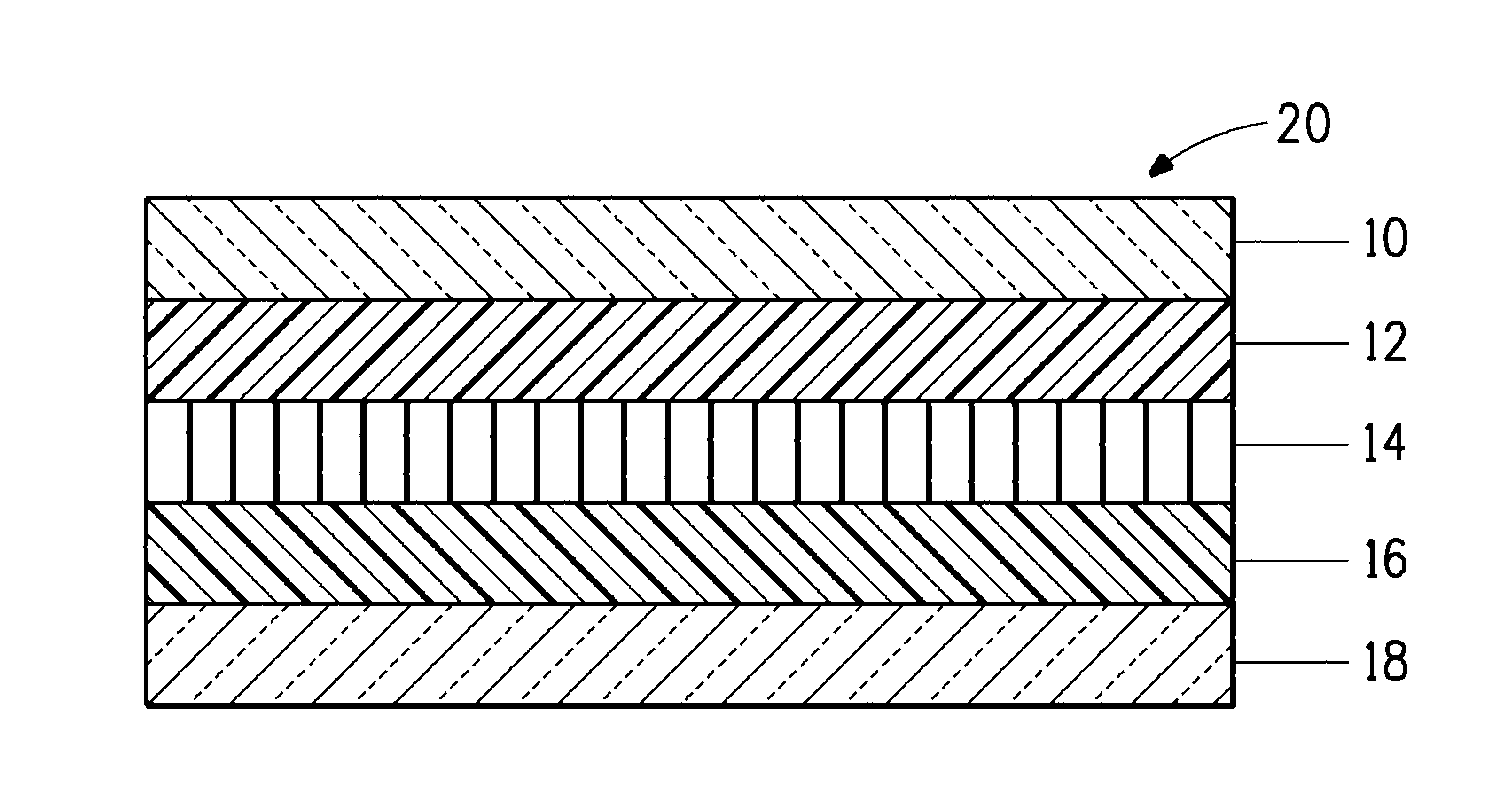
The patent describes a solar cell module that includes a solar cell layer and a sheet made of a blend of ethylene copolymers. The blend composition has a specific melt flow rate and contains specific types of ethylene copolymers. The module may also have additional layers made of other polymers. The technical effect of this invention is to provide a more efficient and durable solar cell module that can withstand environmental stresses and maintain its performance over a long period of time.

Problems solved by technology

When solar cell modules are used in the field, it is found that if the encapsulant sheet and its adjacent layer(s) are not tightly sealed, moisture tends to enter and cause de-lamination.
This is especially true in the thin film solar cell industry where the practice of providing edge seals around the peripheral edges of the modules incurs substantial cost and results in process concerns.

Method used

the structure of the environmentally friendly knitted fabric provided by the present invention; figure 2 Flow chart of the yarn wrapping machine for environmentally friendly knitted fabrics and storage devices; image 3 Is the parameter map of the yarn covering machine
View more

Image

Smart Image Click on the blue labels to locate them in the text.
Viewing Examples
Smart Image
  • Solar cell modules comprising an encapsulant sheet of a blend of ethylene copolymers
  • Solar cell modules comprising an encapsulant sheet of a blend of ethylene copolymers

Examples

Experimental program
Comparison scheme
Effect test

examples

[0082]The following polymer materials were used in the examples:[0083]EMA-1—an ethylene / methyl acrylate copolymer comprising 20 wt % of copolymerized units of methyl acrylate, based on the total weight of the copolymer, and having a melt flow rate of 8 g / 10 min, as determined in accordance with ASTM D1238 at 190° C. and 2.16 kg;[0084]EMA-2—an ethylene / n-butyl acrylate copolymer comprising 27 wt % of copolymerized units of n-butyl acrylate, based on the total weight of the copolymer, and having a melt flow rate of 4 g / 10 min, as determined in accordance with ASTM D1238 at 190° C. and 2.16 kg;[0085]EMA-3—an ethylene / methyl acrylate copolymer comprising 24 wt % of copolymerized units of methyl acrylate, based on the total weight of the copolymer, and having a melt flow rate of 2 g / 10 min, as determined in accordance with ASTM D1238 at 190° C. and 2.16 kg.[0086]E / MAME-1—an ethylene / monoethyl maleate copolymer comprising 9.5 wt % of copolymerized units of the monoethyl ester of maleic ac...

examples e16 and e17

[0111]In E16, a two-layer laminate comprising a 10 mil (0.25 mm) thick press molded film of ECP-1 and a 5 mil (0.051 mm) thick DuPont Kapton® film were made by pressing the two films for 30 seconds at 140° C. under 100 psi (0.689 MPa) in a pre-heated press. Using an Instron tester (Instron Tensile Tester Model 1122) the ECP-1 film was peeled away from the Kapton® film at a 180° angle and a 12.7 cm / min rate, and the peel load was recorded as 4.5 lb / in.

[0112]In E17, a two-layer laminate with the same structure of that in E16 was prepared similarly, except that the films were pressed together at 160° C., and the peel load was recorded as 5.2 lb / in.

Examples E18-E37

[0113]12×12 in (305×305 mm) solar cell modules described in Table 4 are prepared following either lamination process 1 (E18-E27) or lamination process 2 (E28-E37), as outlined below. Layers 1 and 2 constitute the incident layer and the front encapsulant layer, respectively, and Layers 4 and 5 constitute the back encapsulant la...

the structure of the environmentally friendly knitted fabric provided by the present invention; figure 2 Flow chart of the yarn wrapping machine for environmentally friendly knitted fabrics and storage devices; image 3 Is the parameter map of the yarn covering machine
Login to View More

PUM

PropertyMeasurementUnit
melt flow rateaaaaaaaaaa
wt %aaaaaaaaaa
wt %aaaaaaaaaa
Login to View More

Abstract

Disclosed is a solar cell module comprising a polymeric encapsulant sheet, wherein the polymeric encapsulant sheet comprises a blend composition of an ethylene copolymer A and an ethylene copolymer B, the blend composition having a melt flow rate of less than 100 g / 10 min, as determined in accordance with ASTM D1238 at 190° C. and 2.16 kg, and wherein the ethylene copolymer A comprises copolymerized units of ethylene and about 3 to about 20 wt % of an ester or anhydride of a C4-C8 unsaturated acid having two carboxylic acid groups and the ethylene copolymer B comprises copolymerized units of ethylene and about 6 to about 40 wt % of a polar monomer selected from the group consisting of vinyl acetate, alkyl (meth)acrylates, and mixtures thereof.

Description

FIELD OF THE INVENTION[0001]The present invention is directed to solar cell modules comprising a polymeric encapsulant sheet formed of a blend of ethylene copolymers.BACKGROUND OF THE INVENTION[0002]Because they provide a sustainable energy resource, the use of solar cells is rapidly expanding. Solar cells can typically be categorized into two types based on the light absorbing material used, i.e., bulk or wafer-based solar cells and thin film solar cells.[0003]Monocrystalline silicon (c-Si), poly- or multi-crystalline silicon (poly-Si or mc-Si) and ribbon silicon are the materials used most commonly in forming the more traditional wafer-based solar cells. Solar cell modules derived from wafer-based solar cells often comprise a series of self-supporting wafers (or cells) that are soldered together. The wafers generally have a thickness of between about 180 and about 240 μm. Such a panel of solar cells is called a solar cell layer and it may further comprise electrical wirings such a...

Claims

the structure of the environmentally friendly knitted fabric provided by the present invention; figure 2 Flow chart of the yarn wrapping machine for environmentally friendly knitted fabrics and storage devices; image 3 Is the parameter map of the yarn covering machine
Login to View More

Application Information

Patent Timeline
no application Login to View More
Patent Type & Authority Patents(United States)
IPC IPC(8): H01L31/042H01L31/00
CPCB32B17/10743C08L23/0853C08L23/0869H01L31/0481C08L23/0846Y02E10/50C08L2666/06B32B17/10788C08L23/08C08L31/04C08J5/18H01L31/042
Inventor CHOU, RICHARD T.
Owner DOW GLOBAL TECH LLC