Unlock instant, AI-driven research and patent intelligence for your innovation.

Epoxide (meth) acrylate composition

a technology of acrylate and epoxide, which is applied in the direction of organic non-macromolecular adhesives, adhesives, etc., can solve the problems of unfavorable stress in the adhesive bond, unsuitable thermally sensitive substrates, and stress within the cured composition, so as to inhibit the free-radical polymerization reaction and achieve optimal early strength

Inactive Publication Date: 2012-11-27
SIKA TECH AG
View PDF14 Cites 0 Cited by
  • Summary
  • Abstract
  • Description
  • Claims
  • Application Information

AI Technical Summary

Benefits of technology

The composition achieves high early strength and final strength at room temperature, eliminating the need for heat and preventing stress issues in thermally sensitive substrates, while ensuring optimal curing and adhesion.

Problems solved by technology

With these compositions, an elevated temperature in the range from about 120 to 150° C. is needed for the curing of the epoxy resin, and they are thus unsuitable for thermally sensitive substrates.
Uneven heating and the associated uneven curing of heat-curing compositions can lead in such a case to stresses within the cured composition.
Known heat-curing compositions are likewise unsuitable for the adhesive bonding of substrates with different coefficients of thermal expansion, since they have different contractions as they are cooled after the curing of the adhesive, which can result in unfavorable stresses in the adhesive bond.
The hardeners known to date for epoxy resins, such as aliphatic amines, which enable curing of the epoxy resin even at room temperature are unsuitable for use in a hybrid system comprising (meth)acrylates and epoxides, because they inhibit the free-radical polymerization reaction of the (meth)acrylate monomers and hence an optimal early strength is not achieved.

Method used

the structure of the environmentally friendly knitted fabric provided by the present invention; figure 2 Flow chart of the yarn wrapping machine for environmentally friendly knitted fabrics and storage devices; image 3 Is the parameter map of the yarn covering machine
View more

Image

Smart Image Click on the blue labels to locate them in the text.
Viewing Examples
Smart Image
  • Epoxide (meth) acrylate composition
  • Epoxide (meth) acrylate composition
  • Epoxide (meth) acrylate composition

Examples

Experimental program
Comparison scheme
Effect test

examples

[0158]Working examples are adduced below, which are intended to explain the disclosure described in detail. The disclosure is of course not restricted to these working examples described.

Preparation of 2-hydroxy-3-((2-hydroxyethyl)(methyl)amino)propyl methacrylate “M1”

[0159]10.0 g (133.1 mmol) of 2-(methylamino)ethanol and 85 g of tetrahydrofurfuryl methacrylate were weighed into a 250 ml three-neck flask with magnetic stirrer bar, thermometer and reflux condenser. At room temperature, 19.5 g (137.1 mmol) of glycidyl methacrylate were slowly added dropwise while stirring constantly. In the course of this, slight exothermicity was observed, but the temperature never exceeded 70° C. After stirring at 70° C. for 6 hours, it was possible to detect only small traces of 2-(methylamino)ethanol by means of a gas chromatograph. This approx. 25% product solution in tetrahydrofurfuryl methacrylate was transferred into a glass bottle and used in the model formulations without further workup.

Pro...

the structure of the environmentally friendly knitted fabric provided by the present invention; figure 2 Flow chart of the yarn wrapping machine for environmentally friendly knitted fabrics and storage devices; image 3 Is the parameter map of the yarn covering machine
Login to View More

PUM

PropertyMeasurementUnit
temperatureaaaaaaaaaa
glass transition temperature Tgaaaaaaaaaa
temperatureaaaaaaaaaa
Login to View More

Abstract

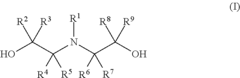
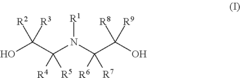
The disclosure relates to a composition having at least one radically polymerisable monomer M; at least one radical former, at least one epoxide resin A including an average of more than one epoxide group per molecule, and at least one compound of formula (I). Such compositions are suitable as adhesives, sealants or coatings. Shortly after the application thereof, they have a high initial strength and, after further hardening at room temperature, they reach a high level of final strength.

Description

RELATED APPLICATIONS[0001]This application claims priority as a continuation application under 35 U.S.C. §120 to PCT / EP2009 / 059200, which was filed as an International Application on Jul. 17, 2009 designating the U.S., and which claims priority to Swiss Application No. 01119 / 08 filed in Switzerland on Jul. 17, 2008 and European Application No. 08169630.4 filed in Europe on Nov. 21, 2008. The entire contents of these applications are hereby incorporated by reference in their entireties.FIELD[0002]The disclosure relates to the field of polymerizable compositions based on epoxy resins and free-radically polymerizable monomers.BACKGROUND INFORMATION[0003]The use of both (meth)acrylate compositions and epoxy resins in adhesive, sealing and coating technology is widespread. (Meth)acrylate compositions are notable for a high early strength and rapid curing, and epoxy resins are notable for a high final strength.[0004]In order to utilize advantages of both technologies, hybrid systems compr...

Claims

the structure of the environmentally friendly knitted fabric provided by the present invention; figure 2 Flow chart of the yarn wrapping machine for environmentally friendly knitted fabrics and storage devices; image 3 Is the parameter map of the yarn covering machine
Login to View More

Application Information

Patent Timeline
no application Login to View More
Patent Type & Authority Patents(United States)
IPC IPC(8): C09J4/02
CPCC08L33/10C09J4/00C08L63/00C08L59/00C08L2666/22
Inventor HAUFE, MARKUSKRAMER, ANDREAS
Owner SIKA TECH AG