
Method of producing coupled radical products via desulfoxylation
- Summary
- Abstract
- Description
- Claims
- Application Information
AI Technical Summary
Benefits of technology
Problems solved by technology
Method used
Image

Examples
Embodiment Construction
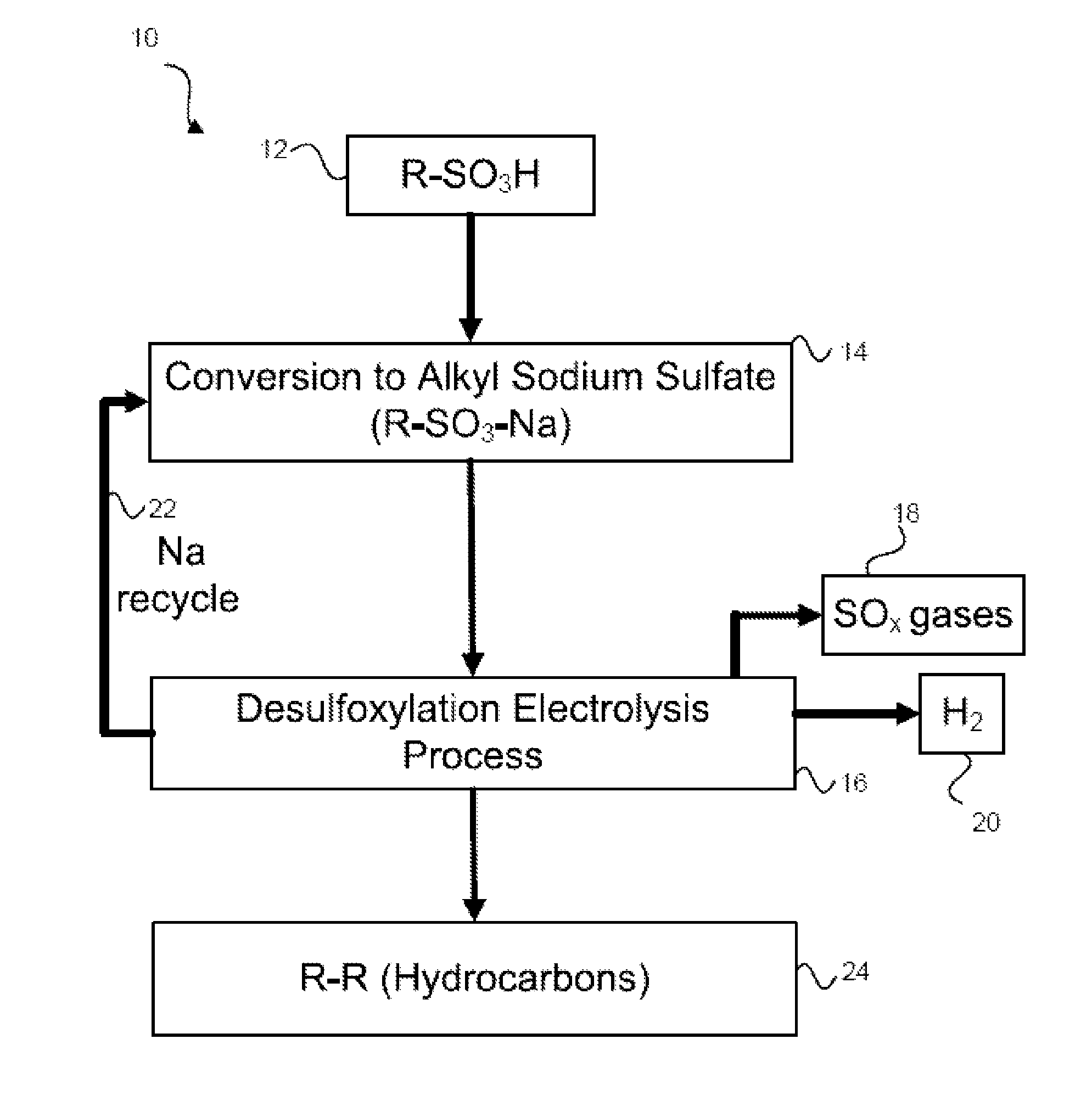
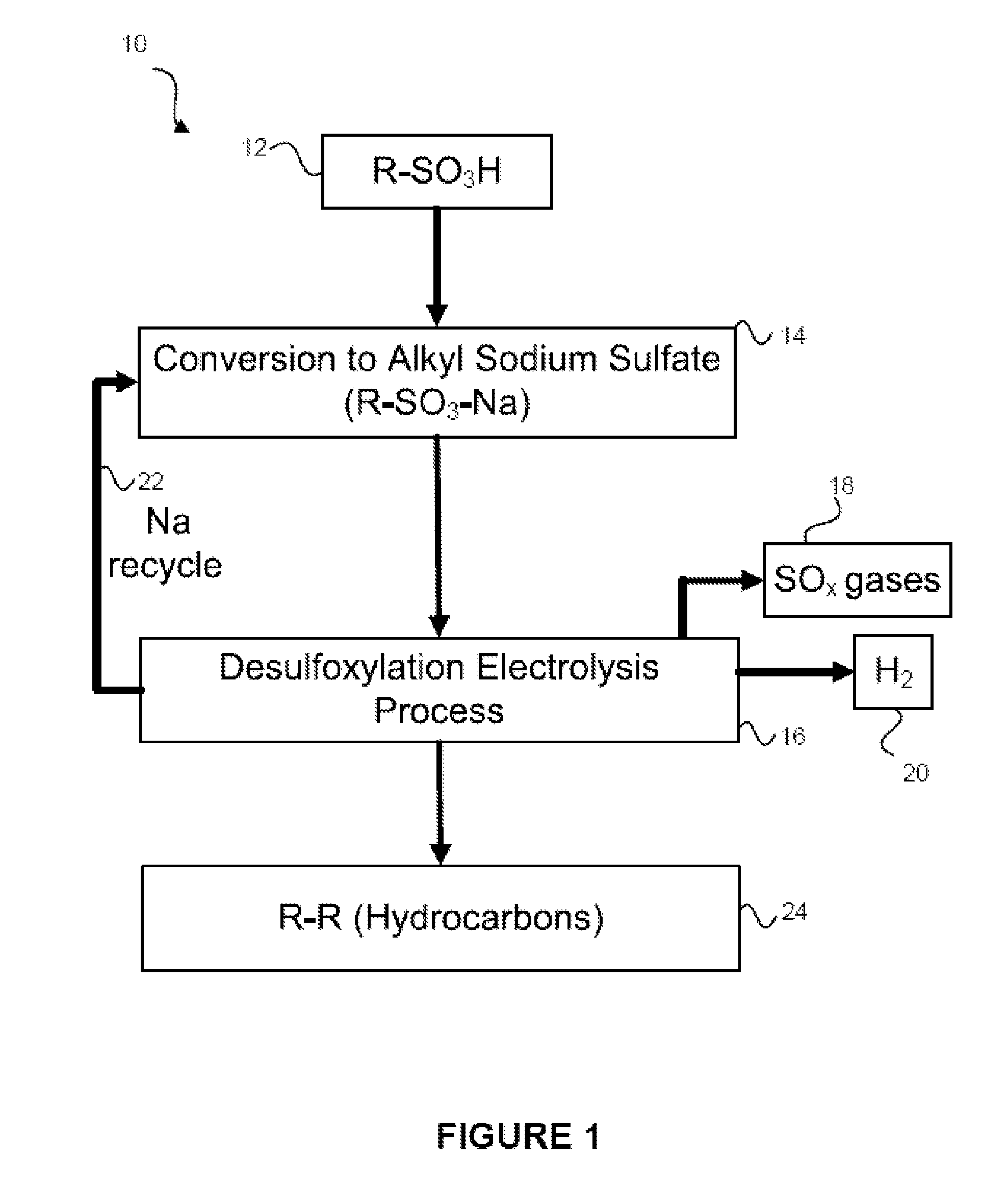
[0039]Referring now to FIG. 1, the overall process 10 for producing a coupled radical product is disclosed. As shown in FIG. 1, a quantity of a sulfonic acid (R—SO3H) may be obtained 12. This sulfonic acid may be an organic acid and may be obtained from biomass or from any other source. Those skilled in the art will appreciate the various different sources of sulfonic acids. Any and all sources of the sulfonic acid fall within the present embodiments. The above-recited published patent applications describe biomass as a potential starting material and that the biomass may be converted into sulfonic acids via known methods.
[0040]Once the sulfonic acid is obtained, the sulfonic acid may be converted 14 into the alkyl sodium sulfate (R—SO3—Na). This conversion reaction may occur by reacting the sulfonic acid with a base, may occur in an electrochemical cell, or may occur in some other way. In other embodiments, instead of obtaining the sulfonic acid and reacting it to form the alkyl so...
PUM
| Property | Measurement | Unit |
|---|---|---|
| structure | aaaaa | aaaaa |
| time | aaaaa | aaaaa |
| conductive | aaaaa | aaaaa |
Abstract
Description
Claims
Application Information
 Login to View More