
Spherical liquid-crystal laser
a liquid crystal laser and spherical technology, applied in the direction of lasers, liquid crystal laser construction details, laser construction details, etc., can solve the problem of large temperature sensitivity of the amplitude of stimulated emission of spherical resonators
- Summary
- Abstract
- Description
- Claims
- Application Information
AI Technical Summary
Benefits of technology
Problems solved by technology
Method used
Image

Examples
Embodiment Construction
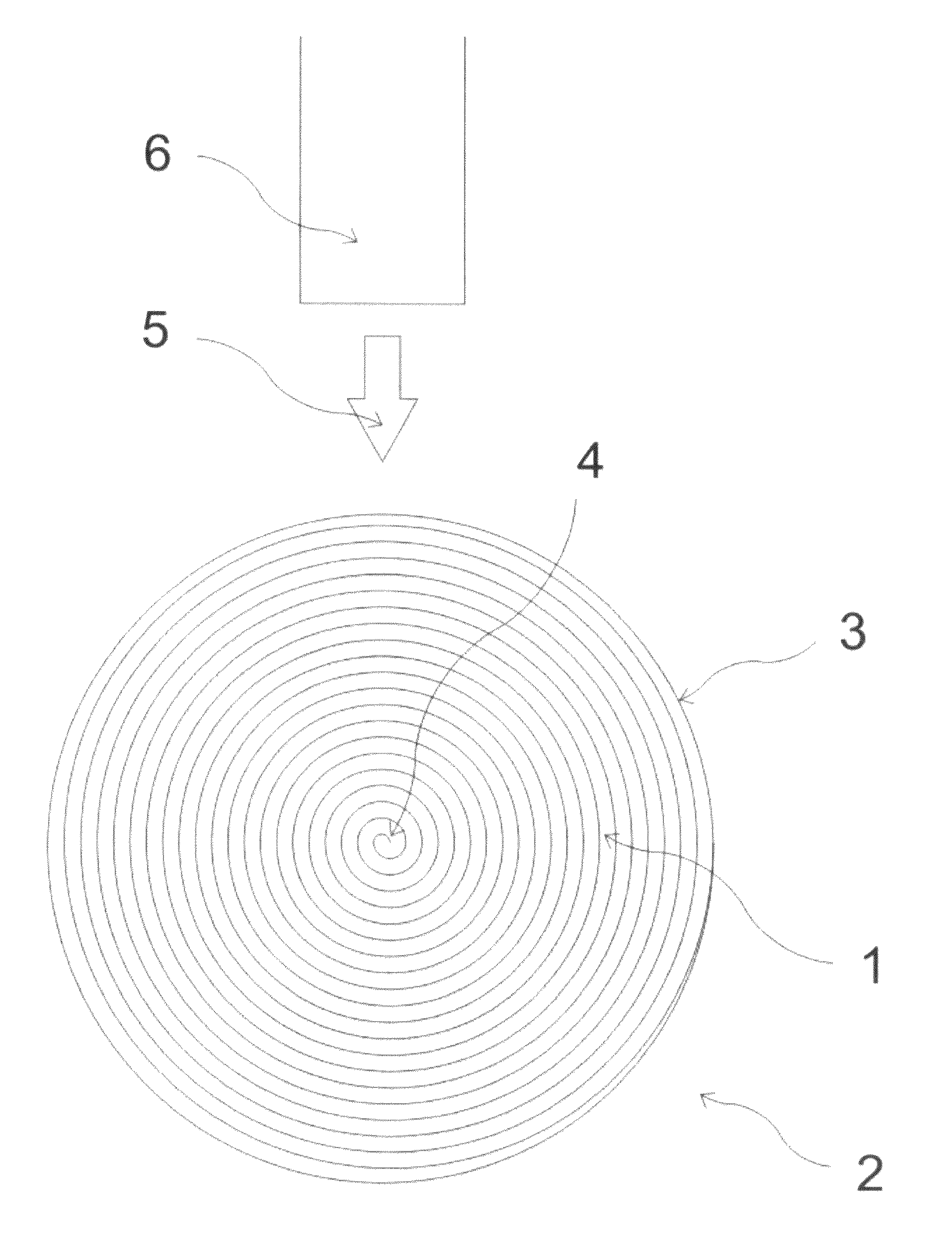
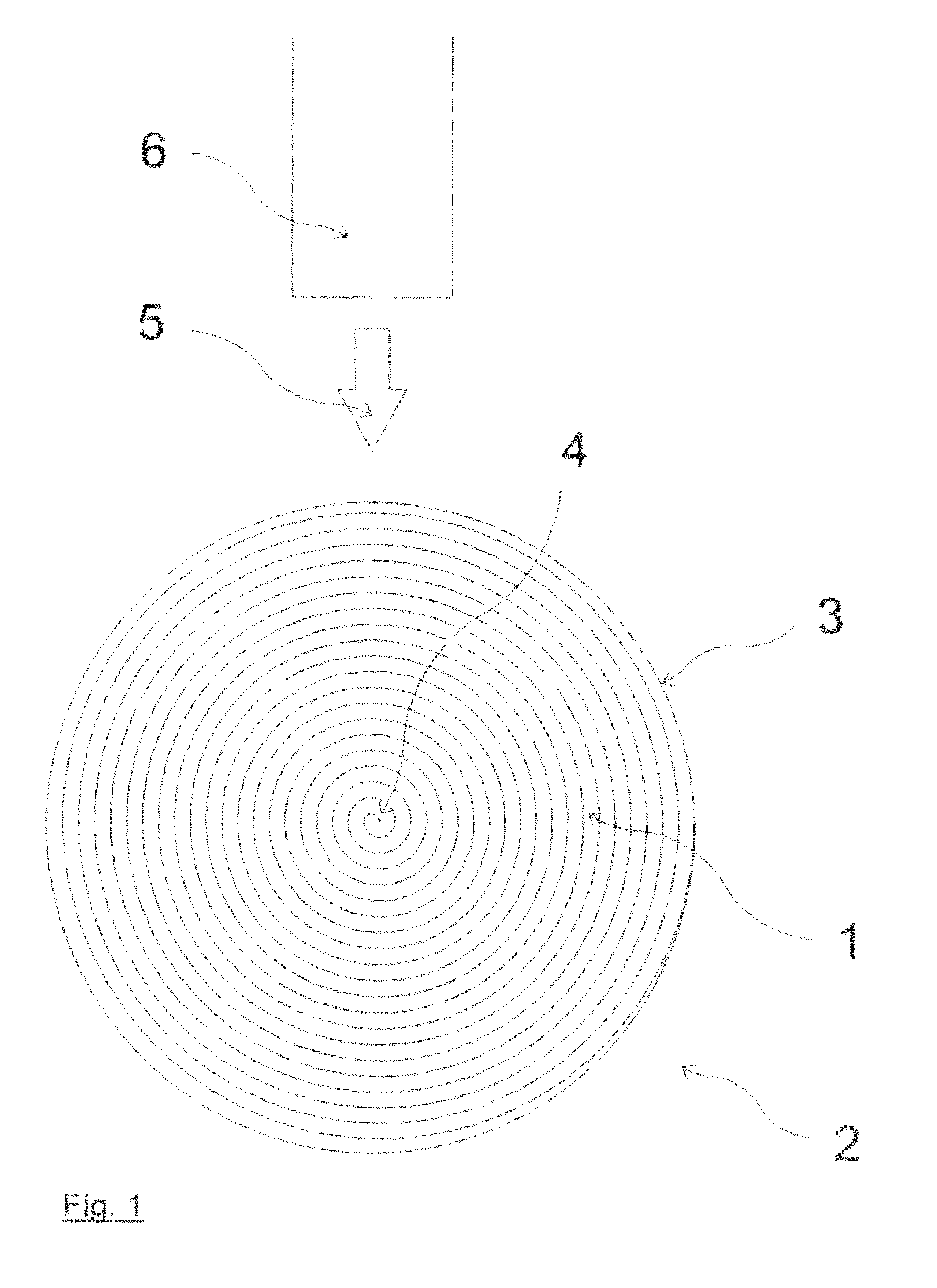
[0031]FIG. 1 schematically presents the basic spherical liquid-crystal laser common to all the presented variations. The spherical liquid-crystal laser is made in the shape of a droplet with helically arranged liquid crystals 1 placed in a transparent external medium 2 with an optically clear boundary 3 between the two elements. Due to the surface tension the droplet of cholesteric liquid crystals is shaped into a completely spherical droplet in the external liquid medium. The droplet size is preferable in the range between a few nanometers and 100, μm. Droplets can be formed by the mechanical mixing of liquid crystals and an external liquid medium or by the well-known procedures of phase separation during polymerisation or photo-polymerisation of the supporting optically isotropic medium, in which the liquid-crystal droplets are distributed.
[0032]The boundary between the external substance and the inside of a droplet is formed in such a way that the molecules of the liquid crystals...
PUM
 Login to View More
 Abstract
Description
Claims
Application Information
 Login to View More