Devices and methods for sorting droplets by surface tension
a technology of surface tension and droplets, applied in surface tension analysis, color/spectral property measurement, material testing goods, etc., can solve the problem of few studies that demonstrate droplets
- Summary
- Abstract
- Description
- Claims
- Application Information
AI Technical Summary
Benefits of technology
Problems solved by technology
Method used
Image



Examples
example 1
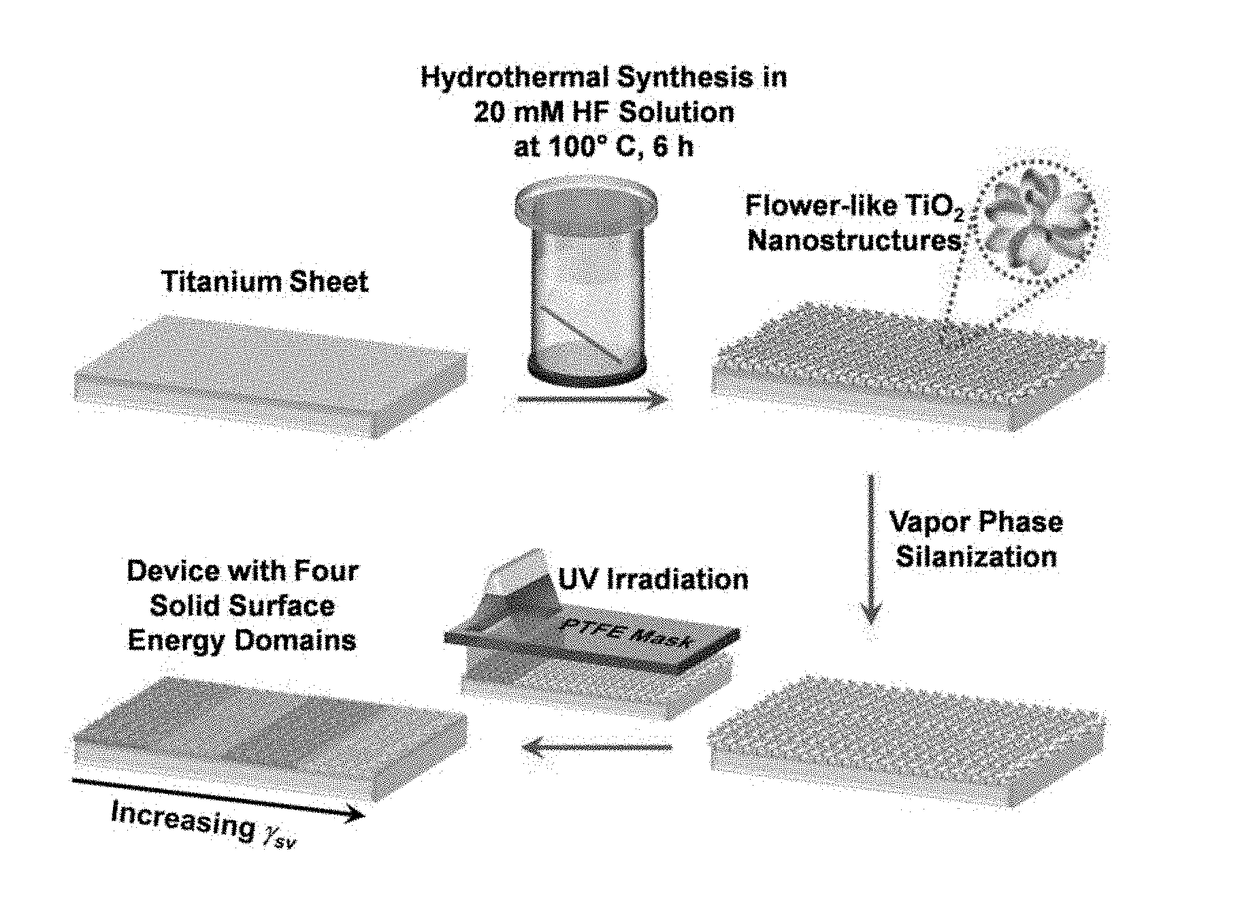
Fabrication of Devices with Discrete Solid Surface Energy Domains
[0110]Hydrothermal Synthesis of Superomniphobic Surfaces: Titanium (Ti) sheets (6 cm long×2 cm wide×0.8 mm thick) were cleaned by sonication in acetone and isopropanol, dried with nitrogen and placed in a PTFE-lined stainless steel autoclave containing 20 mM hydrofluoric acid (Sigma Aldrich). The autoclave was sealed and the Ti sheets were etched under hydrothermal conditions at 100° C. for different times (FIG. 4). As the etching time tetch increased, more TiO2 nanostructures formed and consequently the roughness Rrms of the surface increased (FIG. 5). After hydrothermal synthesis, the samples were rinsed thoroughly with deionized water, dried with nitrogen, and the surface was modified via vapor phase silanization at 120° C. for 1 hour using 200 μL of heptadecafluoro-1,1,2,2-tetrahydrodecyl trichlorosilane (Gelest, Inc). Superomniphobic surfaces with flower-like TiO2 nanostructures were obtained by etching under hydr...
example 2
Estimation of Solid Surface Energy
[0119]Owens-Wendt approach was used to estimate the solid surface energy γsv of the fluorinated TiO2 surfaces before and after UV irradiation. n-hexadecane (γlv=27.5 mN m−1) was used as the non-polar liquid to estimate the dispersive component of the solid surface energy γsvd and water (γlvd=21.1 mN m−1 and γlvp=51.0 mN m−1) was used as the polar liquid to estimate the polar component of the solid surface energy γsvp. The advancing contact angle θadv is approximately equal to Young's contact angle, hence the advancing contact angles measured at different UV irradiation times tUV on fluorinated, non-textured TiO2 surfaces were used to estimate the solid surface energy (Table 1).
[0120]
TABLE 1Advancing contact angles of water and n-hexadecane and solid surfaceenergies, at different UV irradiation times, for fluorinated, non-texturedTiO2 surfaces.θadvtUV (min)n-hexadecaneWaterγsv (mN m−1)080°120°10277°108°12473°104°14669° 97°17862° 85°241056° 74°31
example 3
Apparent Contact Angles of Different Liquids on Superomniphobic Surfaces Before UV Irradiation
[0121]The apparent advancing and the apparent receding contact angles of different liquids on superomniphobic surfaces before UV irradiation (tUV=0 min) are listed in Table 2.
[0122]
TABLE 2The apparent advancing and the apparent receding contact anglesof different liquids on superomniphobic surfaces before UV irradiation.Surface tensionLiquid(mN m−1)θadv*θrec*Water72.1164°162°Water + 10% Ethanol53.4161°159°Water + 20% Ethanol43.7159°155°Water + 30% Ethanol37.2156°153°Water + 60% Ethanol28.7154°150°n-hexadecane27.5153°150°
PUM
| Property | Measurement | Unit |
|---|---|---|
| longitudinal width | aaaaa | aaaaa |
| width | aaaaa | aaaaa |
| surface energy | aaaaa | aaaaa |
Abstract
Description
Claims
Application Information
 Login to View More