

Biodegradable fertilizer
a biodegradable and composition technology, applied in the field of biorenewable fertilizer compositions, can solve the problems of synthetic fertilizers becoming disfavored, sources not being able to scale up sufficiently for commercial applications, and consuming a large amount of energy for the haber-bosh reaction
- Summary
- Abstract
- Description
- Claims
- Application Information
AI Technical Summary
Benefits of technology
Problems solved by technology
Method used
Image

Examples
example 1
Analysis
[0069]Fifteen exemplary fertilizer compositions were prepared with a biodegradable nutrient carrier and one or more stabilizers. The soy-based nutrient carriers were either soy polymer with adipic acid plasticizer (SPA) or soy flour (SF). Two types of commercially available polylactic acid (PLA) were used, 3001 PLA and 2003 PLA both obtained from NatureWorks, LLC. Each of the fifteen exemplary fertilizer compositions was analyzed for nitrogen, phosphorus, and potassium. Nitrogen content was assessed according to AOAC 993.13 standardized method for total nitrogen content by weight percent of the fertilizer compositions. Phosphorus and Potassium content were assessed according to the Manure Analysis A3769 method for P2O5 and K2O content by weight percent of the fertilizer compositions. The compositions and their nutrient profiles are provided in Table 2.
[0070]Table 2 shows that the soy-based nutrient carriers provided good nitrogen content and the algae provided good phosphoru...
example 2
Study
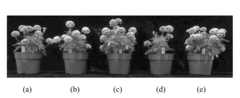
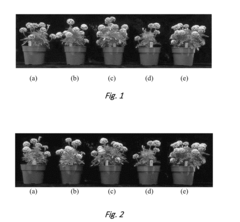
[0072]Two different slow-release fertilizer compositions were prepared according to Table 3 in pelletized form through an extrusion process. The soy used was a soy polymer plasticized with adipic anhydride. Six-inch pots were prepared and marigolds were planted in them. Four grams, eight grams, and sixteen grams of the fertilizer composition were added to different pots. Two control treatments for each composition were also prepared, one that was watered only and one that was treated with a commercial slow release fertilizer (“SRF”).
[0073]
TABLE 3PLA (Comp. A)SoyPHA (Comp. B)BiocharComposition A37.5 wt. %37.5 wt. %25 wt. %Composition B37.5 wt. %37.5 wt. %25 wt. %
[0074]Performance of the different compositions was studied and can be viewed in FIGS. 1 and 2. FIG. 1 shows the comparison of Composition A in the varying amounts and as compared with the controls. FIG. 2 shows the comparison of Composition B in the varying amounts and as compared with the controls.
[0075]It was determin...
example 3
Growth Comparison
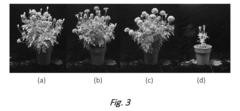
[0076]A study was also performed with turfgrass, testing pelletized fertilizer compositions defined in Table 4 against two commercially available bio-based fertilizers, corn gluten meal and Milorganite®, and another treatment with no fertilizer. An area of turf grass was separated into five foot by five foot squares. Fertilizer treatments of the four types were applied at equal rates of nitrogen (N)—two pounds N per 1000 square feet.
[0077]
TABLE 4Soy Polymer Plasticized with PHAAdipic AnhydrideBiocharComposition C22.5 wt. %62.5 wt. %15 wt. %Soy Polymer Plasticized withPLAAdipic AnhydrideBiocharComposition D42.5 wt. %42.5 wt. %15 wt. %
[0078]Both soy-biochar fertilizer compositions pellets perform better after five weeks than the two bio-based fertilizers that are commercially available and better than the water-only control. The PLA-Soy-Biochar fertilized turf was the greenest and healthiest after five weeks, followed by the PHA-Soy-Biochar.
PUM
| Property | Measurement | Unit |
|---|---|---|
| pH | aaaaa | aaaaa |
| composition | aaaaa | aaaaa |
| volumes | aaaaa | aaaaa |
Abstract
Description
Claims
Application Information
 Login to View More