

Self-adaptive controlled-array star sensor
A sensor and self-adaptive technology, used in photo interpretation, integrated navigator and other directions, can solve the problems of star point energy attenuation, star stray light interference, poor dynamic performance, etc., achieve high attitude measurement and output, save power consumption and cost, and the effect of improving measurement reliability
Inactive Publication Date: 2010-12-01
BEIHANG UNIV
View PDF2 Cites 2 Cited by
- Summary
- Abstract
- Description
- Claims
- Application Information
AI Technical Summary
Problems solved by technology
Limited by many factors such as the frame frequency characteristics of imaging devices, star map image processing capabilities, and exposure time, the data update rate of existing star sensors is low, generally not exceeding 10Hz
2. The accuracy of attitude measurement needs to be further improved
Because the focal length of the optical system of the existing star sensor is generally much larger than the size of its imaging surface, the measurement accuracy of the roll angle of the existing star sensor is low, which is about an order of magnitude lower than the pitch angle and yaw angle, generally greater than 10° second (1σ), thus affecting the accuracy of spacecraft attitude measurement, and space missions put forward higher requirements for the accuracy of three-axis attitude measurement of spacecraft. Taking high-resolution earth observation as an example, the attitude measurement and control accuracy of satellite platforms directly affect to earth observation resolution
3. Insufficient reliability
Existing star sensors are easily affected by the uneven distribution of stars in the sky area, the interference of near celestial bodies and environmental stray light, etc., and the attitude loss occurs, and the attitude output cannot be stably and reliably
4. In the case of a large angular velocity of the carrier movement, the existing star sensor causes star point energy attenuation due to star point imaging smear, which makes the number of stars that can be observed sharply reduced, and the dynamic performance is not good.
In order to solve the above problems, the more common method at present is to install multiple star sensors on the spacecraft, and each star sensor works independently and serves as a backup for each other. This method can improve the attitude measurement accuracy and attitude measurement accuracy of the roll angle to a certain extent. The reliability of the measurement, but using this method, the data update rate still cannot be improved, and the installation of multiple star sensors will lead to increased weight and power consumption of the spacecraft, and high cost
Method used
the structure of the environmentally friendly knitted fabric provided by the present invention; figure 2 Flow chart of the yarn wrapping machine for environmentally friendly knitted fabrics and storage devices; image 3 Is the parameter map of the yarn covering machine
View moreImage
Smart Image Click on the blue labels to locate them in the text.
Smart ImageViewing Examples



Examples
Experimental program
Comparison scheme
Effect test
Embodiment Construction
the structure of the environmentally friendly knitted fabric provided by the present invention; figure 2 Flow chart of the yarn wrapping machine for environmentally friendly knitted fabrics and storage devices; image 3 Is the parameter map of the yarn covering machine
Login to View More PUM
 Login to View More
 Abstract
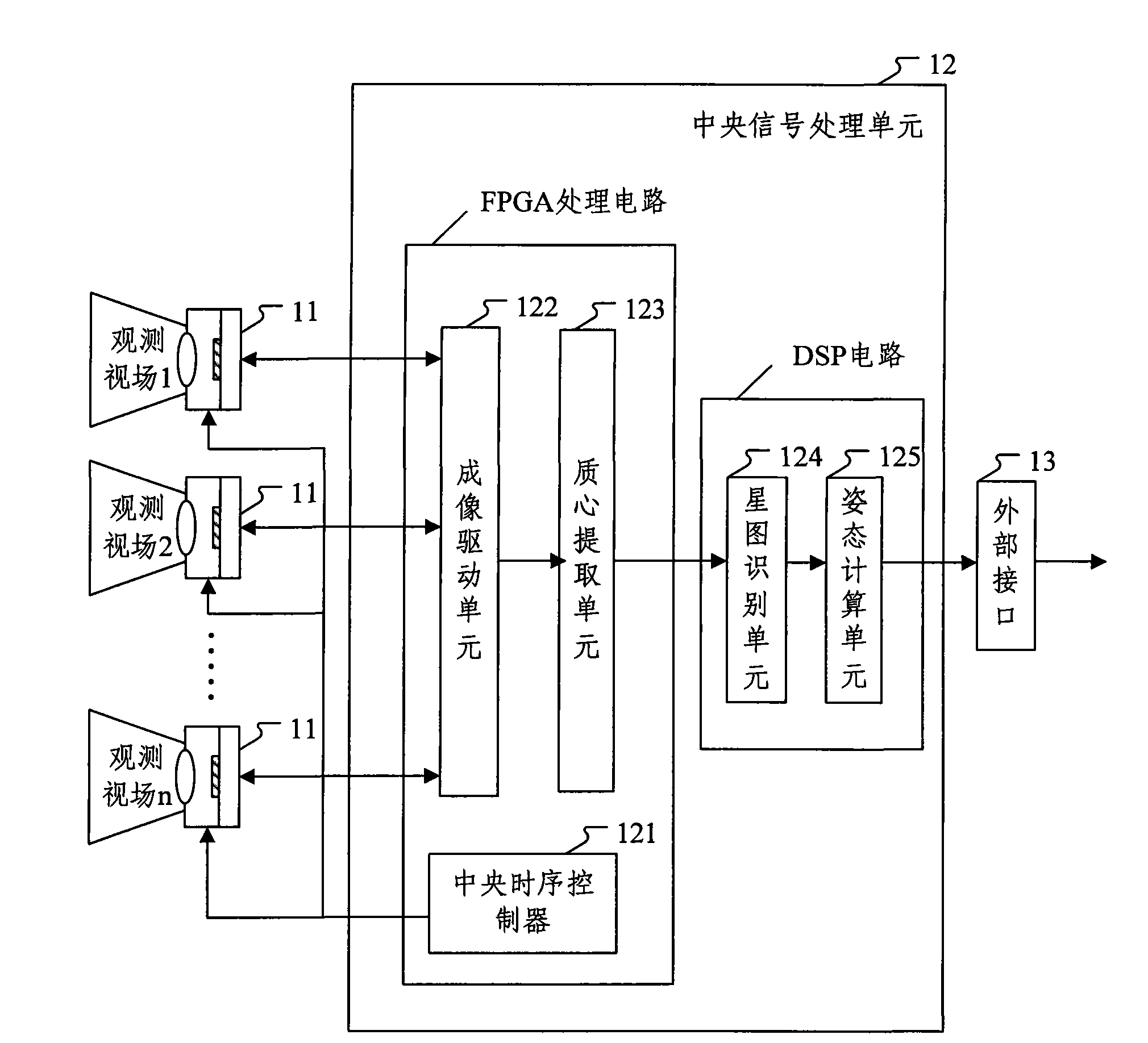
The invention discloses a self-adaptive controlled-array star sensor, which comprises a plurality of observing view fields and a central signal processing unit comprising a central time sequence controller, a imaging driving unit, a mass center extracting unit, a start atlas recognition unit and an attitude calculation unit, wherein the central sequence controller performs the time sequence control of the observing view fields; the observing view fields shot the images of the star atlases according to the time sequence control and the imaging drive provided by the imaging driving unit; the mass center extracting unit extracts the mass center of star points according to the images of the start atlases; the star atlas recognition unit performs star atlas recognition according to the extracted mass centers of the star atlases; and the attitude calculation unit calculates the attitude of a spacecraft according to the star atlas recognition results. The sensor can improve the attitude measurement precision and data update rate in both a synchronous mode and an asynchronous mode. In addition, with the plurality of observing view fields, the sensor avoids attitude loss caused by influences such as uneven distribution of stars in sky coverage, has excellent dynamic performance, and can reduce weight and save power consumption and cost.
Description
A self-adaptive control array star sensor technical field The invention relates to spacecraft attitude measurement technology, in particular to an adaptive control array star sensor for measuring spacecraft attitude. Background technique Celestial navigation is a navigation method based on the coordinate position and motion law of celestial bodies, and determines the space attitude and position of the spacecraft by observing the orientation of celestial bodies. The star sensor used in celestial navigation is a method that uses star observation to obtain spaceflight information. It is an aerospace measuring instrument with high-precision attitude information. Its working principle is: the front-end camera unit of the star sensor uses a charge-coupled device (CCD) image sensor or a complementary metal-oxide-semiconductor (CMOS) image sensor to capture star map images, and through the image processing program Process the captured star map image to obtain information such as t...
Claims
the structure of the environmentally friendly knitted fabric provided by the present invention; figure 2 Flow chart of the yarn wrapping machine for environmentally friendly knitted fabrics and storage devices; image 3 Is the parameter map of the yarn covering machine
Login to View More Application Information
Patent Timeline
 Login to View More
 Patent Type & Authority Patents(China)
IPC IPC(8): G01C21/24G01C11/04
Inventor 张广军魏新国叶生龙江洁樊巧云
Owner BEIHANG UNIV