AI technical title is built by Patsnap AI team. It summarizes the technical point description of the patent document.
A technology of polyester staple fiber and spinning oil, which is applied in the directions of fiber treatment, fiber type, textile and paper making, etc., can solve the problems of unsuitable fibers and short fibers water repellency, etc., and achieves good hydrophilicity and good spinnability. Effect
Active Publication Date: 2010-10-13
HANGZHOU TRANSFAR CHEM LTD +3
View PDF7 Cites 7 Cited by
Summary
Abstract
Description
Claims
Application Information
AI Technical Summary
This helps you quickly interpret patents by identifying the three key elements:
Problems solved by technology
Method used
Benefits of technology
Problems solved by technology
However, the short fibers produced by existing oil agents are all water-repellent, and cannot be applied to those fields that require hydrophilic fibers
Method used
the structure of the environmentally friendly knitted fabric provided by the present invention; figure 2 Flow chart of the yarn wrapping machine for environmentally friendly knitted fabrics and storage devices; image 3 Is the parameter map of the yarn covering machine
View more
Image
Smart Image Click on the blue labels to locate them in the text.
Viewing Examples
Smart Image
Click on the blue label to locate the original text in one second.
Reading with bidirectional positioning of images and text.
Smart Image
Examples
Experimental program
Comparison scheme
Effect test
Embodiment 1
[0033] The proportions of the following components are percentages by weight:
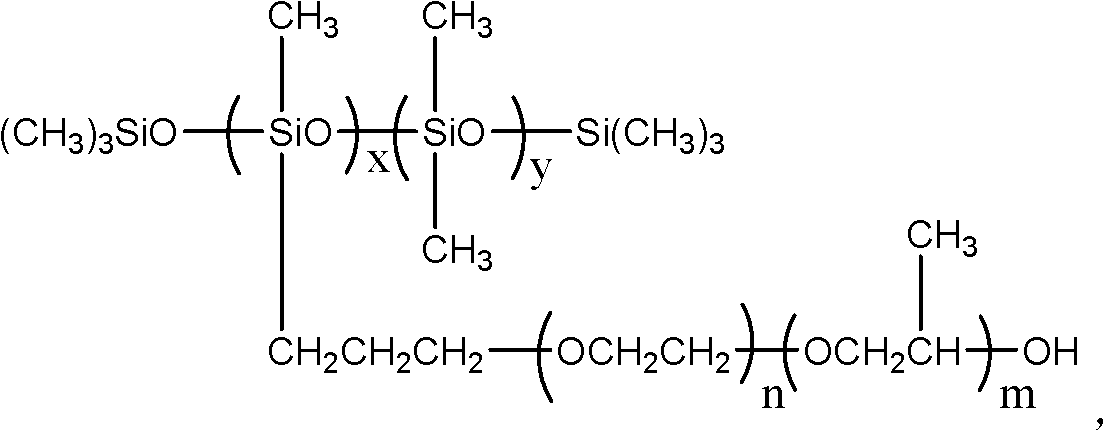
[0034] 1. Polyether modified silicone oil (structure as follows) 70 parts
[0035]
[0036] Where X=15, Y=350, n=20, m=10.
[0037] 2. Isomerized alcohol polyether phosphate (structure as follows) 20 parts
[0040] 3. Octadecylamine polyoxyethylene (10) ether 10 parts
[0041] The above three components are formulated into 0.3% (pre-spinning) and 2.0% (post-spinning) emulsions with pure water, and the pH is adjusted to 8-10.
Embodiment 2
[0043] The proportions of the following components are percentages by weight:
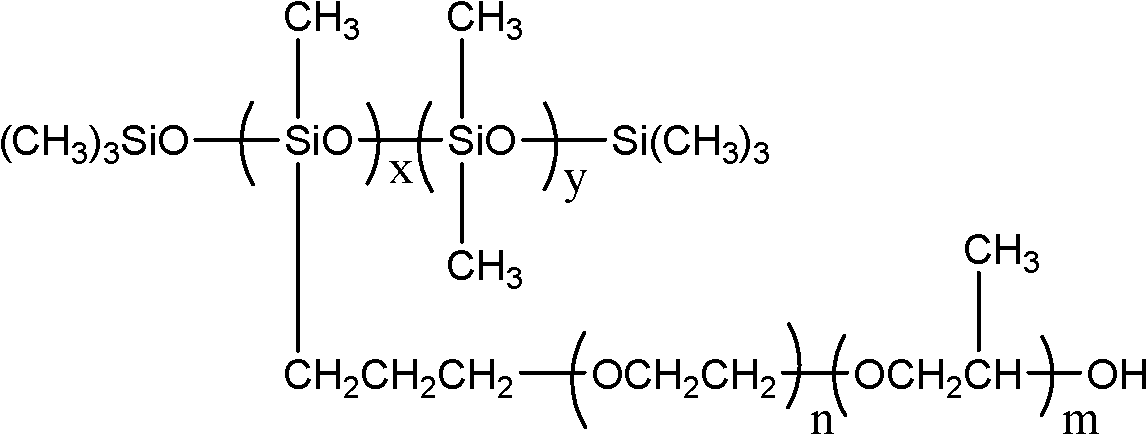
[0044] 1. Polyether modified silicone oil (structure as follows) 75 parts
[0045]
[0046] Where X=8, Y=300, n=15, m=8.
[0047] 2. 16 parts of isomeric alcohol polyether phosphate (structure as follows)
[0050] 3. Hexadecylamine polyoxyethylene (10) ether 9 parts
[0051] The above three components are formulated into 0.3% (pre-spinning) and 2.0% (post-spinning) emulsions with pure water, and the pH is adjusted to 8-10.
Embodiment 3
[0053] The proportions of the following components are percentages by weight:
[0054] 1. Polyether modified silicone oil (structure as follows) 80 parts
[0055]
[0056] Where X=5, Y=200, n=25, m=5.
[0057] 2. Isomerized alcohol polyether phosphate (structure as follows) 13 parts
[0058]
[0059] Wherein, R is an isomeric fatty alcohol with 18 carbons; n is 5; M is sodium element.
[0060] 3. Dodecylamine polyoxyethylene (10) ether 7 parts
[0061] The above three components are formulated into 0.3% (pre-spinning) and 2.0% (post-spinning) emulsions with pure water, and the pH is adjusted to 8-10.
the structure of the environmentally friendly knitted fabric provided by the present invention; figure 2 Flow chart of the yarn wrapping machine for environmentally friendly knitted fabrics and storage devices; image 3 Is the parameter map of the yarn covering machine
Login to View More
PUM
Login to View More
Abstract
Staple fibers produced by the existing oil are all water-repellent and cannot be applicable for the fields with hydrophilic requirement on the fibers. The invention provides polyester staple fiber hydrophilic spinning oil, which comprises the following components in percentage by weight: 70 to 80 percent of component A, i.e. polyether modified silicone oil; 10 to 20 percent of component B, i.e. isomeric alcoholpolyoxyethylene etherphosphate; and 5 to 10 percent of component C, i.e. aliphatic amine polyether. An emulsion is prepared from the three components by adding water. The effective concentration of the emulsion is between 0.3 and 2.5 percent. A pH value of the emulsion is regulated to between 8.0 and 10.0. Not only the polyester staple fiber hydrophilic spinning oil of the invention is suitable for each process of the staple fiberspinning, but also the produced fibers have excellent hydrophilicity. The polyester staple fiber hydrophilic spinning oil can be directly used in the field of non-woven fabric weaving with hydrophilic requirement.
Description
technical field [0001] The invention relates to the field of synthetic fiberprocessing, in particular to a hydrophilic spinning oil for polyester staple fiber processing. Background technique [0002] As we all know, the technology used for conventional polyester staple fiber spinning oil is very mature, and a large number of materials and patent documents have carried out detailed reports on this. With the differentiation and functional development of fiber production, the output of short fibers used in the field of non-woven fabrics is increasing. Non-woven fabrics often have hydrophilic requirements in subsequent processing processes (such as spunlace, sizing, etc.). It is undoubtedly the most economical and convenient way to give fibers good hydrophilicity during the spinning process, which puts forward hydrophilic requirements for the oil agent used in the spinning process. [0003] In the prior art, staple fiber oils generally use straight-chain alkylphosphate or st...
Claims
the structure of the environmentally friendly knitted fabric provided by the present invention; figure 2 Flow chart of the yarn wrapping machine for environmentally friendly knitted fabrics and storage devices; image 3 Is the parameter map of the yarn covering machine
Login to View More
Application Information
Patent Timeline
Application Date:The date an application was filed.
Publication Date:The date a patent or application was officially published.
First Publication Date:The earliest publication date of a patent with the same application number.
Issue Date:Publication date of the patent grant document.
PCT Entry Date:The Entry date of PCT National Phase.
Estimated Expiry Date:The statutory expiry date of a patent right according to the Patent Law, and it is the longest term of protection that the patent right can achieve without the termination of the patent right due to other reasons(Term extension factor has been taken into account ).
Invalid Date:Actual expiry date is based on effective date or publication date of legal transaction data of invalid patent.



 Login to View More
  Login to View More