Anti-freeze nanometer titanium dioxide composite material and application thereof

A nano-titanium dioxide and composite material technology is applied in the field of anti-icing nano-titanium dioxide composite material and its preparation, and the field of titanium dioxide composite material and its preparation, and achieves the effects of simple preparation method, good anti-icing resistance and low cost

CN102408656AActive Publication Date: 2012-04-11SHANDONG JIAOTONG UNIV
6 Cites 9 Cited by

Patent Information

Authority / Receiving Office
CN · China
Current Assignee / Owner
Publication Date
2012-04-11

Smart Images

  • Figure 1
    Figure 1
Patent Text Reader

Abstract

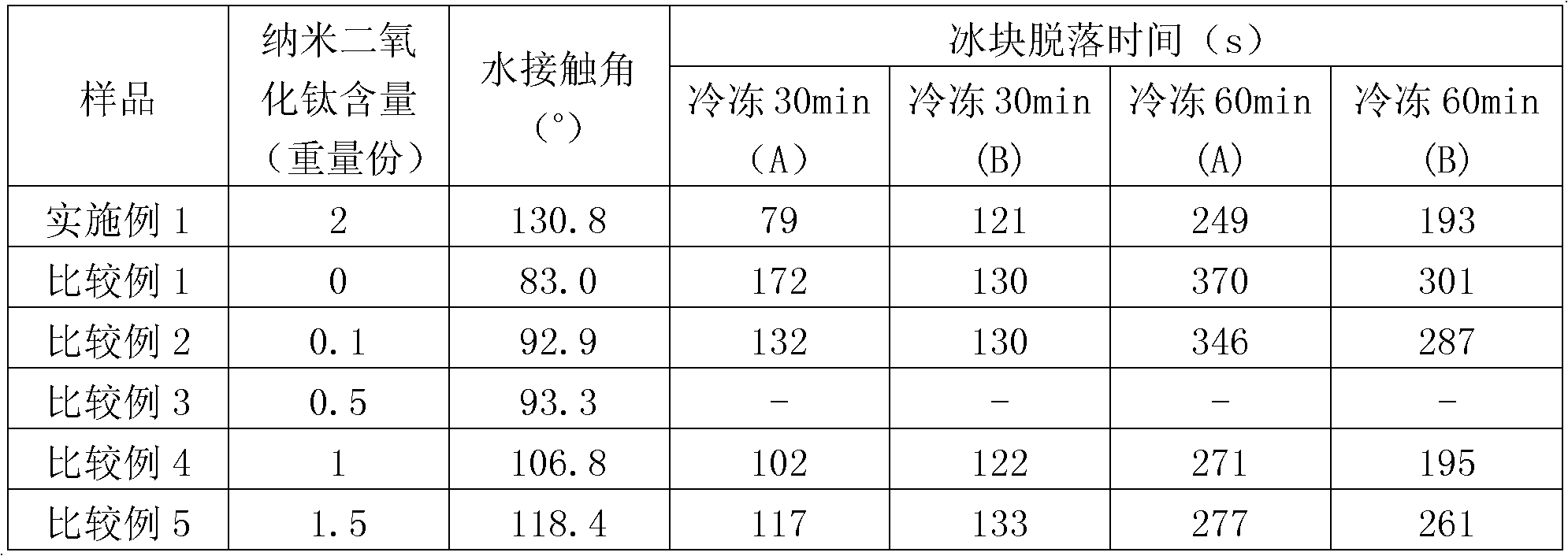
The invention discloses an anti-freeze nanometer titanium dioxide composite material, comprising the following components based on parts by weight: 1-10 parts of nanometer titanium dioxide, 0.1-20 parts of copolymer, 0.1-10 parts of epoxy resin curing agent and 10-90 parts of organic solvent. The composite material is prepared as follows: dissolving the copolymer and the curing agent into a certain amount of mixed solvent of toluene and acetone to obtain polymer bonder, and dispersing the nanometer titanium dioxide into a certain amount of mixed solvent of toluene and acetone at the same time, and uniformly mixing and stirring them to obtain. The nanometer titanium dioxide composite material is advantaged by strong anti-freeze ability, aging resistance, abrasion resistance, low production cost and so on. The composite material can be used as anti-freeze coating material to be coated on the substrate surface such that the substrate surface has obvious anti-freeze ability, and can be widely used in industries like aviation, electricity and traffic.
Need to check novelty before this filing date? Find Prior Art

Description

technical field

[0001] The invention relates to a titanium dioxide composite material and a preparation method thereof, in particular to an anti-icing nano titanium dioxide composite material, a preparation method and an application thereof, belonging to the technical field of special composite materials. Background technique

[0002] Disasters and accidents caused by freezing weather seriously affect people's normal work and life, and have a series of consequences. For example, icing on wires or cables will increase the load and cause interruption of the power system; icing on aircraft wings will lead to aircraft crashes and fatal accidents; icing on highways will seriously hinder traffic and threaten the safety of life and property. Therefore, the development and application of anti-icing materials are of great significance and have broad prospects.

[0003] At present, the main method to suppress road icing is to spray deicing agent, and deicing mainly relies on manpower...

Examples

Embodiment 1

[0020] (1) Preparation of copolymer

[0021] A 100mL three-necked bottle equipped with a thermometer and a constant pressure dropping funnel, in parts by weight (unit: gram), sequentially add 3 parts of styrene, 4 parts of glycidyl methacrylate, and 15 parts of methacrylic acid Butyl ester and 35mL toluene, under the protection of nitrogen flow, magnetic stirring, constant temperature heating to 85 ° C, 0.2 parts of azobisisobutyronitrile (AIBN) dissolved in 5mL toluene, slowly drop into the three-necked flask through the constant pressure dropping funnel , After the dropwise addition, continue heating and stirring at constant temperature for 2.5h. Add the reactants dropwise to petroleum ether (b.p. 60-90°C), and the formed white flocculent precipitate is the copolymer. The copolymer is vacuum-dried at room temperature to obtain a colorless transparent crystalline solid, which is the pure copolymer.

[0022] (2) Preparation of polymer binder

[0023] In parts by weight (unit...