Scanning radar super-resolution imaging method

A super-resolution imaging and scanning radar technology, applied in the field of radar, can solve the problems of a large number of samples, unsuitable for real-time imaging of scanning radar, and the limitation of the real aperture length of the resolution.

CN103412305AActive Publication Date: 2013-11-27UNIV OF ELECTRONICS SCI & TECH OF CHINA
2 Cites 29 Cited by

Patent Information

Authority / Receiving Office
CN · China
Patent Type
Applications(China)
Current Assignee / Owner
Publication Date
2013-11-27

Smart Images

  • Figure 1
    Figure 1
  • Figure 2
    Figure 2
  • Figure 3
    Figure 3
Patent Text Reader

Abstract

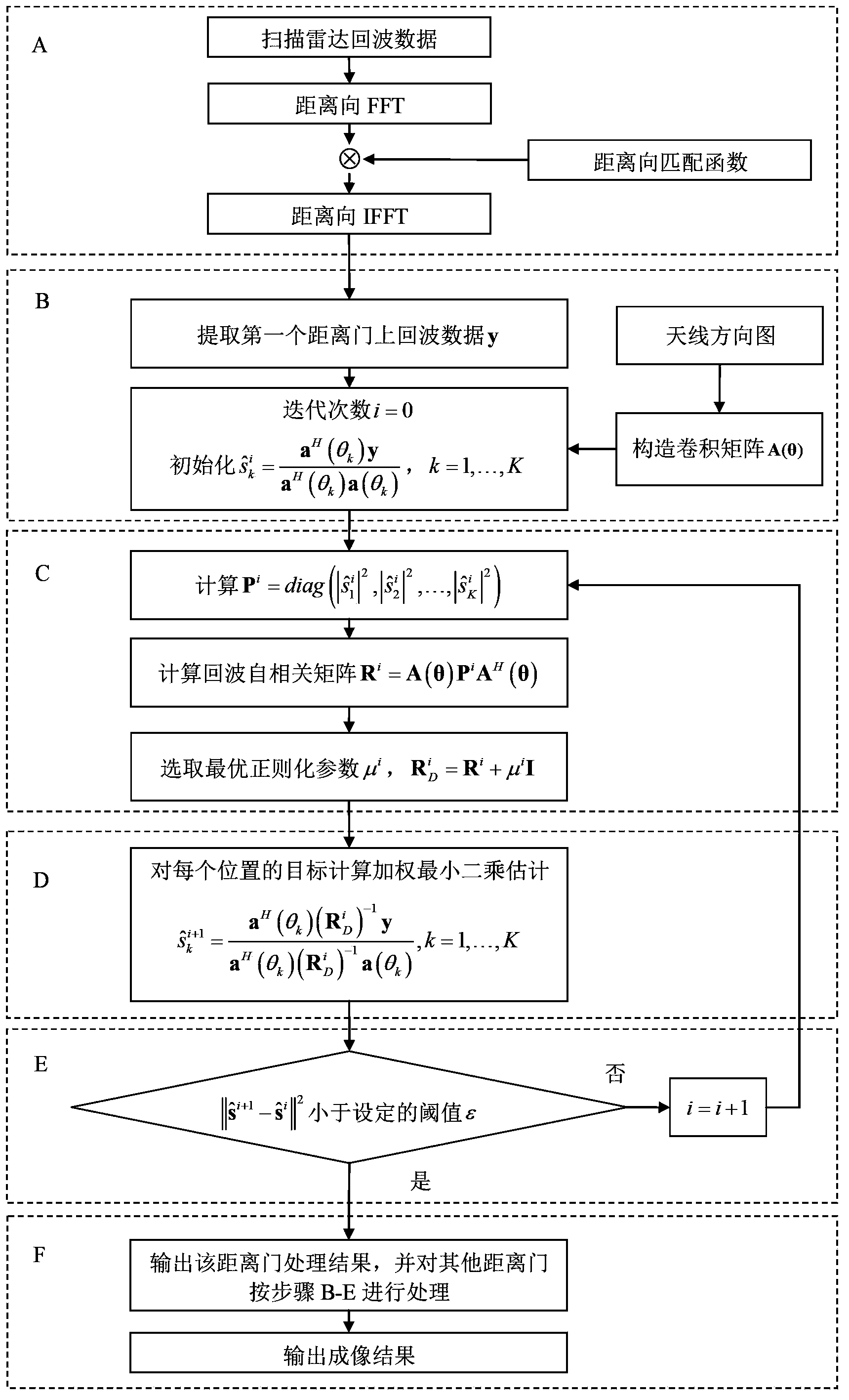
The invention discloses a scanning radar super-resolution imaging method. The method comprises the following steps of: performing distance-to-pulse compression; constructing a convolution matrix; initializing the convolution matrix; calculating an echo autocorrelation matrix; regularizing the echo autocorrelation matrix; performing orientation-to-parameter estimation; judging whether iteration is performed until a convergence state appears; and outputting super-resolution imaging results. According to the scanning radar super-resolution imaging method, an orientation-to-echo spectrum estimation model is constructed according to a radar antenna scanning process; a scanning radar imaging problem is converted into a parameter estimation problem; and amplitude and orientation estimation is performed on a site through an iteration self-adaptive method. Compared with an existing method, the scanning radar super-resolution imaging method can be applicable to low signal-to-noise ratio and has high robustness; and at the same time, with the scanning radar super-resolution imaging method adopted, robust imaging results can be obtained with a single times of scanning.
Need to check novelty before this filing date? Find Prior Art

Description

technical field

[0001] The invention belongs to the technical field of radar, relates to radar imaging, and in particular relates to a scanning radar azimuth super-resolution method. Background technique

[0002] With its advantages of strong penetration, all-weather, large dynamic range and high imaging quality, radar imaging technology has become an irreplaceable technical means in the field of detection today, and is playing an increasingly important role in many fields. Scanning radar imaging is an important imaging method for radar stationary platforms and moving platforms. In scanning radar imaging, high resolution can be obtained by matching the chirp signal in the range direction, but the resolution in the azimuth direction is limited by the real aperture. Length restrictions.

[0003] For scanning radar imaging, especially how to improve the azimuth resolution, the document "A new Sector Imaging Radar for Enhanced Vision–SIREV, SPIE Conference on Enhanced and Synth...

Examples

Embodiment Construction

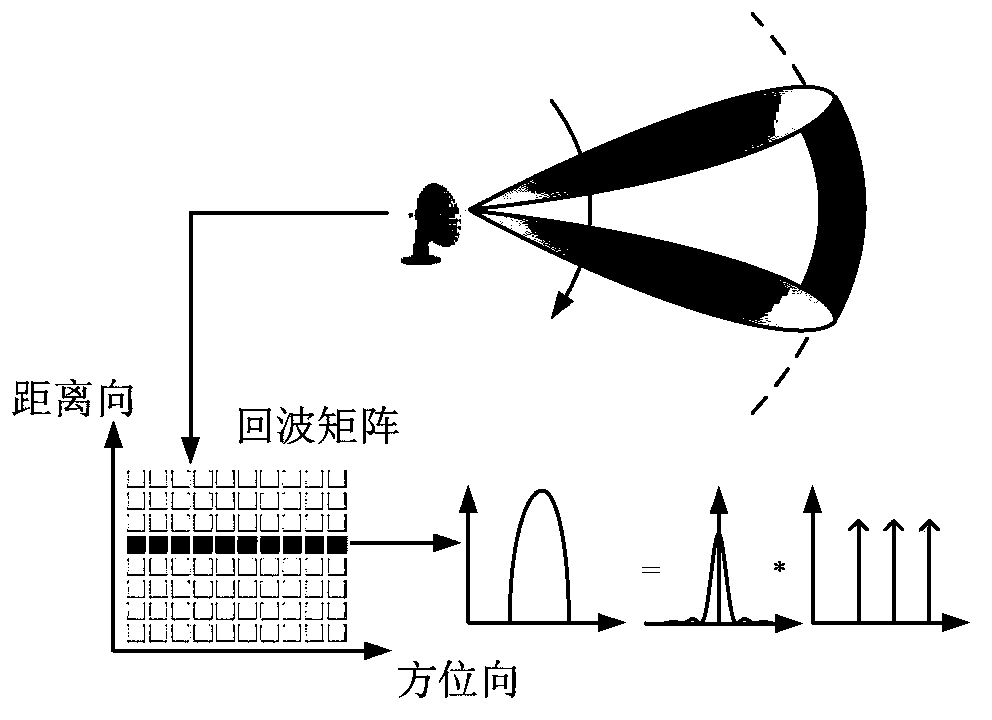
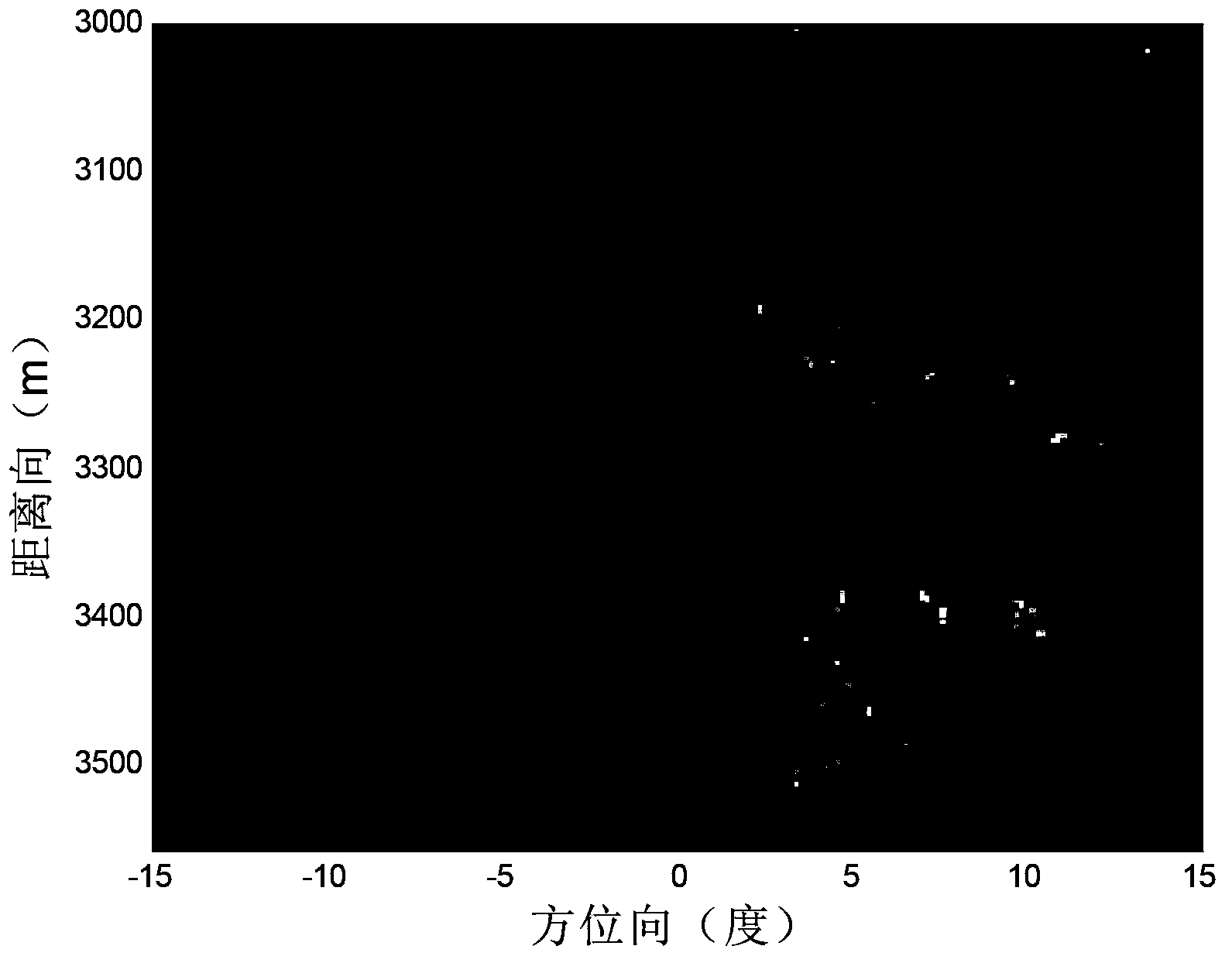
[0036] figure 1 It is a schematic diagram of scanning radar imaging in this embodiment, and the original imaging scene is as follows figure 2 shown. where the antenna azimuth beamwidth is θ w =3°, the scanning range of the antenna is ±15°, the scanning speed is ω=60° / s, the wavelength of the transmitted signal is λ=0.03m, the bandwidth is B=50MHz, and the frequency modulation slope is K r =2.5×10 13 Hz / s chirp signal. Pulse repetition frequency PRF=1000, azimuth sampling points K=500. Figure 5 It is the original echo obtained after the radar scans the scene.

[0037] In the following discussion, only a certain distance R is considered 0 Target upwards in all directions. Assuming that in the scanning area, there are targets at each azimuth sampling point, let the position parameters of these targets be θ=(θ 1 ,θ 2 ,…,θ K ), the magnitude parameter is σ=(σ 1 ,σ 2 ,…,σ K ), then these target echo signals after coherent demodulation can be expressed as:

[0038] ...