
Polyurethane wood substitution composition
A technology of polyurethane and composition is applied in the field of manual preparation of the model products, which can solve the problems such as short operating time of pasty wood substitutes, and achieve the effects of good hardness and good mechanical properties.
- Summary
- Abstract
- Description
- Claims
- Application Information
AI Technical Summary
Problems solved by technology
Method used
Image

Examples
Embodiment 1
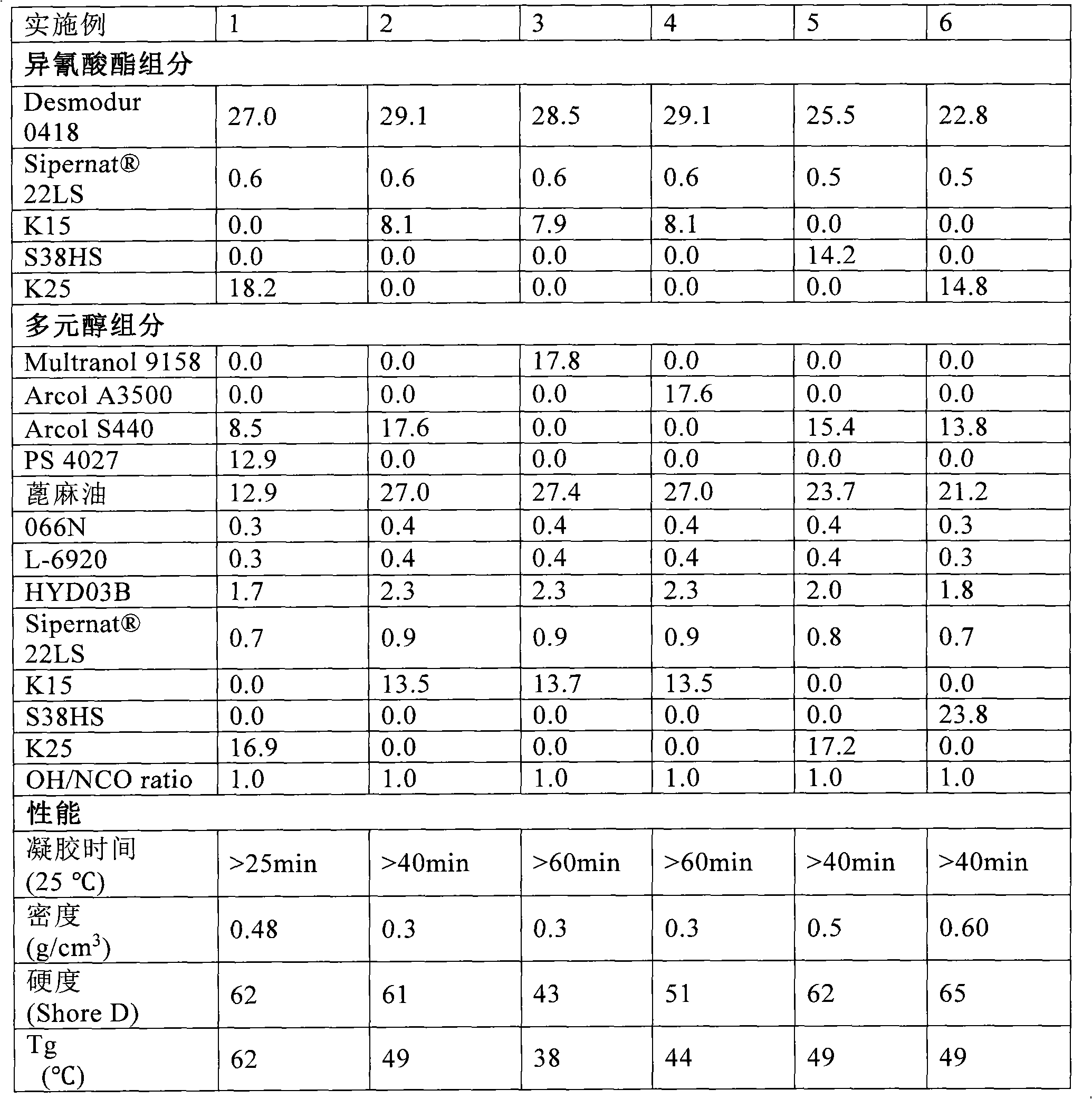
[0112] Embodiment 1: adopt the following steps to implement. Prepare 1000g of materials according to the weight percentages shown in Table 1, and mix them by hand. All operations (weighing and mixing) were performed at room temperature in a fume hood (temperature 20-25°C, relative humidity 45% to 55%).
[0113] 300g of the mixed material was horizontally applied to a vertical surface of a foam substrate with a thickness of 20mm, 30mm, 40mm and 50mm to evaluate its anti-sag performance.
[0114] Apply 500g of the mixed material to a foam substrate with a thickness of 30mm. After curing at room temperature for 12 hours, use a CNC machine tool to process it into a designed shape, and use an electronic magnifying glass to observe its surface quality.
[0115] The remaining 200g material is used to test Shore D hardness and density, the test standards are ISO868:2003 and ISO2781:1996 respectively
[0116] The operation method of embodiment 2-6 is the same as embodiment 1, and con...
PUM
 Login to View More
 Abstract
Description
Claims
Application Information
 Login to View More