Glass cleaning agent with bactericidal effect
A technology of glass cleaning agent and bactericidal effect, applied in the field of cleaning agents, can solve the problems of wasting water, unclean cleaning, waste, etc., and achieve the effects of obvious bactericidal effect, good penetration effect, and good cleaning effect
- Summary
- Abstract
- Description
- Claims
- Application Information
AI Technical Summary
Problems solved by technology
Method used
Image

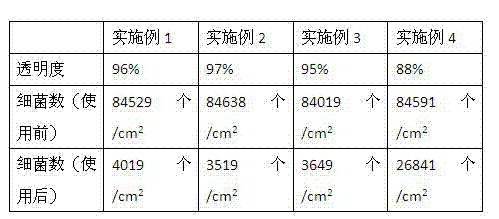
Examples
Embodiment 1
[0013] A glass cleaning agent with bactericidal effect, which consists of the following components in parts by weight: 12 parts of dodecyltrimethylammonium chloride, 6 parts of hexadecyltrimethylammonium bromide, 2.5 parts of sodium phosphate, 6 parts of ethanol, 4 parts of ethylene glycol monobutyl ether, 12 parts of isopropanol, 0.5 parts of ammonia water, and 100 parts of deionized water.
Embodiment 2
[0015] A glass cleaning agent with bactericidal effect, consisting of the following components in parts by weight: 15 parts of dodecyltrimethylammonium chloride, 7 parts of hexadecyltrimethylammonium bromide, 3 parts of sodium phosphate, 8 parts of ethanol, 5 parts of ethylene glycol monobutyl ether, 13 parts of isopropanol, 1 part of ammonia water, and 100 parts of deionized water.
Embodiment 3
[0017] A glass cleaning agent with bactericidal effect, consisting of the following components in parts by weight: 18 parts of dodecyltrimethylammonium chloride, 8 parts of hexadecyltrimethylammonium bromide, 5 parts of sodium phosphate, 10 parts of ethanol, 6 parts of ethylene glycol monobutyl ether, 15 parts of isopropanol, 1 part of ammonia water, and 100 parts of deionized water.
PUM
 Login to View More
 Abstract
Description
Claims
Application Information
 Login to View More