
Amorphous ivabradine hydrochloride and preparation method thereof
An ivabradine hydrochloride, amorphous technology, applied in cardiovascular system diseases, active ingredients of heterocyclic compounds, drug combinations, etc., can solve problems such as easy water absorption, low production efficiency, instability, etc., and achieve simple operation and good performance , the effect of stable quality
Patent Information
- Authority / Receiving Office
- CN · China
- Patent Type
- Applications(China)
- Current Assignee / Owner
- Publication Date
- 2015-08-12
- Estimated Expiration
- Not applicable · inactive patent
Smart Images
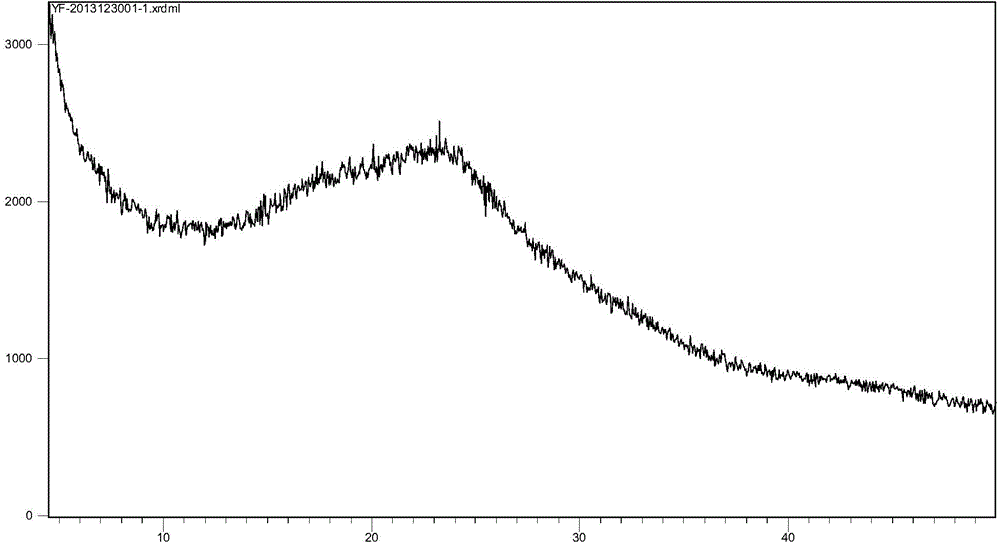
Figure 1 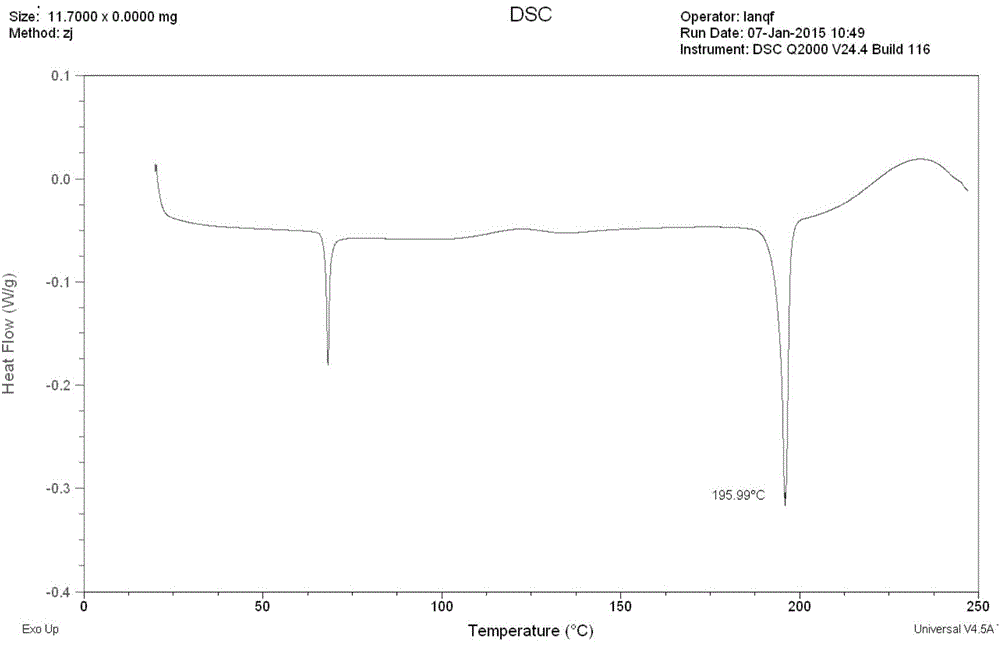
Figure 2 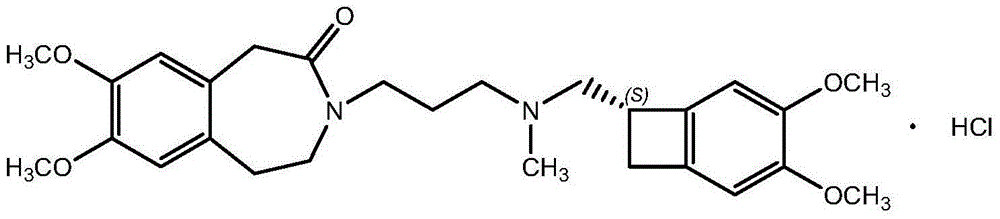
Figure 3
Abstract
Description
technical field
[0001] The invention relates to the field of medicinal chemistry, in particular to amorphous ivabradine hydrochloride, a preparation method thereof and a pharmaceutical composition containing it. Background technique
[0002] Ivabradine Hydrochloride (Ivabradine Hydrochloride), the chemical name is 3-[3-[[(8S)-3,4-dimethoxy-8-bicyclo[4.2.0]octane-1,3,5-tri En]methyl-methylamino]propyl]-7,8-dimethoxy-2,5-dihydro-1H-3-benzazepin-4-one hydrochloride. Its chemical formula is
[0003]
[0004] Ivabradine and its addition salts with pharmaceutically acceptable acids, more particularly its hydrochloride, possess extremely valuable pharmacological and therapeutic properties, especially bradycardic properties, making these compounds It is useful in the treatment or prophylaxis of various clinical conditions of myocardial ischemia such as angina pectoris, myocardial infarction and associated arrhythmias, as well as various pathological conditions involving arrhyth...
Examples
Embodiment 1
[0063] Mix 90ml of purified water and 10ml of absolute ethanol, then add 10g of ivabradine hydrochloride in batches, while stirring, until the solution is complete. The resulting clear solution was heated at 50 °C for an additional 0.5 h, then gradually cooled to ambient temperature. Turn on the freeze dryer and set the freeze-drying curve: -50°C, 10 5 Pa(4h); -20°C, 10Pa(12h); 0°C, 10Pa(2h); 15°C, 10Pa(2h); 30°C, 10Pa(2h); 50°C, 10Pa(10h), the product was 9.7g , which was detected as an amorphous powder by XRD, and the test results were as follows figure 1 .
[0064] The amorphous ivabradine hydrochloride prepared in Example 1 was characterized by differential scanning calorimetry (DSC). see results figure 2 .
[0065] Depend on figure 2 The results show that the differential scanning calorimetry curve has an endothermic peak at about 195.99°C.
Embodiment 2
[0067] Mix 70ml of purified water and 30ml of absolute ethanol, then add 10g of ivabradine hydrochloride in batches, while stirring, until the solution is complete. The resulting clear solution was heated at 50 °C for an additional 0.5 h, then gradually cooled to ambient temperature. Turn on the freeze dryer, set the freeze-drying curve -40°C, 10 5 Pa(4h); -30℃, 10Pa(12h); 0℃, 10Pa(2h); 10℃, 10Pa(2h); 30℃, 10Pa(2h); 50℃, 10Pa(10h), the product was 9.6g , which was detected as an amorphous powder by XRD, and the test results were as follows figure 1 , DSC detection result is the same as embodiment 1.
Embodiment 3
[0069] Mix 90ml of purified water and 10ml of tert-butanol, then add 10g of ivabradine hydrochloride in batches, while stirring, until the solution is complete. The resulting clear solution was heated at 50 °C for an additional 0.5 h, then gradually cooled to ambient temperature. Turn on the freeze dryer and set the freeze-drying curve: -60°C, 10 5 Pa(4h); -30℃, 10Pa(12h); 0℃, 10Pa(2h); 20℃, 10Pa(2h); 40℃, 10Pa(2h); 80℃, 10Pa(10h), the product 9.6g was obtained , which was detected as an amorphous powder by XRD, and the test results were as follows figure 1 , DSC detection result is the same as embodiment 1.