Al technical title is built by PatSnap Al team. It summarizes the technical point description of the patent document.
A detection method and quantitative determination technology, applied in the biological field, can solve the problem of high price
Active Publication Date: 2015-08-26
王贤俊
View PDF5 Cites 0 Cited by
Summary
Abstract
Description
Claims
Application Information
AI Technical Summary
This helps you quickly interpret patents by identifying the three key elements:
Problems solved by technology
Method used
Benefits of technology
Problems solved by technology
At present, domestic clinical laboratories use homogeneous phase method to determine LDL-C reagents, which are mostly imported from Japan, such as the reagents produced by Ichika and Wako, or domestic reagents produced by foreign technologies, such as the products of Leadman and Shensuo. higher price
Method used
the structure of the environmentally friendly knitted fabric provided by the present invention; figure 2 Flow chart of the yarn wrapping machine for environmentally friendly knitted fabrics and storage devices; image 3 Is the parameter map of the yarn covering machine
View more
Image
Smart Image Click on the blue labels to locate them in the text.
Viewing Examples
Smart Image
Click on the blue label to locate the original text in one second.
Reading with bidirectional positioning of images and text.
Smart Image
Examples
Experimental program
Comparison scheme
Effect test
Embodiment 1
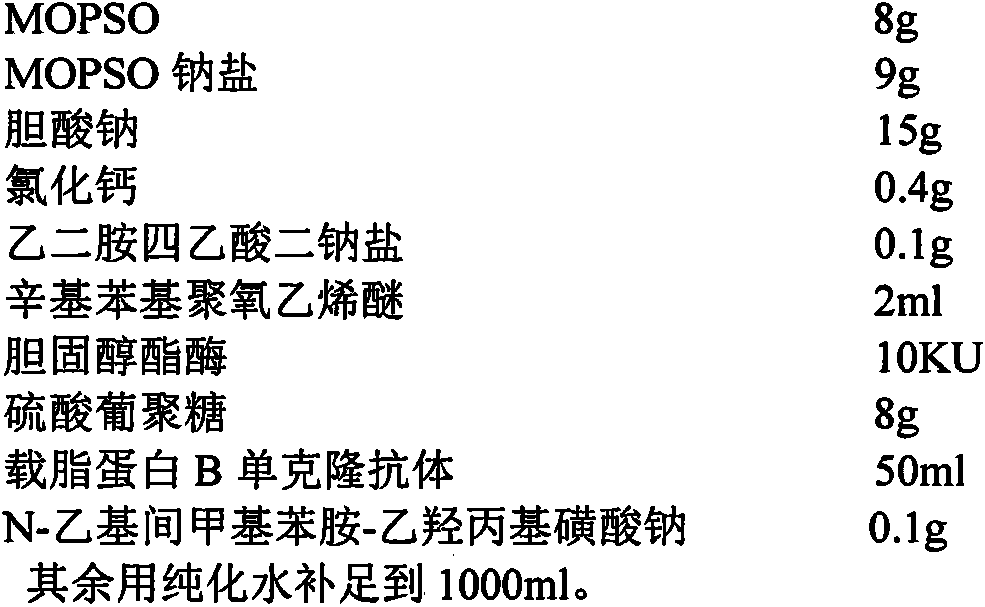
[0021] 1. Preparation of reagent 1:
[0022]
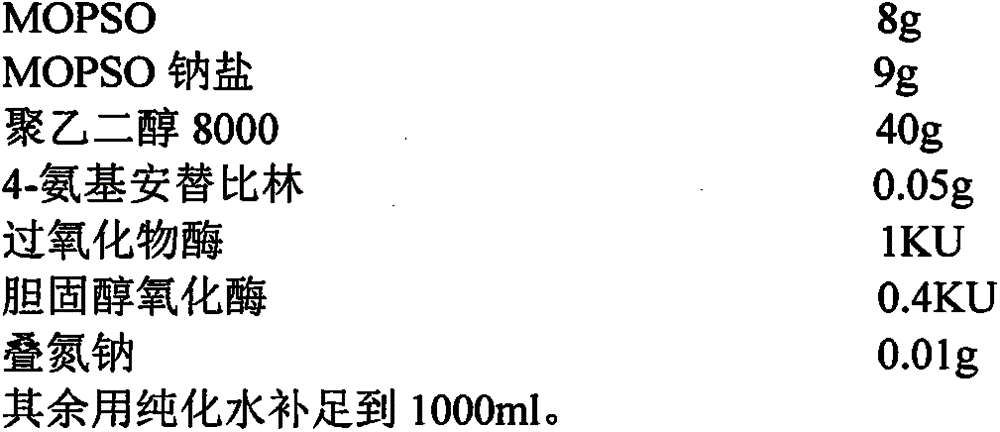
[0023] 2. Preparation of reagent 2:
[0024]
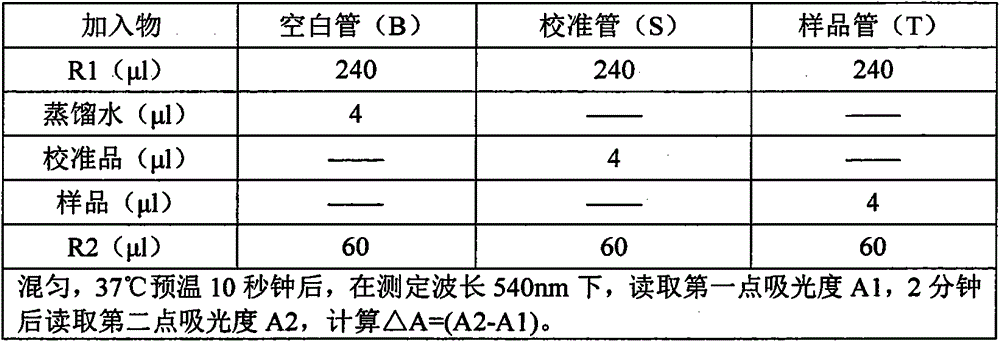
[0025] Table 2 is the result data of the LDL-C detection kit prepared in Example 1, which was continuously measured for 10 times on the Hitachi 7180 automatic biochemical analyzer under the same external conditions.
[0026] Table 2 Accuracy measurement results table
[0027] Measurement times Result (mmol / L) 1 2.91 2 2.89
[0029] As can be seen from Table 2, the accuracy of the LDL-C detection kit prepared in Example 1 is: 0.69%
[0030] Table 3 shows the result data of 20 consecutive determinations of quality control serum on a Hitachi 7180 automatic biochemical analyzer using the LDL-C detection kit prepared in Example 1 under the same external conditions.
[0031] Table 3 Precision measurement result table
[003...
Embodiment 2
[0040] 1. Preparation of reagent 1:
[0041]
[0042]
[0043] 2. Preparation of reagent 2:
[0044]
[0045] Table 2 is the result data of the LDL-C detection kit prepared in Example 2, which was continuously measured for 10 times on the Hitachi 7180 automatic biochemical analyzer under the same external conditions.
[0046] Table 2 Accuracy measurement results table
[0047] Measurement times Result (mmol / L) 1 2.58 2 2.64 3 2.56 4 2.57 5 2.62 6 2.53 7 2.56 8 2.59 9 2.59 10 2.62 average 2.59
[0048] As can be seen from Table 2, the accuracy of the LDL-C detection kit prepared in Example 2 is: 0.81%
[0049] Table 3 shows the result data of 20 consecutive determinations of quality control serum on the Hitachi 7180 automatic biochemical analyzer with the LDL-C detection kit prepared in Example 2 under the same external conditions.
[0050] Table 3 Precision measurement result table
[0051] ...
the structure of the environmentally friendly knitted fabric provided by the present invention; figure 2 Flow chart of the yarn wrapping machine for environmentally friendly knitted fabrics and storage devices; image 3 Is the parameter map of the yarn covering machine
Login to View More
PUM
Login to View More
Abstract
The invention discloses a detection method for quantitatively determining LDL-C (Low-Density LipoproteinCholesterol) by a joint covering method. Double liquid reagents are adopted and formed by a reagent 1 and a reagent 2 which are placed separately, wherein metalchloride, an LDL-C monoclonalantibody and a quantitative enzymereagent are contained in the reagent 1 and a surface active agent, a color developing agent, a preservative, anti-interference materials and a reaction promoter are contained in the reagent 2. According to the LDL-C quantitative detection method, the color developing characteristic is good, the accuracy is high, the reagent composition is stable, the operation is simple, and the LDL-C quantitative detection method is suitable for various clinical full-automatic biochemical analyzers and is used for detecting the content of the LDL-C in serum of a human body.
Description
Technical field: [0001] The invention discloses a detection method for quantitatively measuring LDL-C through a combined masking method, which belongs to the field of biotechnology. Background technique: [0002] Low-density lipoprotein (LDL) is the most abundant lipoprotein in human blood, and the cholesterol (LDL-C) it carries is considered to be the main pathogenic factor of atherosclerosis and coronary heart disease, and clinical detection has become increasingly important. [0003] At present, there is no real reference method for measuring LDL-C. The CDC tentative reference method for measuring LDL-C is the ultracentrifugation method (Betaquantification, β-quantitative method / BQ method), which is also recommended by NCEP. The LDL-C measured by this method actually includes the cholesterol content of lipoprotein (a) [Lp(a)] and intermediate density lipoprotein (IDL), which is also the basis for evaluating the correctness of other detection methods. This method require...
Claims
the structure of the environmentally friendly knitted fabric provided by the present invention; figure 2 Flow chart of the yarn wrapping machine for environmentally friendly knitted fabrics and storage devices; image 3 Is the parameter map of the yarn covering machine
Login to View More
Application Information
Patent Timeline
Application Date:The date an application was filed.
Publication Date:The date a patent or application was officially published.
First Publication Date:The earliest publication date of a patent with the same application number.
Issue Date:Publication date of the patent grant document.
PCT Entry Date:The Entry date of PCT National Phase.
Estimated Expiry Date:The statutory expiry date of a patent right according to the Patent Law, and it is the longest term of protection that the patent right can achieve without the termination of the patent right due to other reasons(Term extension factor has been taken into account ).
Invalid Date:Actual expiry date is based on effective date or publication date of legal transaction data of invalid patent.

 Login to View More
  Login to View More