Coking method for improving liquid yield
A technology of liquid and coking raw materials, which is applied in the field of coking technology and can solve the problems of low liquid yield
- Summary
- Abstract
- Description
- Claims
- Application Information
AI Technical Summary
Problems solved by technology
Method used
Image



Examples
Embodiment 1
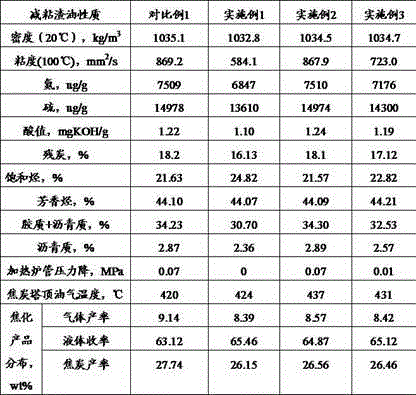
[0087] The vacuum residue is mixed with 10wt% hydrogenated catalytic distillate oil and then enters the visbreaking-coking unit. The visbreaking reaction conditions are: reaction temperature 410°C, residence time 30min, reaction pressure 0.5MPa, and the visbreaking product passes through the visbreaking flash tank Vis-reduced oil and gas and vis-reduced residue are separated (see Table 2 for properties). The vis-reduced oil and gas enter the coking fractionation tower, and the vis-reduced residue enters the delayed coking unit. The coking reaction conditions are: reaction temperature 490°C, coke tower top pressure 0.18 MPa, the coking cycle ratio is 0.
[0088] Investigate the pressure drop of the coking heating furnace tube and the oil and gas temperature at the top of the coke tower. During the test, coking gas, coking liquid products and coke were collected, and the yield of coking products using visbreaking residue as raw material was calculated. The results are shown in T...
Embodiment 2
[0090] The vacuum residue enters the visbreaking-coking unit, and 10wt% hydrogenated catalytic distillate oil is heated to 520°C and then injected into the coke tower. The visbreaking-coking process conditions are the same as in Example 1.
[0091] Investigate the pressure drop of the coking heating furnace tube and the oil and gas temperature at the top of the coke tower. During the test, coking dry gas, coking liquid products and coke were collected, and the yield of coking products using visbreaking residue as raw material was calculated. The results are shown in Table 2.
Embodiment 3
[0093] The vacuum residue is mixed with 5wt% hydrogenated catalytic distillate oil and then enters the visbreaking-coking unit. At the same time, the 5wt% hydrogenated catalytic distillate oil is heated to 525°C and then injected into the coke tower. The visbreaking-coking process conditions are the same as in Example 1 same.
[0094] Investigate the pressure drop of the coking heating furnace tube and the oil and gas temperature at the top of the coke tower. During the test, coking dry gas, coking liquid products and coke were collected, and the yield of coking products using visbreaking residue as raw material was calculated. The results are shown in Table 2.
PUM
 Login to View More
 Abstract
Description
Claims
Application Information
 Login to View More