

Nitrogen-containing heterogeneous ring compound, preparation method thereof and application of nitrogen-containing heterogeneous ring compound in inhibition of kinase activity
A compound and solvate technology, applied in the field of medicinal chemistry, can solve problems such as low selectivity and poor curative effect
Patent Information
- Authority / Receiving Office
- CN · China
- Patent Type
- Applications(China)
- Current Assignee / Owner
- Publication Date
- 2017-05-24
- Estimated Expiration
- Not applicable · inactive patent
Smart Images

Figure 1 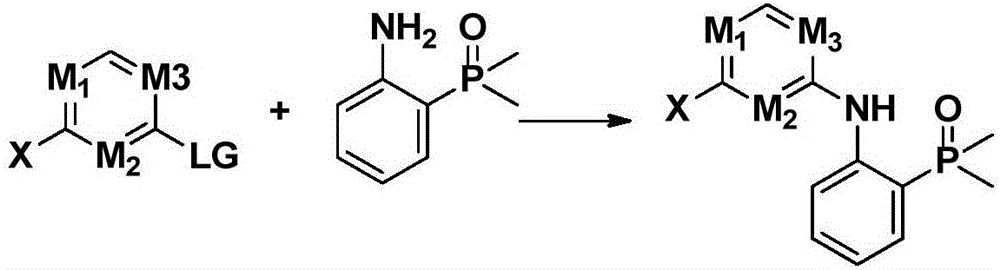
Figure 2 
Figure 3
Abstract
Description
technical field
[0001] The invention relates to a nitrogen-containing heterocyclic compound, a preparation method thereof and an application in inhibiting kinase activity, belonging to the technical field of medicinal chemistry. Background technique
[0002] Molecular targeted therapy of tumors is based on the key proteins closely related to the occurrence and development of tumors, and selectively acts on signaling proteins by chemical means to kill tumor cells. The characteristics of targeted therapy are: high specificity, strong selectivity, and lower toxicity and side effects compared with traditional chemotherapy drugs; when used in combination, it can enhance the efficacy of traditional chemotherapy; targeted inhibitors are prone to drug resistance in clinical practice and make the therapeutic drugs invalidated.
[0003] Lung cancer is the malignant tumor with the highest morbidity and mortality in the world, and the 5-year survival rate is only 16.8%. In 2010, the mo...
Examples
Embodiment 1
[0169] Intermediate 11 (25mg, 0.10mmol) and Intermediate 20 (35mg, 0.12mmol) were dissolved in iPrOH (1mL), concentrated hydrochloric acid (24mg, 0.25mmol) was added, microwave reaction (250w, 130°C, 120min, 300psi) . Cool to room temperature, add EA (20mL), wash with saturated sodium bicarbonate (aq) (20mL×3), wash with saturated brine (20mL×3), column chromatography (D / M / Et 3 N=10:1:0.02), to obtain Example 1: 48 mg of off-white solid with a yield of 71%.
[0170] The structure verification data is as follows: 1 H NMR (CDCl 3 )δ (ppm): 10.01 (s, 1H), 8.46 (dd, J 1 =8.4Hz,J 2 =4.4Hz,1H),8.35(s,1H),7.47(t,J=7.6Hz,1H),7.23-7.15(m,2H),7.02-6.98(m,1H),6.45(d,J= 8.8Hz, 1H), 6.35(s, 1H), 5.87(s, 1H), 4.60(t, J=8.8Hz, 2H), 3.40(d, J=12.0Hz, 2H), 3.20(t, J= 8.8Hz, 2H), 2.67(t, J=12.0Hz, 2H), 2.33(s, 6H), 2.29-2.23(m, 1H), 1.93(d, J=12.0Hz, 2H), 1.80(s, 3H),1.74(s,3H),1.68-1.58(m,2H).HRMS(ESI):m / z,calcd for C 27 h 36 N 6 o 2 P[M+H + ]:507.2637, found 507.2646.
Embodiment 2
[0172]Using Intermediate 11 (50 mg, 0.19 mmol) and Intermediate 21 (71 mg, 0.24 mmol) as raw materials, the same method as Example 1 was used to synthesize Example 2: 84 mg of off-white solid with a yield of 84%.
[0173] The structure verification data is as follows: 1 H NMR (DMSO-d 6 )δ (ppm): 11.51 (s, 1H), 8.66 (m, 1H), 8.24 (s, 1H), 8.02 (d, J = 3.2Hz, 1H), 7.54 (dd, J 1 =13.6Hz,J 2 =7.6Hz, 1H), 7.32(t, J=7.6Hz, 1H), 7.21(d, J=8.4Hz, 1H), 7.08(t, J=7.2Hz, 1H), 6.44(d, J=8.8 Hz,1H),4.49(t,J=8.4Hz,2H),3.41-3.39(m,2H),3.16(t,J=8.0Hz,2H),3.01(m,1H),2.64(t,J =12.0Hz,2H),2.53(s,6H),2.01(d,J=10.0Hz,2H),1.80(s,3H),1.77(s,3H),1.80-1.65(m,2H).HRMS (ESI): m / z, calcd for C 27 h 35 N 6 o 2 PF[M+H + ]:525.2543, found 525.2557.
Embodiment 3
[0175] Using Intermediate 11 (40 mg, 0.15 mmol) and Intermediate 22 (54 mg, 0.19 mmol) as raw materials, the same method as in Example 1 was used to synthesize Example 3: 35 mg of an off-white solid with a yield of 45%.
[0176] The structure verification data is as follows: 1 H NMR (DMSO-d 6 )δ(ppm):10.95(s,1H),8.51-8.50(m,1H),8.11(s,1H),7.95(d,J=5.6Hz,1H),7.52(d,J 1 =12.8Hz,J 2 =6.4Hz, 1H), 7.31(t, J=7.6Hz, 1H), 7.25(d, J=8.4Hz, 1H), 7.04(d, J=7.6Hz, 1H), 6.43(d, J=8.8 Hz,1H),5.96(d,J=5.6Hz,1H),4.49(t,J=8.4Hz,2H),3.39(m,2H),3.17-3.13(m,3H),2.63(t,J =12.0Hz,2H),2.43(s,6H),1.97-1.94(m,2H),1.78(s,3H),1.75(s,3H),1.62-1.59(m,2H).HRMS(ESI) :m / z, calcd for C 27 h 36 N 6 o 2 P[M+H + ]:507.2637, found 507.2634.