
A kind of polymer solid electrolyte membrane and preparation method thereof
A solid electrolyte membrane and polymer technology, applied in circuits, electrical components, secondary batteries, etc., can solve the problems of low electrical conductivity, film-forming mechanical deformation, easy leakage, short life and other problems, and achieve high mechanical performance, electrochemical performance. The effect of wide window and low vapor pressure
- Summary
- Abstract
- Description
- Claims
- Application Information
AI Technical Summary
Problems solved by technology
Method used
Image

Examples
Embodiment 1
[0031] Step 1: In the glove box, weigh 24 grams of lithium bis(trifluoromethylsulfonyl)imide in a 50ml flask, take out the flask from the glove box, add 5ml deionized water and stir evenly at 0°C, while Add 8.84 grams of 1-ethylimidazole dropwise, react for 10 hours, and dry to obtain a composite ionic liquid, which is put into a glove box for use;
[0032] Step 2: Dissolve 12 grams of poly(vinylidene fluoride-hexafluoropropylene) in 108 grams of N-methyl-pyrrolidone, then add the composite ionic liquid obtained in step 1, and cast to form a film to obtain the target polymer solid electrolyte membrane .
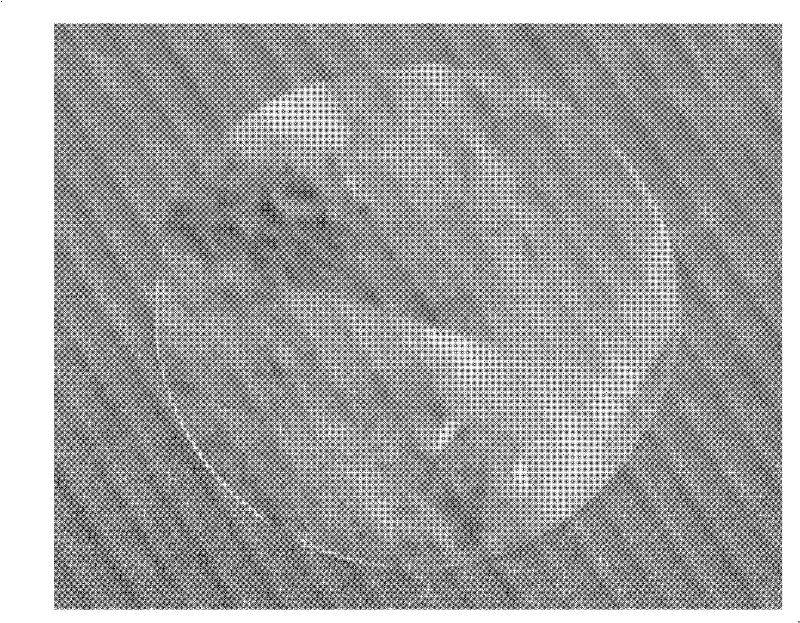
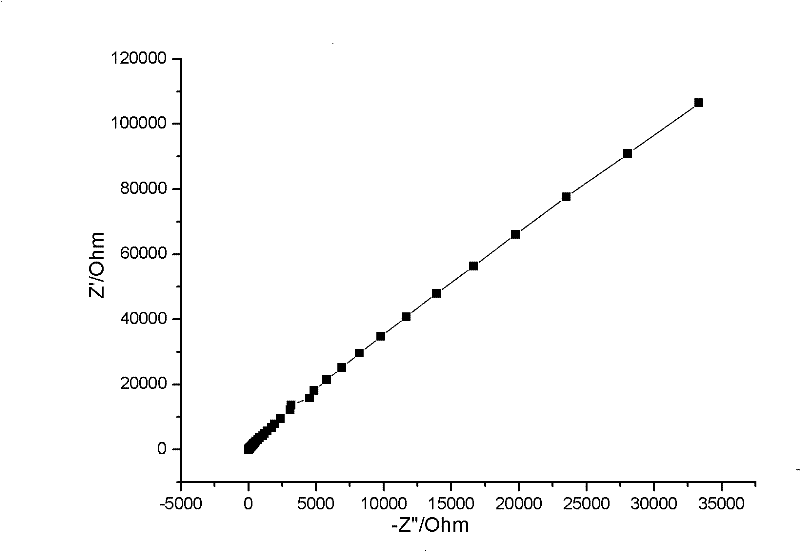
[0033] The appearance of the target polymer solid electrolyte membrane is as follows figure 1 As shown, the AC impedance spectrum as figure 2 As shown, the room temperature ionic conductivity according to the AC impedance test is 2.0mS / cm.
Embodiment 2
[0035] Step 1: In the glove box, weigh 24 grams of lithium hexafluorophosphate in a 50 ml flask, take out the flask from the glove box, add 4 ml of methanol and stir evenly at 0 ° C, while adding 17.75 grams of 1-methylpyrrolidine dropwise, reaction 8 Hour, dry and obtain composite ionic liquid, put into glove box and stand-by;
[0036] Step 2: Dissolve 24 grams of polypyrrole in 130 grams of N,N-dimethylacetamide, take out 30 grams of the solution, add 6 grams of the composite ionic liquid obtained in step 1, stir to form a casting solution, and cast to obtain Target polymer solid electrolyte membrane. According to the AC impedance test, its room temperature ionic conductivity is 2.3mS / cm.
Embodiment 3
[0038] Step 1: In the glove box, weigh 24 grams of lithium tetrafluoroborate in a 50 ml flask, take out the flask from the glove box, add 5 ml of methanol and stir evenly at 0 ° C, and drop 24 grams of 1-methylpyrazole at the same time , after reacting for 7 hours, dry to obtain the composite ionic liquid, put it into the glove box for use;
[0039] Step 2: Dissolve 20 grams of polyoxyethylene in 150 grams of N-methyl pyrrolidone, take out 30 grams of polyoxyethylene solution and add 12 grams of the composite ionic liquid obtained in step 1, stir to form a casting solution, and cast to obtain the target Polymer solid electrolyte membrane. According to the AC impedance test, its room temperature ionic conductivity is 3.4mS / cm.
PUM
 Login to View More
 Abstract
Description
Claims
Application Information
 Login to View More