Method for improving resistance of rice blast by using sucrose synthase
What is AI technical title?
AI technical title is built by PatSnap AI team. It summarizes the technical point description of the patent document.
A rice blast and sucrose synthase technology, which is applied in the field of constructing transsucrose synthase gene rice, can solve the problems of rice blast resistance of plants without sucrose synthase.
Inactive Publication Date: 2017-06-16
HUAZHONG AGRI UNIV
View PDF0 Cites 4 Cited by
Summary
Abstract
Description
Claims
Application Information
AI Technical Summary
This helps you quickly interpret patents by identifying the three key elements:
Problems solved by technology
Method used
Benefits of technology
Problems solved by technology
But so far, there is no report on how sucrose synthase can improve the resistance of plants to rice blast
Method used
the structure of the environmentally friendly knitted fabric provided by the present invention; figure 2 Flow chart of the yarn wrapping machine for environmentally friendly knitted fabrics and storage devices; image 3 Is the parameter map of the yarn covering machine
View more
Image
Smart Image Click on the blue labels to locate them in the text.
Viewing Examples
Smart Image
Click on the blue label to locate the original text in one second.
Reading with bidirectional positioning of images and text.
Smart Image
Examples
Experimental program
Comparison scheme
Effect test
Embodiment 1
[0034] One, embodiment 1: the cloning of AtCESA8 promoter and OsSUS3 gene cDNA
[0035] The full-length AtCESA8 promoter was cloned from Arabidopsis thaliana with a length of 949bp. The cDNA of OsSUS3 gene was cloned from rice, the length was 2643bp, and the CDS was 2451bp. The PCR product was recovered, digested, and connected to the vector.
[0036] ——Using the genomic DNA of Arabidopsis thaliana as a template, primers were synthesized to amplify the AtCESA8 promoter.
[0043] 1. The construction of the OsSUS3 vector (pC1300T-AtCESA8-OsSUS3) overexpressing rice with the Arabidopsis AtCESA8 promoter (see image 3 ):
[0044] ——The promoter and the OsSUS3 cDNA sequence were respectively connected to the T vector, digested with restriction enzymes, and transferred into the expression vector pC1300T.
[0047] Draw the preserved Agrobacterium (EHA105) on the solid LB medium (add antibiotics: Kan, if no antibiotics are added, the Ti plasmid of these strains may be lost, resulting in the lack of infectivity of Agrobacterium), the antibiotic concentration is: 50μg / mL, culture at 28°C for 1-2 days, then transfer to a new solid LB medium with antibiotics and culture for another 2 days;
[0048] 2. Preparation of Agrobacterium Competent Cells
[0049] Inoculate 100 μL into 1 mL of LB liquid medium, shake at 150 rpm at 28°C overnight;
[0050] Take 1mL of the bacterial liquid and inoculate it into 100mL of liquid medium and cultivate until OD600=0.5;
[0051] Place the bacterial solution on ice for 30 minutes, and cool the culture to 0°C;
[0052] Centrifuge at 5000rpm for 30s at 4°C and discard the supernatant;
[0053] Precipitate with 60mL 0.1M CaCl 2 Suspende...
the structure of the environmentally friendly knitted fabric provided by the present invention; figure 2 Flow chart of the yarn wrapping machine for environmentally friendly knitted fabrics and storage devices; image 3 Is the parameter map of the yarn covering machine
Login to View More
PUM
Login to View More
Abstract
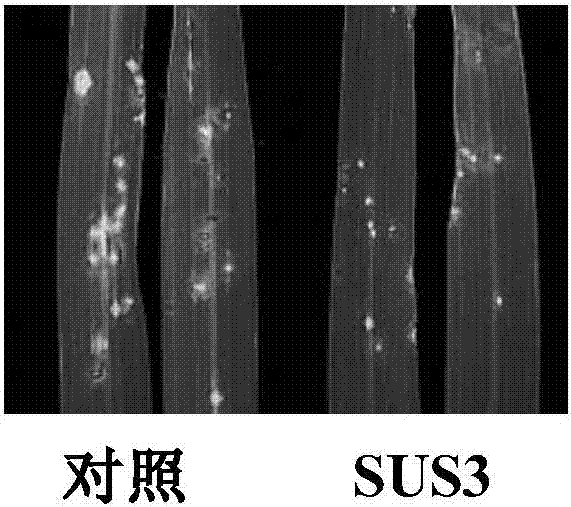
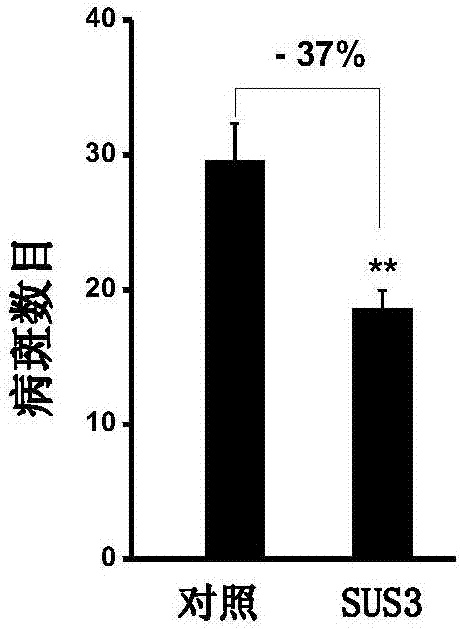
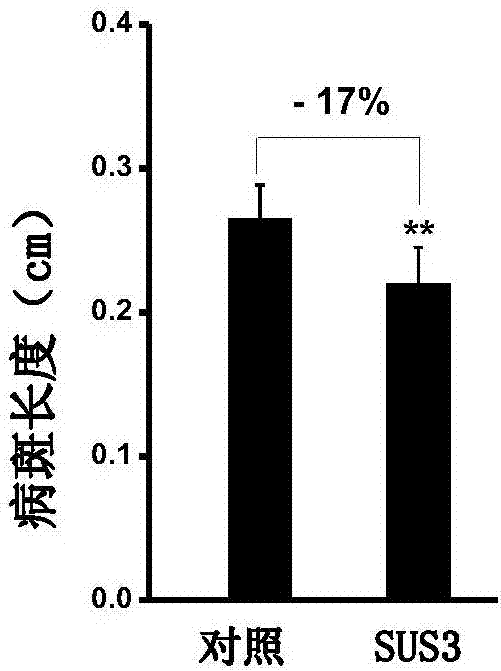
The invention discloses a method for improving the resistance of rice blast by using sucrose synthase (OsSUS3), and belongs to the technical field of molecular biology of sucrose synthase rice. The method comprises the following steps: firstly, cloning OsSUS3 gene cDNA from rice; secondly, constructing an OsSUS3 gene over-expression vector, converting rice middle flowers 11 to obtain transgenetic seedlings, wherein the OsSUS3 gene converted rice seeds Sus3(Oryza sativa Sus3) are preserved in China Center for Type Culture Collection on Jan. 3rd, 2017, and the preservation number is CCTCC NO:P201702; and thirdly, carrying out rice blast resistance measurement on the rice material of the obtained over-expression OsSUS3 gene. According to the method, the expression quantity of the OsSUS3 gene is increased, so that the rice blast scab length of transgenic rice is decreased by 17%, and the number of scabs is decreased by 37%.
Description
technical field [0001] The invention relates to a method for constructing sucrose synthase gene-transformed rice, which belongs to the technical field of molecular biology of sucrose synthase-transformed rice, and specifically relates to a method for improving rice blast resistance by using sucrose synthase (OsSUS3). Background technique [0002] Sucrose synthase (EC 2.4.1.13, SUS) is a glycosyltransferase that catalyzes a reversible reaction: It is generally believed that it mainly plays a role in the decomposition of sucrose in plants [1,2] (Tsai et al., 1970; Su and Preiss, 1978). The sucrose synthasegene family of the monocotyledonous model species rice has 6 homologous genes named OsSUS1-6 respectively. When plants are under stress, sucrose (the main carbon source in plants) accumulates, which is a feedback regulation for plants to adapt to the external environment. Existing studies have shown that sucrose synthase can participate in the stress resistance process by...
Claims
the structure of the environmentally friendly knitted fabric provided by the present invention; figure 2 Flow chart of the yarn wrapping machine for environmentally friendly knitted fabrics and storage devices; image 3 Is the parameter map of the yarn covering machine
Login to View More
Application Information
Patent Timeline
Application Date:The date an application was filed.
Publication Date:The date a patent or application was officially published.
First Publication Date:The earliest publication date of a patent with the same application number.
Issue Date:Publication date of the patent grant document.
PCT Entry Date:The Entry date of PCT National Phase.
Estimated Expiry Date:The statutory expiry date of a patent right according to the Patent Law, and it is the longest term of protection that the patent right can achieve without the termination of the patent right due to other reasons(Term extension factor has been taken into account ).
Invalid Date:Actual expiry date is based on effective date or publication date of legal transaction data of invalid patent.



 Login to View More
  Login to View More