
Polyvinyl alcohol/sodium alginate medicine-loading hydrogel dressing having light-responsive bacteria resistance and preparation method of polyvinyl alcohol/sodium alginate medicine-loading hydrogel dressing
A technology of sodium alginate and polyvinyl alcohol, which is applied in the direction of antibacterial drugs, medical preparations with non-active ingredients, medical preparations containing active ingredients, etc. It can solve the side effects of tissues and organs, and the difficulty in controlling and enhancing the dosage of antibiotics Bacterial resistance and other issues to achieve the effect of avoiding side effects
- Summary
- Abstract
- Description
- Claims
- Application Information
AI Technical Summary
Problems solved by technology
Method used
Image

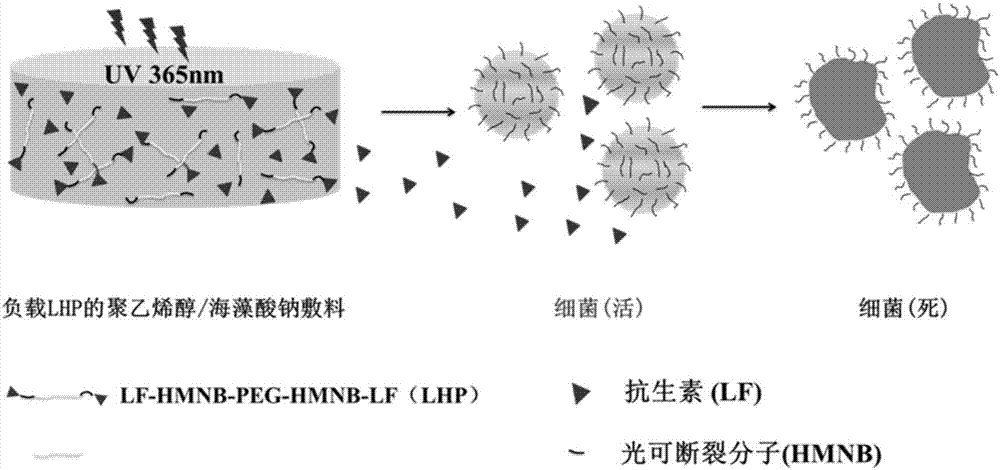
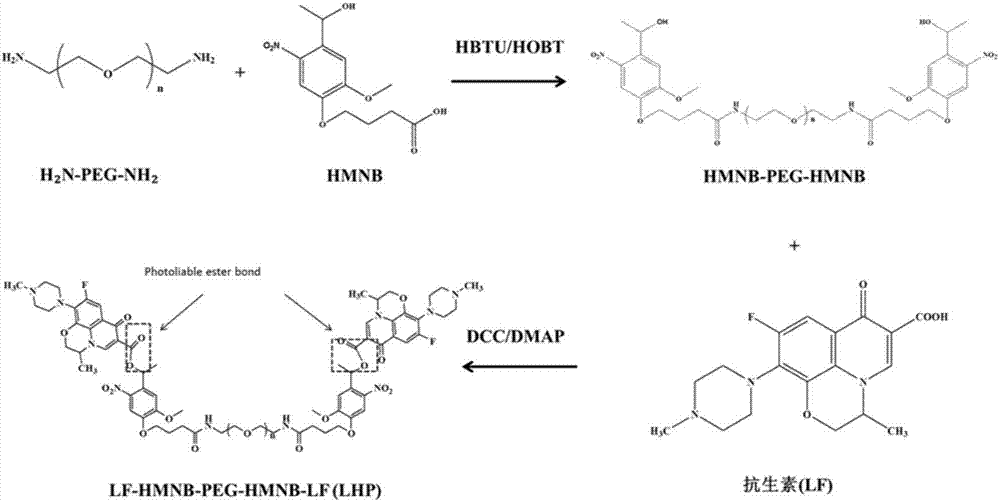
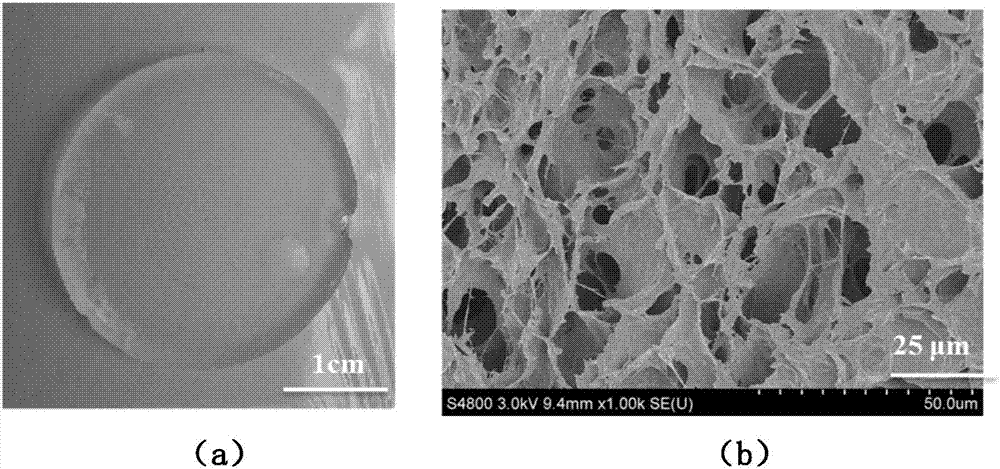
Examples
example 1
[0026] a) Synthesis of UV-cleavable macromolecular drugs
[0027] Take 0.3g (1mmol) HMNB dissolved in 4ml of methylpyrrolidone and heat it ultrasonically to make it fully dissolved, and pass through N 2 Purify for 10 minutes, add 0.41g (1.08mmol) HBTU, 0.146g (1.08mmol) HOBT, 0.25g (1.97mmol) DIEA, ultrasonically disperse, dissolve and stir for 5min, take 0.5g (0.1mmol) NH 2 -PEG5000-NH 2 Dissolve in 4ml of methylpyrrolidone, and add dropwise to the above solution, immediately vortex and heat the mixed solution until all the reagents are completely dissolved. React at room temperature overnight in the dark. After the reaction, the reaction solution was precipitated with glacial ether (the reaction solution was slowly added to 10 times the volume of glacial ether), centrifuged, and the precipitated product was washed with glacial ether again, and centrifuged twice. After vacuum drying, the obtained centrifuged product was redissolved in Centrifuge in deionized water to remov...
example 2
[0032] a) Synthesis of macromolecular drugs that can be broken by ultraviolet light Take 0.3g (1mmol) HMNB dissolved in 4ml of methylpyrrolidone and heat it so that it is fully dissolved by ultrasonic heating. 2 Purify for 10 minutes, add 0.41g (1.08mmol) HBTU, 0.146g (1.08mmol) HOBT, 0.25g (1.97mmol) DIEA, ultrasonically disperse, dissolve and stir for 5min, take 0.5g (0.1mmol) NH 2 -PEG5000-NH 2 Dissolve in 4ml of methylpyrrolidone and add dropwise to the above solution. Immediately vortex and heat the mixed solution until all reagents are completely dissolved. React at room temperature overnight in the dark. After the reaction, the reaction solution was precipitated with glacial ether (the reaction solution was slowly added to 10 times the volume of glacial ether), centrifuged, and the precipitated product was washed with glacial ether again, and centrifuged twice. After vacuum drying, the obtained centrifuged product was redissolved in Centrifuge in deionized water to re...
PUM
 Login to View More
 Abstract
Description
Claims
Application Information
 Login to View More