Rotation angle detecting device and dynamo-electric machine
A technology of rotation angle detection and rotation angle, which is applied in the direction of measuring devices, electromechanical devices, and electric/magnetic devices to transmit sensing components, etc., can solve the problems of rotation angle detection, lack of redundancy, etc., and achieve the goal of reducing the number of terminals Effect
- Summary
- Abstract
- Description
- Claims
- Application Information
AI Technical Summary
Problems solved by technology
Method used
Image



Examples
Embodiment approach 1
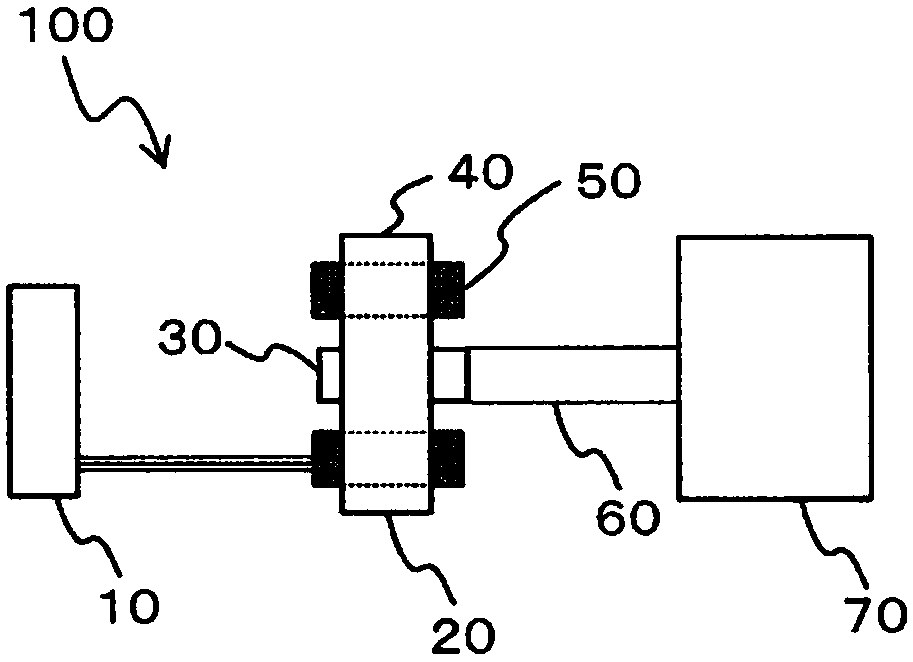
[0047] figure 2 It is a block diagram showing the rotation angle detection device according to Embodiment 1 of the present invention. exist figure 2 Among them, the resolver 20 has a first output winding 21 , a second output winding 22 , a third output winding 23 , a first field winding 24 , and a second field winding 25 , which are coils 50 wound around the teeth of the stator 40 .
[0048] The first output winding 21 , the second output winding 22 , and the third output winding 23 are connected to the angle calculator 10 via positive terminals Sa+, Sb+, Sc+ and negative terminals Sa−, Sb−, Sc−, respectively. The angle calculator 10 calculates and outputs the rotation angle of the rotor 30 from the output voltages generated in the three-phase output windings of the resolver 20 .
[0049] The first field winding 24 and the second field winding 25 are connected to the first field circuit 81 and the second field circuit 82 via positive terminals Ra+, Rb+ and negative termi...
Embodiment approach 2
[0119] Figure 11 It is an explanatory diagram showing the relationship between the number of turns of the first and second field windings and the number of teeth in the resolver of the rotation angle detection device according to Embodiment 2 of the present invention. exist Figure 11 In , the winding distribution of the field winding is shown. Furthermore, the number of turns of the field winding is normalized by the amplitude of the turns.
[0120] In addition, the resolver according to Embodiment 2 of the present invention has the same image 3 The shown resolver 20 has the same structure, and the number N of teeth 41 of the stator 40 s is 12, the number N of the salient poles 31 of the rotor 30 x for 5. In addition, in Embodiment 2 of the present invention, the number N of teeth 41 s Set to 12, the number of salient poles 31 N x Although it is assumed that 5 is used for description, it is not limited to the above-mentioned number, and the same effect can be obtaine...
Embodiment approach 3
[0129] Figure 13 It is a sectional view showing the resolver of the rotation angle detection device according to Embodiment 3 of the present invention. exist Figure 13 Among them, the two-phase field windings 24 and 25 and the three-phase output windings 21 to 23 are respectively wound around the teeth T1 to T12 of the stator 40 .
[0130] In addition, in Figure 13 The illustrated resolver 20 has a configuration in which two-phase field windings 24 and 25 are wound on the inner diameter side of the tooth portion 41 and three-phase output windings 21 to 23 are wound on the outer diameter side. At this time, any one of the first field winding 24 and the second field winding 25 may be wound first, and the first output winding 21 , the second output winding 22 , and the third output winding 23 may be wound in any order. In addition, the winding and the tooth portion 41 are insulated by an insulator formed of insulating paper, coating, or the like.
[0131] In Embodiment 3 o...
PUM
 Login to View More
 Abstract
Description
Claims
Application Information
 Login to View More