Unlock instant, AI-driven research and patent intelligence for your innovation.

A Method of Infrared Dim Small Target Detection Based on Tensor Robust Principal Component Analysis

A technology of principal component analysis and weak and small targets, which is applied in the field of infrared weak and small targets detection based on tensor robust principal component analysis, can solve the local optimal solution of nuclear norm and local structure weight, detect target distortion, and target detection accuracy Low-level problems, to achieve the effect of improving the ability to detect targets, suppressing the impact of detection accuracy, and maintaining the ability to maintain the shape of targets

Active Publication Date: 2021-11-02
UNIV OF ELECTRONICS SCI & TECH OF CHINA
View PDF6 Cites 0 Cited by
  • Summary
  • Abstract
  • Description
  • Claims
  • Application Information

AI Technical Summary

Problems solved by technology

[0009] The object of the present invention is: the present invention provides a kind of infrared dim and small target detection method based on tensor robust principal component analysis, solves the nuclear norm and local structure weight adopted in existing method and easily causes local optimum solution and detection The target is distorted, which leads to the problem of low target detection accuracy

Method used

the structure of the environmentally friendly knitted fabric provided by the present invention; figure 2 Flow chart of the yarn wrapping machine for environmentally friendly knitted fabrics and storage devices; image 3 Is the parameter map of the yarn covering machine
View more

Image

Smart Image Click on the blue labels to locate them in the text.
Viewing Examples
Smart Image
  • A Method of Infrared Dim Small Target Detection Based on Tensor Robust Principal Component Analysis
  • A Method of Infrared Dim Small Target Detection Based on Tensor Robust Principal Component Analysis
  • A Method of Infrared Dim Small Target Detection Based on Tensor Robust Principal Component Analysis

Examples

Experimental program
Comparison scheme
Effect test

Embodiment 1

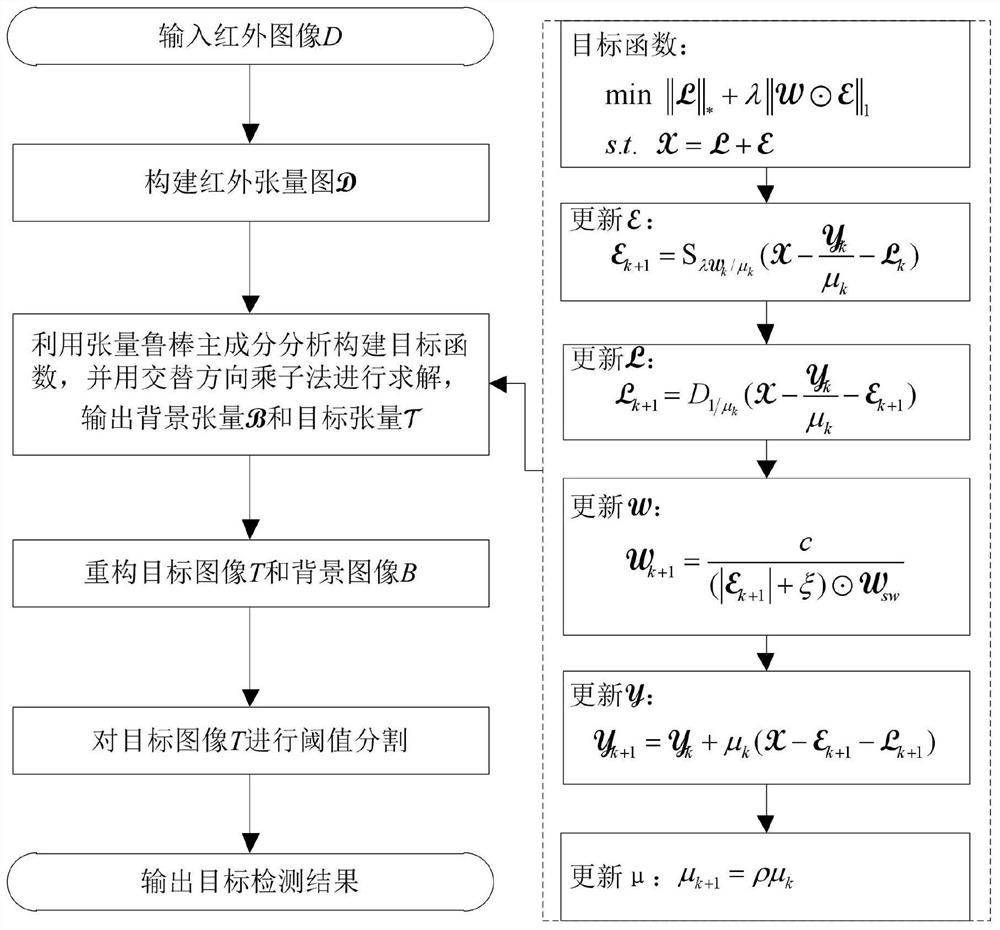
[0169] Such as Figure 1-16 As shown, a method for detecting small infrared targets based on tensor robust principal component analysis includes the following steps:

[0170] Step 1: Use the sliding window to traverse the original image to construct a third-order tensor;

[0171] Step 2: Calculate the second-order structure tensor of the original image, and construct the structure weight tensor according to the second-order structure tensor;

[0172] Step 3: Use the tensor robust principal component analysis to construct the objective function, input the third-order tensor and the structural weight tensor into the objective function, and use the alternating direction multiplier method to solve the objective function to obtain the background tensor and the target tensor;

[0173] Step 4: Reconstruct the background image and target image according to the background tensor and target tensor;

[0174] Step 5: Carry out adaptive threshold segmentation on the target image to deter...

Embodiment 2

[0177] Based on embodiment 1, step 1 includes the following steps:

[0178] Step 1.1: Acquire the infrared image D∈R to be processed m×n , with a size of 240×320;

[0179] Step 1.2: Use a sliding window w with a size of 50×50 to traverse the original image D with a step size of 50, and use the matrix with a size of 50×50 in each sliding window w as a frontal slice;

[0180] Step 1.3: Repeat step 1.2 according to the number of window slides until the traversal is complete, and form all frontal slices into a new tensor

[0181] Such as figure 2 As shown in , it represents an infrared image with a complex background, in addition to weak and small targets, there are also high-brightness white false alarm sources; for example image 3 As shown, it represents the third-order tensor constructed from the original image after step 1

[0182] Step 2.1: Compute the structure tensor J of D ρ ∈R 480×640 :

[0183]

[0184] Among them, K 2 Indicates the Gaussian kernel funct...

Embodiment 3

[0196] Based on embodiment 1 or 2, step 3 includes the following steps:

[0197] Step 3.1: Input the third-rank tensor and structure weight tensor Combining tensor kernel norm and tensor l 1 Norm, build the objective function;

[0198] Step 3.2: and After inputting the objective function, use the alternate direction multiplier method to solve the objective function and solve the background tensor and the target tensor

[0199] Step 3.1 includes the following steps:

[0200] Step 3.1.1: Assume a third rank tensor from low-rank tensors and sparse tensors composed of separate with Build the objective function as follows:

[0201]

[0202]

[0203] Among them, λ represents the balance coefficient, ||·|| * Indicates the tensor nuclear norm, ||·|| 1 represents the tensor l 1 norm,

[0204] Step 3.1.2: Order express The result of doing discrete Fourier transform (Discrete FourierTransform, DFT) along the third dimension, the n 3 frontal slices a...

the structure of the environmentally friendly knitted fabric provided by the present invention; figure 2 Flow chart of the yarn wrapping machine for environmentally friendly knitted fabrics and storage devices; image 3 Is the parameter map of the yarn covering machine
Login to View More

PUM

No PUM Login to View More

Abstract

The invention discloses an infrared weak and small target detection method based on tensor robust principal component analysis, which relates to the field of infrared image processing and target detection; it includes step 1: traversing the original image to construct a third-order tensor; step 2: calculating the original image The second-order structure tensor, and construct the structure weight tensor; Step 3: Use the tensor robust principal component analysis to construct the objective function, input the third-order tensor and the structure weight tensor into the objective function, and use ADMM to solve the objective function to obtain the background Tensor and target tensor; step 4: reconstruct the background image and the target image according to the background tensor and the target tensor; step 5: segment the target image and output the target detection result; the present invention solves the problem of kernels used in existing methods Norm and local structure weights are easy to cause local optimal solution and detection target distortion, which leads to the problem of low target detection accuracy, and achieves the effect of improving target detection and background suppression capabilities, and enhancing target shape retention capabilities.

Description

technical field [0001] The invention relates to the field of infrared image processing and target detection, in particular to an infrared weak and small target detection method based on tensor robust principal component analysis. Background technique [0002] Infrared imaging technology has the characteristics of non-contact and strong ability to capture details, and is not affected by obstacles such as smoke and fog to achieve continuous long-distance target detection day and night; Infrared search and track IRST (Infrared search and track) system is used in military, It has been widely used in civil and other fields. As a basic function of the IRST system, infrared weak and small target detection technology is of great significance in infrared search, infrared early warning, and long-distance target detection. However, due to the lack of texture and structure information of the target in the infrared band, and the influence of long-distance, complex background, and various...

Claims

the structure of the environmentally friendly knitted fabric provided by the present invention; figure 2 Flow chart of the yarn wrapping machine for environmentally friendly knitted fabrics and storage devices; image 3 Is the parameter map of the yarn covering machine
Login to View More

Application Information

Patent Timeline
no application Login to View More
Patent Type & Authority Patents(China)
IPC IPC(8): G06K9/32
CPCG06V10/255
Inventor 张兰丹彭真明刘雨菡宋立李美惠曹思颖彭凌冰黄苏琦何艳敏赵学功杨春平
Owner UNIV OF ELECTRONICS SCI & TECH OF CHINA