Check patentability & draft patents in minutes with Patsnap Eureka AI!

A kind of synthetic method of 1,4-diaminoanthraquinone

A technology of diaminoanthraquinone and synthesis method, which is applied in the field of synthesis of 1,4-diaminoanthraquinone, can solve the problems of high price, high toxicity of hydrazine hydrate, difficult treatment of waste acid and high-salt wastewater, and achieve production cost The effect of low, high economic value

Active Publication Date: 2020-10-02
XIAMEN UNIV
View PDF1 Cites 0 Cited by
  • Summary
  • Abstract
  • Description
  • Claims
  • Application Information

AI Technical Summary

Problems solved by technology

However, the disadvantage of this method is that a large amount of high COD, high salt wastewater and high COD waste acid are produced, and the treatment of waste acid and high salt wastewater is difficult.
[0003] Chinese patent CN108395381A discloses a preparation method of 1,4-diaminoanthraquinone leuco. The method uses 1,4-dihydroxyanthraquinone as a raw material, mixes it with hydrazine hydrate and an organic solvent, and reacts at a reaction pressure of 0.2 to 0.5 MPa. , at a reaction temperature of 50-100°C, react with ammonia to prepare 1,4-diaminoanthraquinone leuco. The disadvantage of this method is that hydrazine hydrate is highly toxic and expensive

Method used

the structure of the environmentally friendly knitted fabric provided by the present invention; figure 2 Flow chart of the yarn wrapping machine for environmentally friendly knitted fabrics and storage devices; image 3 Is the parameter map of the yarn covering machine
View more

Image

Smart Image Click on the blue labels to locate them in the text.
Viewing Examples
Smart Image
  • A kind of synthetic method of 1,4-diaminoanthraquinone

Examples

Experimental program
Comparison scheme
Effect test

Embodiment 1

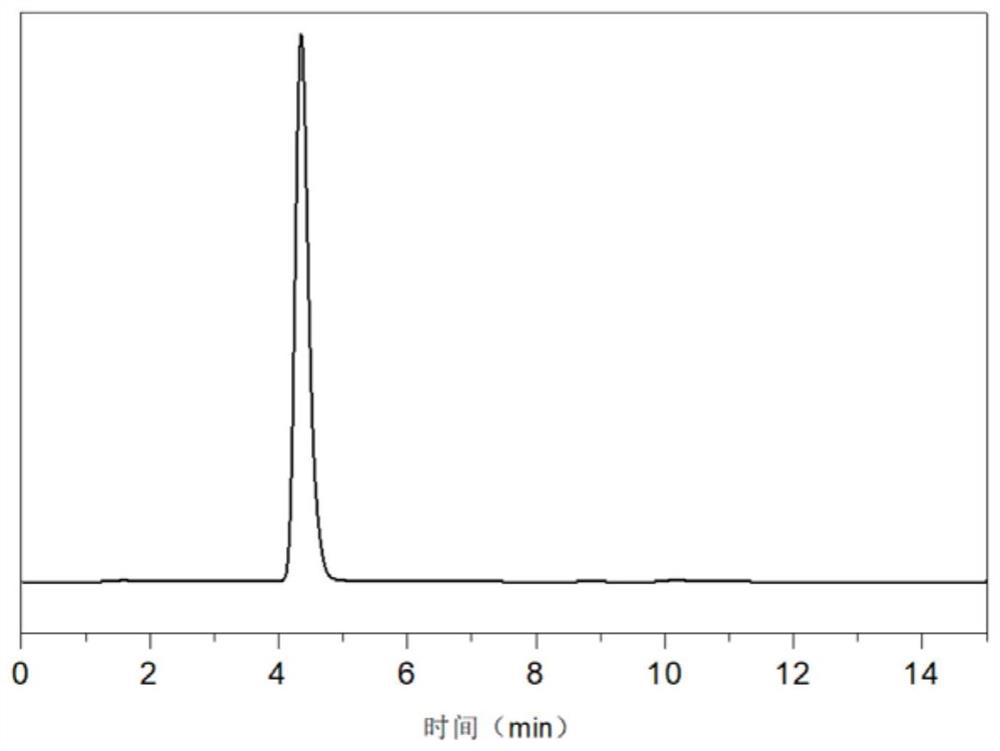
[0021] Add 8g of 1,4-dihydroxyanthraquinone, 100mL of toluene and 0.6g of Pd with a palladium content of 1% into a 500mL autoclave 10 Ru 1 / C catalyst, the catalytic hydrogenation reaction is carried out under the conditions of the reaction temperature of 40°C and the reaction pressure of 1.0MPa. After the reaction is completed, the catalyst is filtered to obtain the hydrogenation liquid. The hydrogenation solution reacts with ammonia for 2 hours. After the reaction, excess ammonia is discharged. After heating and evaporating toluene, the 1,4-diaminoanthraquinone leuco is obtained, and then the 1,4-diaminoanthraquinone leuco is obtained in the air. The 1,4-diaminoanthraquinone was obtained after the color body was heated for 1 hour. HPLC analysis product purity 98.3%, calculated yield is 95%, as figure 1 shown.

Embodiment 2

[0023] 10g of 1,4-dihydroxyanthraquinone, 200mL of ethanol and 1.0g of Pd with a palladium content of 1% were put into a 500mL autoclave 1 Ru 1 / C catalyst, the catalytic hydrogenation reaction is carried out under the conditions of the reaction temperature of 90°C and the reaction pressure of 0.4MPa. After the reaction is completed, the catalyst is filtered to obtain the hydrogenation liquid. The hydrogenation solution reacts with ammonia for 4 hours. After the reaction, excess ammonia is discharged. After heating and evaporating ethanol, the 1,4-diaminoanthraquinone leuco is obtained, and then the 1,4-diaminoanthraquinone leuco is obtained in the air. The 1,4-diaminoanthraquinone was obtained after the color body was heated for 1 hour. The purity of the product analyzed by HPLC was 96.7%, and the calculated yield was 96%.

Embodiment 3

[0025] Put 40g of 1,4-dihydroxyanthraquinone, 300mL of toluene and 2g of PdRu with a palladium content of 1% into a 1000mL autoclave 2 / C catalyst, the catalytic hydrogenation reaction is carried out at a reaction temperature of 60°C and a reaction pressure of 0.6MPa. After the reaction is completed, the catalyst is filtered to obtain a hydrogenation liquid. Under the conditions of a reaction temperature of 60°C and a reaction pressure of 0.6MPa, The hydrogenation solution reacts with ammonia for 1 hour. After the reaction, the ammonia gas is discharged. After heating and evaporating toluene, the 1,4-diaminoanthraquinone leuco is obtained, and then the 1,4-diaminoanthraquinone leuco is obtained in the air. After heating for 3 hours, 1,4-diaminoanthraquinone was obtained. The purity of the product analyzed by HPLC was 97.2%, and the calculated yield was 96%.

the structure of the environmentally friendly knitted fabric provided by the present invention; figure 2 Flow chart of the yarn wrapping machine for environmentally friendly knitted fabrics and storage devices; image 3 Is the parameter map of the yarn covering machine
Login to View More

PUM

PropertyMeasurementUnit
sizeaaaaaaaaaa
Login to View More

Abstract

The invention discloses a green synthesis method of 1, 4-diamino-anthraquinone, and relates to the technical field of chemical synthesis. The method comprises the following steps of hydrogenation: carrying out catalytic hydrogenation reaction taking 1, 4-diamino-anthraquinone as a raw material, taking a Pd Ru bimetallic catalyst loaded by active carbon as a hydrogenation catalyst, in the presenceof an organic solvent to obtain hydrogenation liquid; performing ammoniation: reacting the obtained hydrogenation liquid with ammonia gas, discharging the ammonia gas after the reaction is finished, and evaporating the solvent to obtain the 1, 4-diamino-anthraquinone leuco body; oxidation: heating and reacting the 1, 4-diamino-anthraquinone leuco body to obtain 1, 4- diamino-anthraquinone. By adopting the nano hydrogenation reduction process, the synthesis process has the advantages of no generation of high COD, high salt wastewater or waste acid and environmental protection. The hydrogenationcatalyst can be used repeatedly, the reaction solvent can be recovered, and the production cost is low. The purity of the product is more than or equal to 97 percent, the yield is more than or equalto 95 percent, and the economic value is high.

Description

technical field [0001] The invention relates to chemical synthesis, in particular to a synthesis method of 1,4-diaminoanthraquinone. Background technique [0002] 1,4-Diaminoanthraquinone is an important intermediate in the synthesis of dyes and is widely used in the production of disperse dyes, vat dyes and acid dyes. The key step is the synthesis of 1,4-diaminoanthraquinone leucosome. At present, the widely synthesized method in industry is to use 1,4-dihydroxyanthraquinone as a raw material, and react with ammonia water in one step in the presence of sodium hydrosulfite or hydrazine hydrate to generate 1,4-diaminoanthraquinone leucosome, and then pass through Oleum oxidation produces 1,4-diaminoanthraquinone. However, the disadvantage of this method is that a large amount of high-COD, high-salt wastewater and high-COD waste acid are produced, and the treatment of waste acid and high-salt wastewater is difficult. [0003] Chinese patent CN108395381A discloses a preparat...

Claims

the structure of the environmentally friendly knitted fabric provided by the present invention; figure 2 Flow chart of the yarn wrapping machine for environmentally friendly knitted fabrics and storage devices; image 3 Is the parameter map of the yarn covering machine
Login to View More

Application Information

Patent Timeline
no application Login to View More
Patent Type & Authority Patents(China)
IPC IPC(8): C07C221/00C07C225/34
Inventor 郑南峰汪小楚刘圣杰陈洁
Owner XIAMEN UNIV
Features
  • R&D
  • Intellectual Property
  • Life Sciences
  • Materials
  • Tech Scout
Why Patsnap Eureka
  • Unparalleled Data Quality
  • Higher Quality Content
  • 60% Fewer Hallucinations
Social media
Patsnap Eureka Blog
Learn More