Array sensor for detecting pesticide residues, and preparation method and application of array sensor
An array sensor and pesticide residue technology, applied in the field of analytical chemistry, can solve problems such as powerlessness and no strong interaction, and achieve the effects of simple production process, wide range of detection objects and low cost
- Summary
- Abstract
- Description
- Claims
- Application Information
AI Technical Summary
Problems solved by technology
Method used
Image

Examples
preparation example Construction
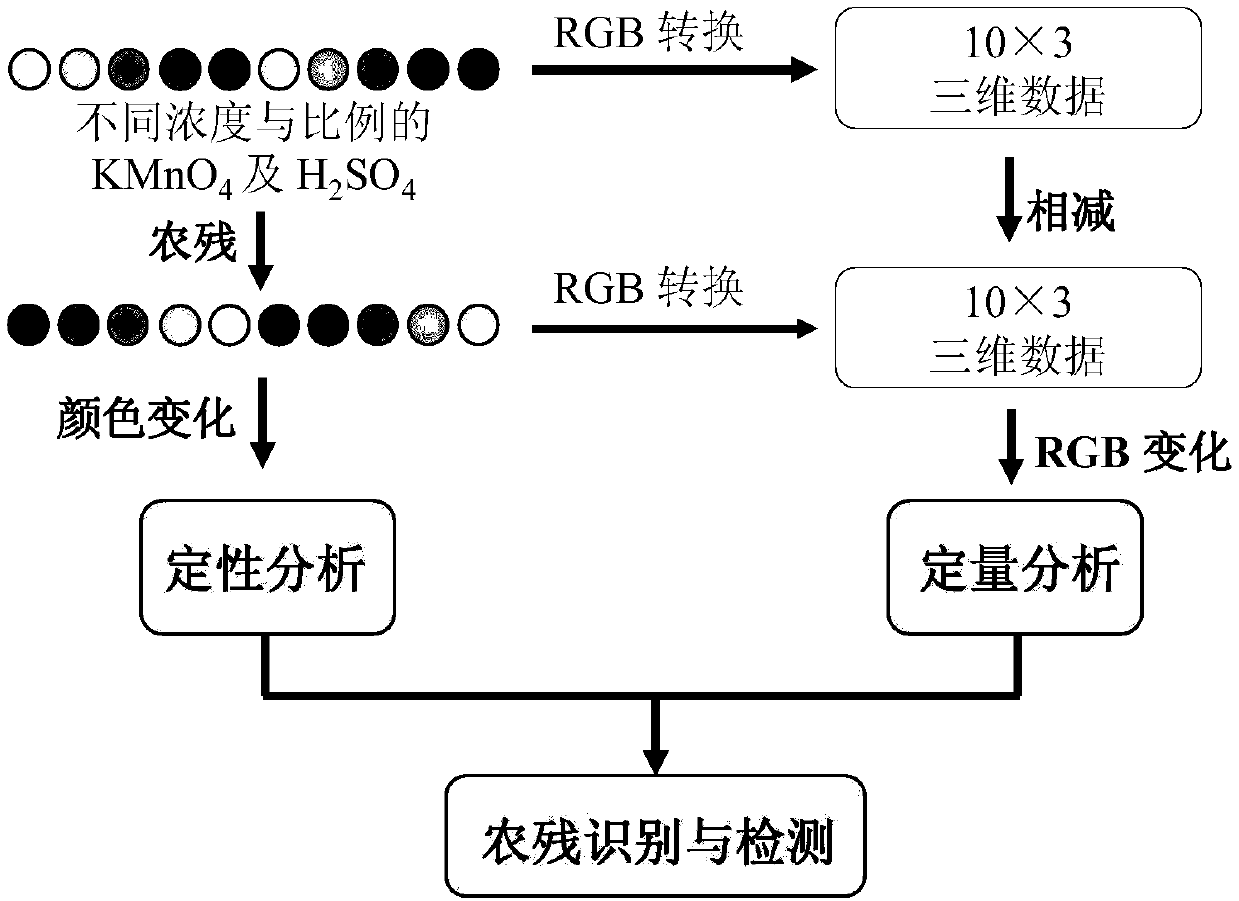
[0027] As an aspect of the technical solution of the present invention, it relates to a method for preparing an array sensor for detecting pesticide residues, which includes:
[0028] Provide a series of uniform mixed systems containing different concentrations of potassium permanganate and / or potassium dichromate and sulfuric acid as the detection solution;
[0029] Each detection solution is respectively placed in each sensing unit of the array sensor to prepare an array sensor for detecting pesticide residues.
[0030] In one embodiment, the concentration of potassium permanganate or potassium dichromate in the detection solution ranges from 0.01 to 0.1 mMol / L.
[0031] Further, the concentration of sulfuric acid in the detection solution ranges from 0.1 to 1.0 Mol / L.
[0032] Further, the molar ratio of potassium permanganate and / or potassium dichromate to sulfuric acid in the detection solution ranges from 0.00001 to 0.001:1.
[0033] Further, there are 2 to 10 sensing ...
Embodiment 1
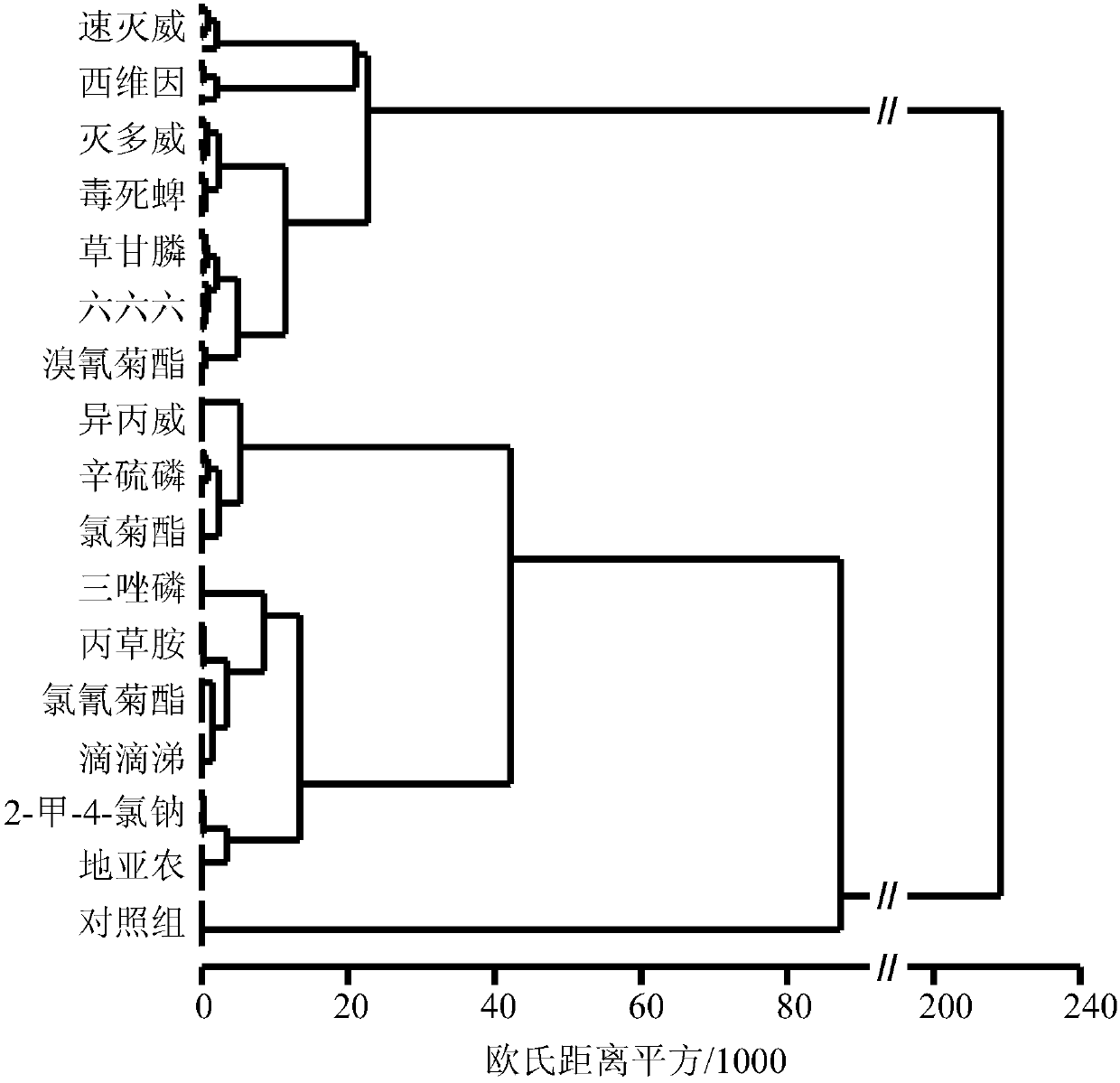
[0050] Embodiment 1 realizes the identification and distinction to multiple pesticide residues
[0051] Standard solutions of the same concentration and different pesticide residues are respectively added to each sensing unit of the array sensor and mixed with the detection solution therein. The sensing units of the array sensor for detecting pesticide residues are mixed with different pesticide residues Different color changes were produced after the reaction, and the color changes of each mixed reaction system were read by a scanner; the color changes read by the scanner were digitally processed by Photoshop software to obtain the RGB values corresponding to the front and rear images of different sensing units, and the The RGB value of the image after the reaction is subtracted from the RGB value of the image before the reaction, and the △R, △G and △B values of the subtraction image are extracted, and the experiment is paralleled 5 times; then a series of △R, △G and △B va...
Embodiment 2
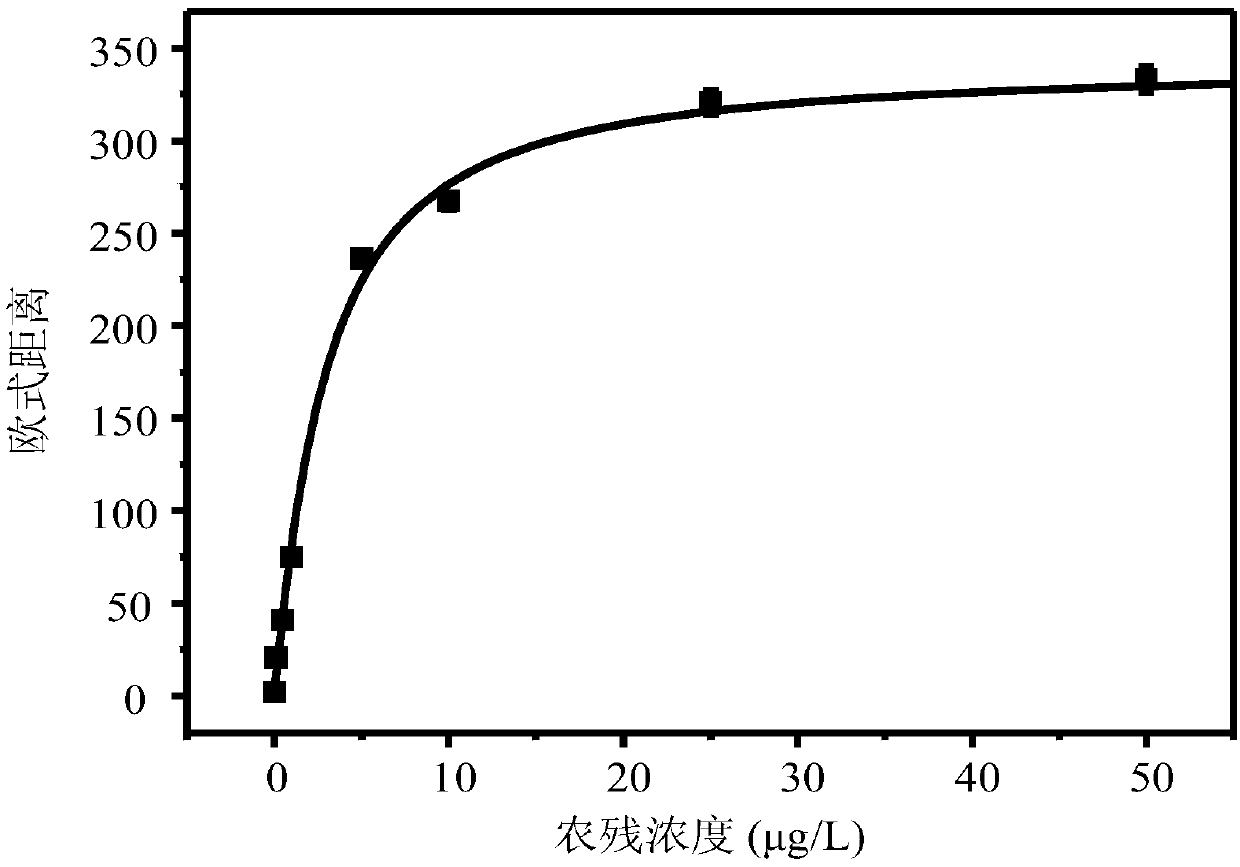
[0052] The establishment of embodiment 2 pesticide residue standard fitting curve
[0053] A series of standard solutions containing different concentrations of pesticide residues were added to each sensing unit of the array sensor and mixed with the detection solution therein, and a certain volume was put into a 96-well plate, which was used to detect pesticide residues The sensing unit of the array sensor reacts with the pesticide residues to produce different color changes, and the color changes of each mixed reaction system are read by a scanner; the color changes read by the scanner are digitally processed by Photoshop software, and different color changes are obtained. The RGB values corresponding to the front and rear images of the sensing unit are subtracted from the RGB values of the post-reaction image by the RGB values of the pre-reaction image to extract the △R, △G and △B values of the subtracted image, and the △R, △G and △B The value is converted into the ...
PUM
 Login to View More
 Abstract
Description
Claims
Application Information
 Login to View More
 - R&D
- Intellectual Property
- Life Sciences
- Materials
- Tech Scout
- Unparalleled Data Quality
- Higher Quality Content
- 60% Fewer Hallucinations
Browse by: Latest US Patents, China's latest patents, Technical Efficacy Thesaurus, Application Domain, Technology Topic, Popular Technical Reports.
© 2025 PatSnap. All rights reserved.Legal|Privacy policy|Modern Slavery Act Transparency Statement|Sitemap|About US| Contact US: help@patsnap.com