Aero-engine nonlinear model modeling method

A nonlinear model, aero-engine technology, which is applied in the field of aero-engines and can solve problems such as large changes in aero-engine operating conditions and working ranges.

CN110222401APending Publication Date: 2019-09-10FUDAN UNIV
3 Cites 34 Cited by

Patent Information

Authority / Receiving Office
CN · China
Current Assignee / Owner
Publication Date
2019-09-10

Smart Images

  • Figure 1
    Figure 1
  • Figure 2
    Figure 2
  • Figure 3
    Figure 3
Patent Text Reader

Abstract

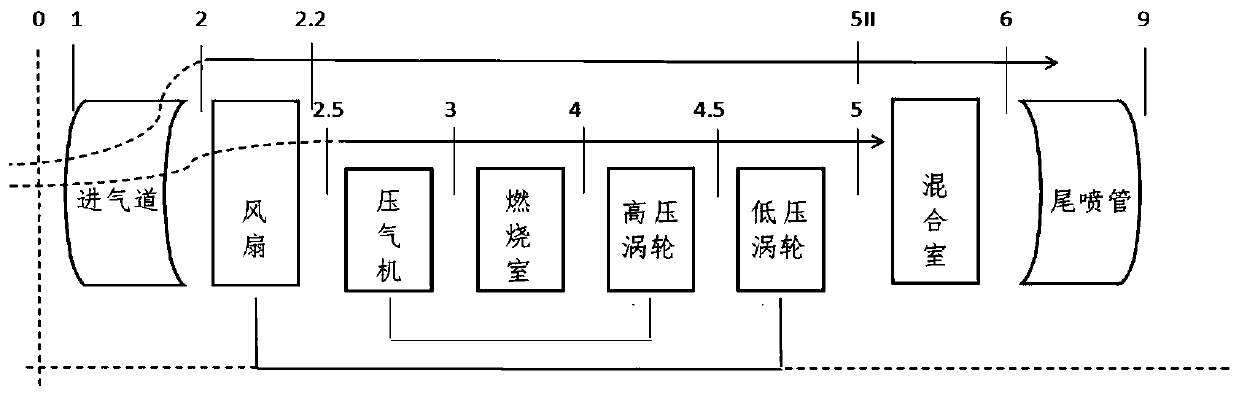
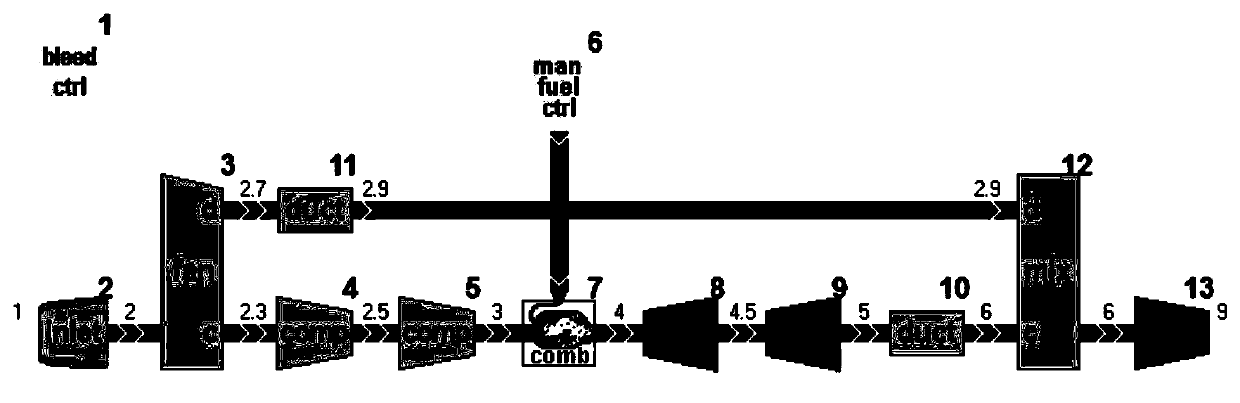
The invention belongs to the technical field of aero-engines, and particularly relates to an aero-engine nonlinear model modeling method. The method comprises the following steps: calculating an engine design point nonlinear model, and calculating a transmitter transition state nonlinear model; the method comprises the steps that an engine subsection model is established, and the model is mainly divided into an air inlet channel, a fan, a gas compressor, a combustion chamber, a turbine and an exhaust port according to the structure and function of an aero-engine; describing the aerothermodynamic law obeyed by each component during working by using a nonlinear equation in sequence, and establishing a component-level model of an aeroengine design point; the latter assumes that the characteristics of the parts in the transition state are the same as those in the steady state, and the volume effect of the parts is considered in numerical simulation in the transition state; only the volumetric effect of parts with large volumes is considered in calculation, and meanwhile momentum conservation is simplified to be replaced by the total pressure recovery coefficient of the channel, so thatenough engineering precision can be ensured, and calculation is greatly simplified.
Need to check novelty before this filing date? Find Prior Art

Description

technical field

[0001] The invention belongs to the technical field of aero-engines, and in particular relates to an aero-engine modeling method. Background technique

[0002] An aero engine is a device that provides power to an aircraft, also known as an aero propulsion system. The development process of aero-engines is long and expensive, and all countries are actively seeking low-cost and high-efficiency research and development solutions. Computer numerical simulation technology is one of the main ways to solve this problem. Establishing an accurate mathematical model of an aero-engine for performance simulation, or for further verification of control law design and optimization of analysis algorithms can greatly reduce test costs and shorten development cycles. In addition, the existing engine numerical models also need to be improved and upgraded accordingly with the overall progress of the technological level and the improvement of use requirements. Therefore, engi...

Examples

Embodiment Construction

[0339] 1. Engine simulation platform

[0340] Foreign countries that started research and development of aero-engines earlier have been conducting research on engine modeling and simulation technology. The engine model has also advanced from the early simple first-order linear differential equations to complex nonlinear dynamic real-time simulation models. In recent years, there have also been some engine synthesis The simulation platform (or simulation software, simulation system) is developed and used. The aero-engine simulation platform needs to be based on a strong engine industry, based on a large number of tests and a comprehensive database, and built on the basis of repeated revisions. It is also a reflection of a country or team's engine research technology reserves. Typical platforms currently include: GSP (Gas Turbine Simulation Program) of the Netherlands Aerospace Laboratory (NLR), CGTES (Computer Gas Turbofan Engine Simulator) of the Russian Central Aviation Engin...