
Method for producing laminate and co-extruded sheet
A manufacturing method and a technology for a laminate, which are applied in chemical instruments and methods, lamination, and layered products, etc., can solve the problems of easy peeling of the polycarbonate layer and not necessarily high polycarbonate adhesion.
- Summary
- Abstract
- Description
- Claims
- Application Information
AI Technical Summary
Problems solved by technology
Method used
Image

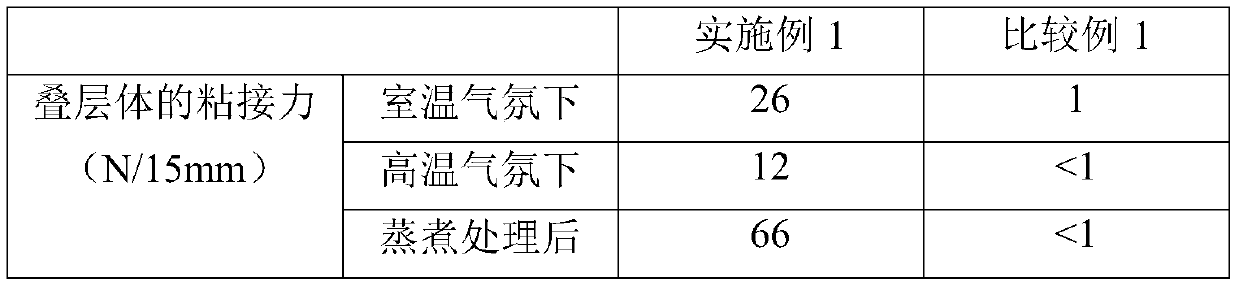
Examples
Embodiment 1 and comparative example 1
[0163]
[0164] 100 parts by weight of PP-1 were mixed with 1 part by weight of maleic anhydride (manufactured by Wako Pure Chemical Industries, Ltd., hereinafter abbreviated as MAH), 2,5-dimethyl-2,5-bis(tert-butylperoxy ) Hexyne-3 (manufactured by NOF Corporation, trade name PERHEXYN (registered trademark) 25B) 0.25 parts by weight, using a twin-screw kneader (manufactured by Nippon Steel Works, TEX-30, L / D: 40, Using a vacuum vent), extrude at a cylinder temperature of 220° C., a screw rotation speed of 200 rpm, and a discharge rate of 80 g / min to obtain a maleic acid-modified polypropylene (hereinafter abbreviated as MAH-PP-1). The density of MAH-PP-1 is 0.915g / cm 3 .
[0165] The obtained MAH-PP-1 was dissolved in xylene, and then the obtained xylene solution was poured into acetone to reprecipitate and purify MAH-PP-1. The amount of grafted maleic anhydride measured by FT-IR was 0.7% by weight.
[0166]
[0167] 90 parts by weight of PP-1, 10 parts by weight of MA...
PUM
| Property | Measurement | Unit |
|---|---|---|
| density | aaaaa | aaaaa |
| density | aaaaa | aaaaa |
| density | aaaaa | aaaaa |
Abstract
Description
Claims
Application Information
 Login to View More