Unlock instant, AI-driven research and patent intelligence for your innovation.

Method for detecting volatile oil components of different parts of wild and/or cultivated Notopterygium forbesii root

A broad-leaf Qiang live, volatile oil technology, applied in the field of detection, can solve problems such as analysis and detection of chemical components of volatile oil that have not yet been

Inactive Publication Date: 2019-12-31
CHENGDU UNIV OF TRADITIONAL CHINESE MEDICINE
View PDF3 Cites 0 Cited by
  • Summary
  • Abstract
  • Description
  • Claims
  • Application Information

AI Technical Summary

Problems solved by technology

At present, most of the studies on Notopterygium focus on cultivation techniques and chemical components, and there is no research report on the analysis and detection of the chemical components of the volatile oils in different parts of its cultivated and wild products.

Method used

the structure of the environmentally friendly knitted fabric provided by the present invention; figure 2 Flow chart of the yarn wrapping machine for environmentally friendly knitted fabrics and storage devices; image 3 Is the parameter map of the yarn covering machine
View more

Image

Smart Image Click on the blue labels to locate them in the text.
Viewing Examples
Smart Image
  • Method for detecting volatile oil components of different parts of wild and/or cultivated Notopterygium forbesii root
  • Method for detecting volatile oil components of different parts of wild and/or cultivated Notopterygium forbesii root
  • Method for detecting volatile oil components of different parts of wild and/or cultivated Notopterygium forbesii root

Examples

Experimental program
Comparison scheme
Effect test

Embodiment 1

[0034] Example 1 The method of the present invention for detecting volatile components in the rhizomes and roots of wild Notopterygium broadleaf

[0035] 1. Detection method

[0036] 1. Prepare the test product

[0037] Take 60g of rhizome and root powder of wild Notopterygium broadleaves, put it in a 1000mL round bottom flask, put a few pieces of broken porcelain, add 600mL of distilled water, shake and mix well, after cold immersion for 1h, connect the volatile oil tester and the reflux condenser to extract 8h;

[0038] Take 0.5ml of the extracted volatile oil and add 10ml of n-hexane to dilute, then add 2g of anhydrous sodium sulfate, let it stand for 24h, take the supernatant and pass it through a 0.22μm microporous membrane, put it into a sample bottle for use;

[0039] 2. Detection by GC-MS (gas chromatography-mass spectrometry)

[0040] Chromatographic column: Agilent HP-5MS type chromatographic column (30m×250μm×0.25μm);

[0041] Chromatographic conditions: tempera...

Embodiment 2

[0045] Example 2 The method of the present invention for detecting volatile components in wild Rhizome of Notopterygium broadleaf

[0046] 1. Detection method

[0047] 1. Prepare the test product

[0048] Take 60g of wild Rhizome Powder of Notopterygium broadleaves, put it in a 1000mL round bottom flask, put a few pieces of broken porcelain pieces, add 600mL of distilled water, shake and mix well, after cold soaking for 1h, connect the volatile oil detector and reflux condenser, extract for 8h;

[0049] Take 0.5ml of the extracted volatile oil and add 10ml of n-hexane to dilute, then add 2g of anhydrous sodium sulfate, let it stand for 24h, take the supernatant and pass it through a 0.22μm microporous membrane, put it into a sample bottle for use;

[0050] 2. Detection by GC-MS (gas chromatography-mass spectrometry)

[0051] With embodiment 1.

[0052] 2. Test results

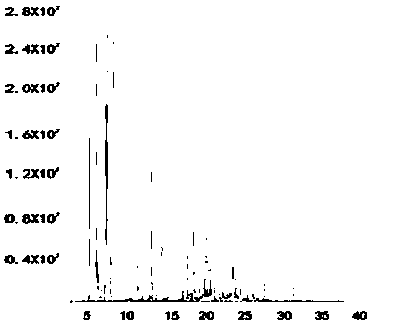
[0053] The total ion chromatogram is as figure 2 shown. Depend on figure 2 It can be seen that the ...

Embodiment 3

[0054] Example 3 The method of the present invention for detecting volatile components in the root of wild Rhizoma Rhizoma

[0055] 1. Detection method

[0056] 1. Prepare the test product

[0057]Take 60g of wild Rhizoma Rhizoma Rhizoma Rhizoma root powder, put it in a 1000mL round bottom flask, put a few pieces of broken porcelain pieces, add 600mL of distilled water, shake and mix well, after cold soaking for 1h, connect the volatile oil detector and reflux condenser, extract for 8h;

[0058] Take 0.5ml of the extracted volatile oil and add 10ml of n-hexane to dilute, then add 2g of anhydrous sodium sulfate, let it stand for 24h, take the supernatant and pass it through a 0.22μm microporous membrane, put it into a sample bottle for use;

[0059] 2. Detection by GC-MS (gas chromatography-mass spectrometry)

[0060] With embodiment 1.

[0061] 2. Test results

[0062] The total ion chromatogram is as image 3 shown. Depend on image 3 It can be seen that the abundance ...

the structure of the environmentally friendly knitted fabric provided by the present invention; figure 2 Flow chart of the yarn wrapping machine for environmentally friendly knitted fabrics and storage devices; image 3 Is the parameter map of the yarn covering machine
Login to View More

PUM

No PUM Login to View More

Abstract

The invention discloses a method for detecting volatile oil components of different parts of a wild and / or cultivated Notopterygium forbesii root. The method comprises the following steps: (1), preparing a test sample solution; to be specific; taking a notopterygium forbesii root sample, adding water, carrying out extraction, adding n-hexane into the extracting solution and carrying out mixing uniformly, adding anhydrous sodium sulfate, carrying out standing for 24 to 48 hours, and taking a supernate to obtain a test sample solution; and (2), carrying out detection; to be specific, carrying out detection by using gas chromatography-mass spectrometry method under the gas chromatography conditions of setting an initial temperature to be 60 DEG C, keeping the temperature for 2 min, rising thetemperature to reach 200 DEG C at a rate of 5 DEG C / min, rising the temperature to reach 280 DEG C at a rate of 20 DEG C / min, and keeping the temperature for 5 min. According to the invention, effective separation, extraction and detection of volatile components in different types and parts of the notopterygium forbesii roots can be realized; and whether the Notopterygium forbesii root is wild one or cultivated one can be identified by characteristic components and the source parts can be identified. Therefore, the method has the practical popularization and application values.

Description

technical field [0001] The invention belongs to the detection field, and in particular relates to a method for detecting volatile oil components in different parts of wild and / or cultivated Notopterygium broadleaves. Background technique [0002] Notopterygium comes from the dry rhizomes and roots of Notopterygium incisum Ting ex H.T.Chang or Notopterygium franchetii H.de Boiss. of the Umbelliferae plant. It is mainly distributed in plateau areas such as northwest Sichuan, Qinghai, Gansu, and eastern Tibet. Chinese and Tibetan medicinal materials, recorded in successive editions of the Chinese Pharmacopoeia, have the effects of relieving exterior cold, expelling wind and dampness, and relieving pain. Modern pharmacological studies have shown that the volatile oil of Notopterygium broadleaf has anti-inflammatory, analgesic, anti-inflammatory and myocardial ischemia effects, and is often used clinically to treat symptoms such as wind-cold cold, rheumatic arthralgia, and headac...

Claims

the structure of the environmentally friendly knitted fabric provided by the present invention; figure 2 Flow chart of the yarn wrapping machine for environmentally friendly knitted fabrics and storage devices; image 3 Is the parameter map of the yarn covering machine
Login to View More

Application Information

Patent Timeline
no application Login to View More
Patent Type & Authority Applications(China)
IPC IPC(8): G01N30/02G01N30/06
CPCG01N30/02G01N30/06
Inventor 蒋桂华唐国琳黄凤陈孝雨刘晓芬高天元王潇霖连艳吴情梅
Owner CHENGDU UNIV OF TRADITIONAL CHINESE MEDICINE