
Greenhouse intelligent decision-making method based on rough set theory and D-S evidence theory
A technology based on rough set theory and evidence theory, which is applied in the field of intelligent decision-making in greenhouses based on rough set theory and D-S evidence theory, and can solve problems such as delay, difficulty, and cross-connection.
- Summary
- Abstract
- Description
- Claims
- Application Information
AI Technical Summary
Problems solved by technology
Method used
Image


Examples
Embodiment 1
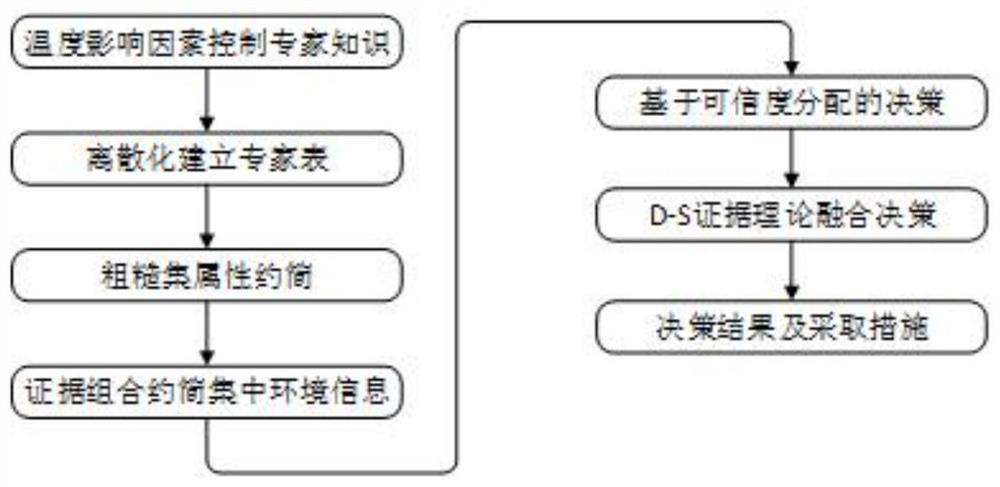
[0076] According to the specific influencing factors information of the selected greenhouses in Northwest China, the expert knowledge table of greenhouse influencing factors control is obtained, as shown in Table 1. There are a total of 12 groups of samples, each group of samples has 6 greenhouse influencing factors and passed 6 The only decision result is judged by the influencing factors. The greenhouse influencing factors are composed of six factors: temperature, humidity, light intensity, soil temperature, soil humidity, and carbon dioxide volume fraction. The decision results include 4 categories such as 1, 2, 3, and 4. , which are to open the roll film, open the roll film and start the fan, start the fan and the cooling curtain, and do not act. The data in Table 1 contain greenhouse impact factor indicators and corresponding decision-making results, but it is difficult for users to understand the information contained in the greenhouse impact factor data, so it is difficu...
Embodiment 2
[0084] According to the attribute reduction algorithm based on information entropy, formulate its domain of discourse, conditional attributes of temperature influencing factors and decision result set, calculate the kernel of temperature influencing factor conditional attributes relative to decision results, and reduce the attributes of the kernel to obtain the reduction The simplified data paved the way for the fusion of D-S evidence theory.
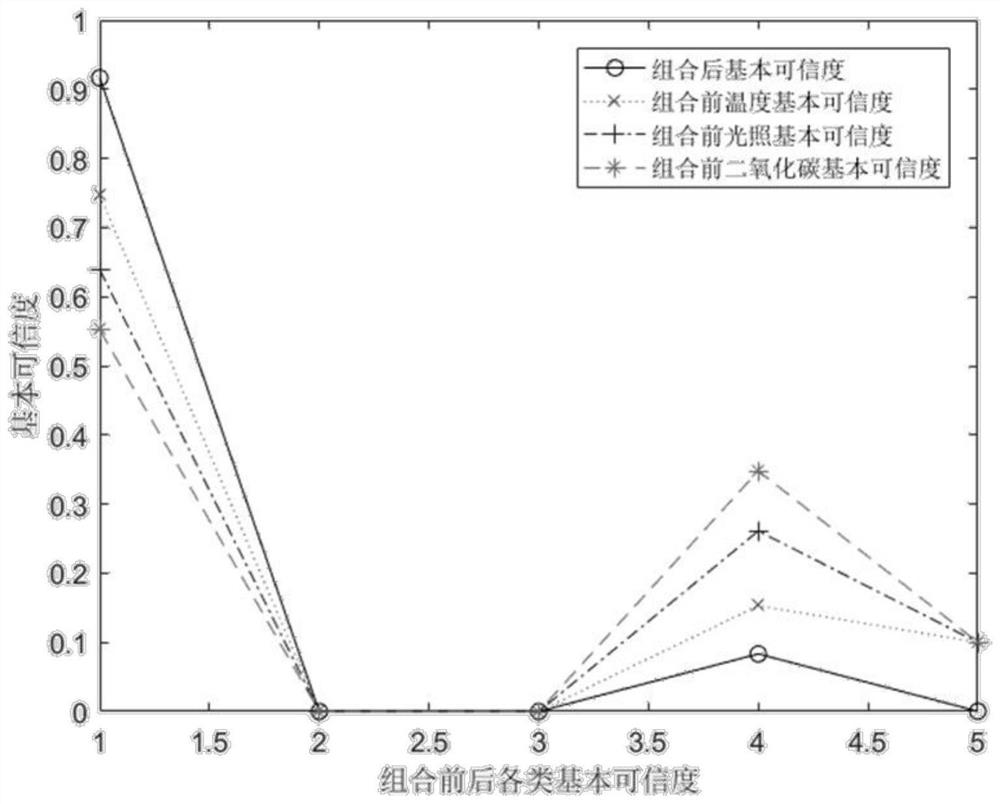
[0085] In the decision-making of intelligent control of greenhouse influencing factors, the influencing factors in the whole framework indicate which control method should be adopted. Therefore, for Table 1, the entire framework can be written as {L(k), k=1, 2, 3, 4}, where k is the result of 4 kinds of decisions. The basic credibility distribution function under the power set of the greenhouse influencing factors control decision recognition framework represents the support degree of the greenhouse influencing factors information for var...
Embodiment 3
[0104] The SVM algorithm for small-sample machine learning is selected for comparison with the decision-making method based on rough sets and D-S evidence theory.
PUM
 Login to View More
 Abstract
Description
Claims
Application Information
 Login to View More