Realization of DC Motor Angle Control Circuit under Low Line Count Grating Based on FPGA

A technology of angle control and DC motor, which is applied in the direction of DC motor speed/torque control, control system, electrical components, etc. It can solve the problems of low control precision, poor adaptability, and high cost of high-precision control devices for low-line gratings. Save hardware resources, low cost, and improve the effect of angle control accuracy

CN112910337BActive Publication Date: 2022-08-09XI AN JIAOTONG UNIV
5 Cites 0 Cited by

Patent Information

Authority / Receiving Office
CN · China
Patent Type
Patents(China)
Current Assignee / Owner
Publication Date
2022-08-09

Smart Images

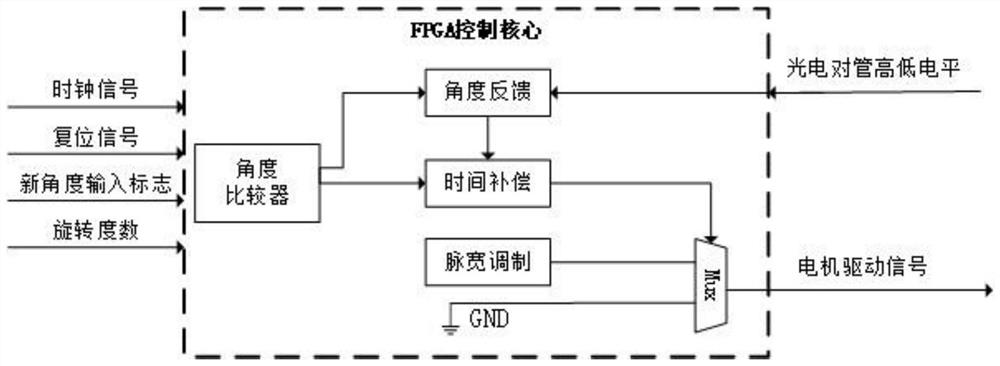
  • Figure 1
    Figure 1
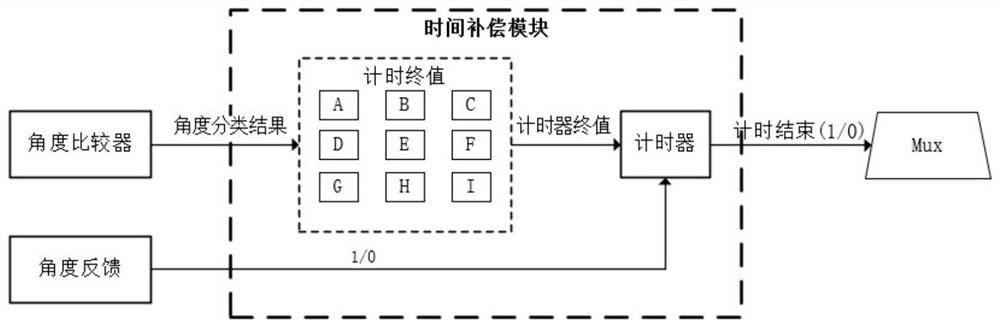
  • Figure 2
    Figure 2
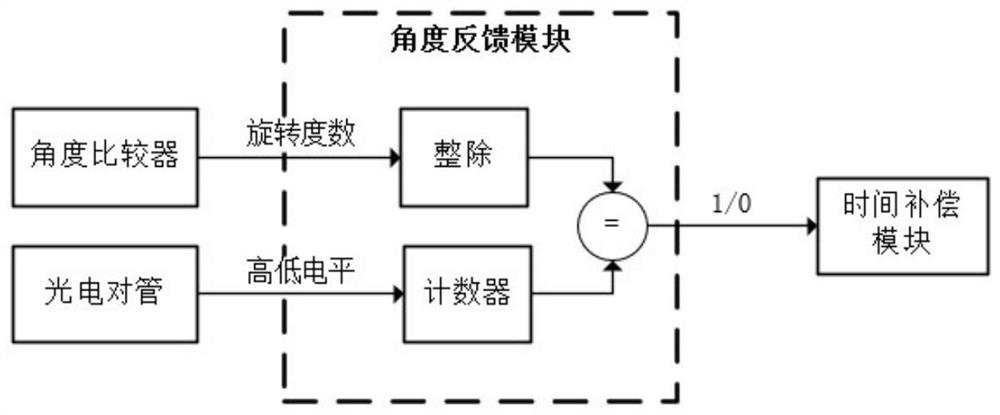
  • Figure 3
    Figure 3
Patent Text Reader

Abstract

The invention realizes the DC motor angle control circuit under the condition of low-line grating based on FPGA, including the FPGA control core, as the core processor of the angle control circuit, and is composed of an angle comparator, an angle feedback module and a time compensation module; the angle comparator, It is used to determine the type of the current angle, and transmit the angle type to the time compensation module; at the same time, the angle comparator synchronizes the rotation degree with the system clock through the register and inputs it to the angle feedback module; the angle feedback module is used to calculate the rotation required by the external grating. The number of lines passed, and according to the number of high levels returned by the photoelectric tube to calculate whether the rotation angle has reached the calculated threshold; the time compensation module is used for the angle category result obtained from the angle comparator. When the angle feedback module finishes working, The time compensation module performs corresponding time compensation on different types of angles to obtain the final angle rotation result. The invention realizes the angle control with high precision by using the low-line grating.
Need to check novelty before this filing date? Find Prior Art

Description

technical field

[0001] The invention belongs to the field of DC motor angle control, and in particular relates to a DC motor angle control circuit based on FPGA to realize low-line-number grating. Background technique

[0002] FPGA is a field programmable gate array, which is the product of further development on the basis of programmable devices such as PAL, GAL, and CPLD. It appears as a semi-custom circuit in the field of application specific integrated circuits (ASIC), which not only solves the shortcomings of custom circuits, but also overcomes the shortcomings of the limited number of gate circuits of the original editable device. The circuit design completed by hardware description language (Verilog or VHDL) can be quickly programmed to FPGA for testing after simple synthesis and layout, which is the mainstream technology of modern IC design verification. These editable elements can be used to implement some basic logic gate circuits (such as AND, OR, XOR, NOT) or mo...

Examples

Embodiment

[0062] Using JGB37-520 motor, using FPGA of Xilinx company XC7Z020-2CLG400I as the main control chip, using Verilog language development, output PWM to control the motor rotation. The angle control verification is carried out with the combination of 200-line grating and photoelectric pair tube module. In the algorithm, the angle is divided into 9 categories. The theoretical accuracy of the 200-line grating is 1.8°, and the angle that can be divisible by 1.8 can be accurately controlled by counting the number of lines the grating turns. For the other 8 types of angles, divide by 1.8 If the residual value is different, make corresponding time compensation.

[0063] The system block diagram of motor angle control is as follows figure 2 shown. All modules are implemented on FPGA.

[0064] The angle control module receives the new angle input flag signal and angle data and the data fed back by the photoelectric tube to realize angle control. New angle input flag signal for ang...