Offshore deep natural gas reservoir sweet spot evaluation method
What is AI technical title?
AI technical title is built by Patsnap AI team. It summarizes the technical point description of the patent document.
An evaluation method and natural gas technology, applied in the field of oil and gas reservoir geology, can solve problems such as difficulty in evaluating reservoir quality, achieve good evaluation effect and solve practical problems.
Active Publication Date: 2021-06-15
CHINA UNIV OF PETROLEUM (EAST CHINA)
View PDF6 Cites 4 Cited by
Summary
Abstract
Description
Claims
Application Information
AI Technical Summary
This helps you quickly interpret patents by identifying the three key elements:
Problems solved by technology
Method used
Benefits of technology
Problems solved by technology
Research in the industry shows that low-permeability-tight sandstone reservoirs are the main formations for the beneficial development of natural gas. This type of reservoirs is mainly affected by sedimentation, diagenesis and tectonics; and has experienced multiple diagenetic events. There are many uncertainties, which make it difficult to evaluate the reservoir quality
Method used
the structure of the environmentally friendly knitted fabric provided by the present invention; figure 2 Flow chart of the yarn wrapping machine for environmentally friendly knitted fabrics and storage devices; image 3 Is the parameter map of the yarn covering machine
View more
Image
Smart Image Click on the blue labels to locate them in the text.
Viewing Examples
Smart Image
Click on the blue label to locate the original text in one second.
Reading with bidirectional positioning of images and text.
Smart Image
Examples
Experimental program
Comparison scheme
Effect test
Embodiment 1
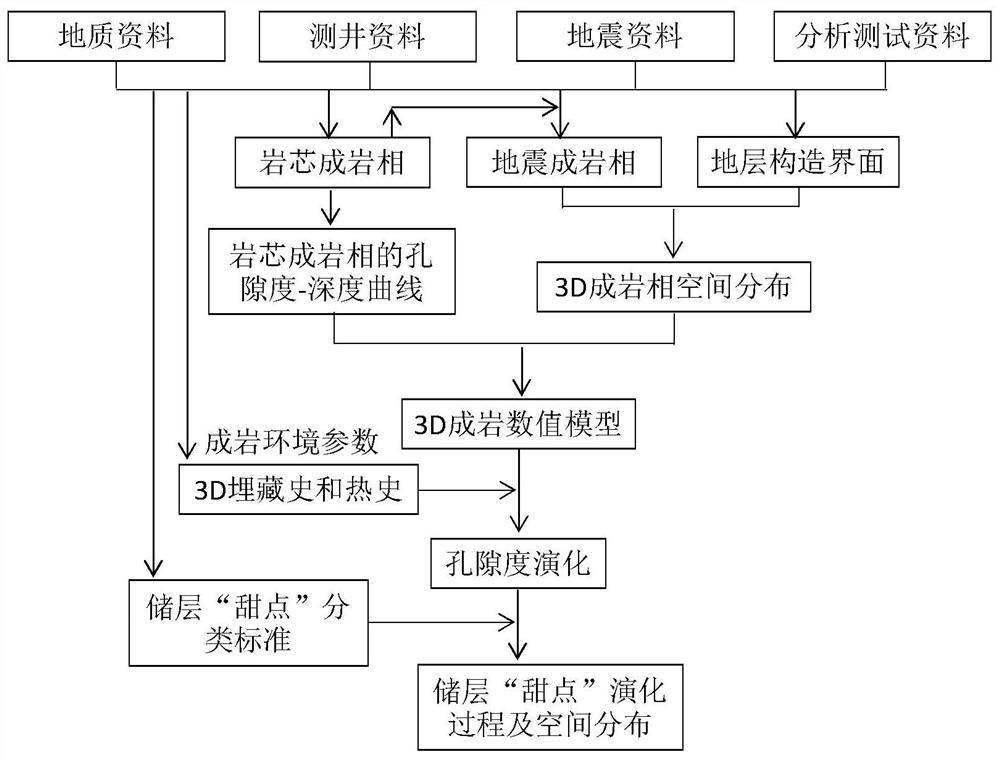
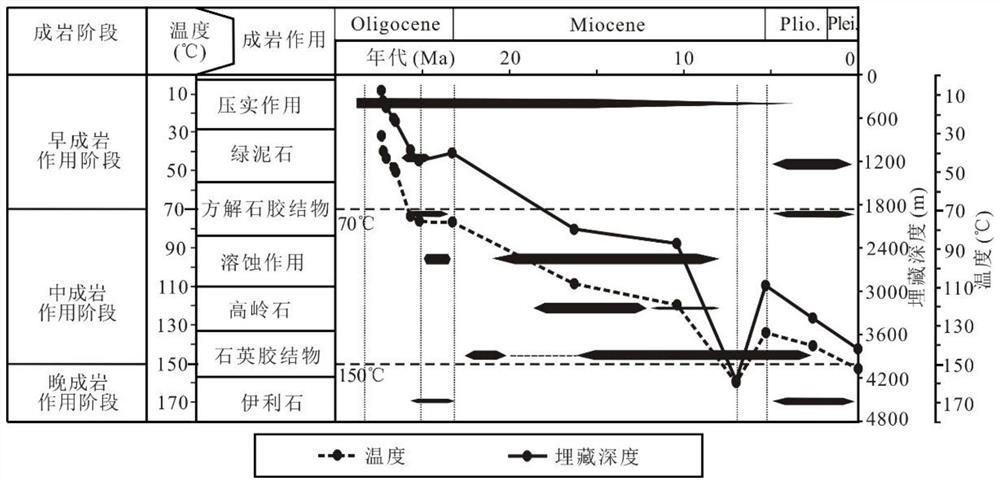
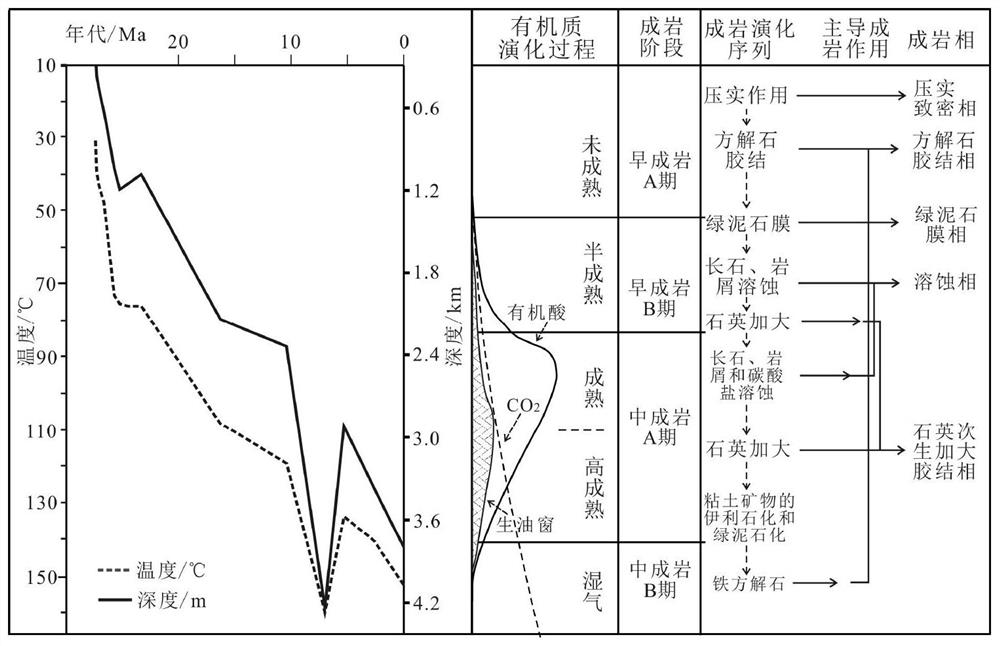
[0050] Embodiment 1: as figure 1 , figure 2 , image 3 , Figure 4 , Figure 5 , Image 6 , Figure 7 , Figure 8 , Figure 9 , Figure 10 , Figure 11 , Figure 12 , Figure 13 , Figure 14 , Figure 15 , Figure 16 , Figure 17 , Figure 18 , Figure 19 , Figure 20 , Figure 21 , Figure 22 , Figure 23 and Figure 24 As shown, a sweet spot evaluation method for deep offshore natural gas reservoirs provides diagenetic evolution sequence, diagenetic facies division scheme, porosity-depth curve of diagenetic facies, distribution of seismic diagenetic facies, reservoir "sweet spots" classification criteria, diagenetic numerical simulation , reservoir "sweet spot" evolution process and spatial distribution, etc., including the following steps:
[0051] Step 1), collecting data: collecting geological data, well logging data, seismic data and analysis and testing data; well logging data includes well logging interpretation porosity and logging interpretatio...
[0106] Step 1), collecting data: collecting geological data, well logging data, seismic data and analysis and testing data; well logging data includes well logging interpretation porosity and logging interpretation permeability curve; analysis and testing data includes casting thin slices, cathodeluminescence thin slices , scanning electron microscope, powder particle size analysis data, conventional core analysis data, quantitative statistical data of casting thin-section petrography and clay X-raydiffraction analysis data.
...
the structure of the environmentally friendly knitted fabric provided by the present invention; figure 2 Flow chart of the yarn wrapping machine for environmentally friendly knitted fabrics and storage devices; image 3 Is the parameter map of the yarn covering machine
Login to View More
PUM
Login to View More
Abstract
An offshore deep natural gas reservoir sweet spot evaluation method belongs to the field of oil and gas reservoir geology. The method comprises the steps of: collecting and sorting geological, logging, earthquake and analysis test data; establishing a diagenesis evolution sequence and a diagenesis phase division scheme; obtaining diagenesis numerical simulation parameters based on powder particle size analysis, conventional core analysis, lithofacies quantitative statistical data and clay x-raydiffractionanalysis data; explaining seismic lithogenous phase distribution of sandstone at a target layer based on typical stratigraphic slices; establishing a reservoir sweet spot classification standard according to the porosity, the permeability and the lithogenous phase; and implanting the parameters into a diagenetic numerical model. On the basis of the burial history and the thermal history, the diagenetic model and the seismic diagenetic phase are combined for diagenetic numerical simulation research, and the porosity evolution process and spatial distribution of the sandstone at the target layer are reproduced. A reservoir sweet spot evolution process and spatial distribution of the sandstone at the target layer are reproduced according to the reservoir sweet spot classification standard.
Description
technical field [0001] The invention belongs to the field of geology of oil and gas reservoirs, in particular to a method for evaluating sweet spots of offshore deep natural gas reservoirs. Background technique [0002] Tight sandstone gas resources have great potential and play an important role in unconventional oil and gas resources. Tight sandstone gas is one of the important areas of global unconventional natural gas exploration and development. Industry research shows that a number of large tight gas fields have been discovered in the Upper Paleozoic of the Ordos Basin in China, the Triassic Xujiahe Formation in the Sichuan Basin, and the Kuqa Depression in the Tarim Basin. A number of tight gas wells with high production have been discovered in Basin and other areas, showing good development prospects. It is generally recognized in the industry that reservoir quality is closely related to production capacity, and the core problem restricting the effectiveness of tig...
Claims
the structure of the environmentally friendly knitted fabric provided by the present invention; figure 2 Flow chart of the yarn wrapping machine for environmentally friendly knitted fabrics and storage devices; image 3 Is the parameter map of the yarn covering machine
Login to View More
Application Information
Patent Timeline
Application Date:The date an application was filed.
Publication Date:The date a patent or application was officially published.
First Publication Date:The earliest publication date of a patent with the same application number.
Issue Date:Publication date of the patent grant document.
PCT Entry Date:The Entry date of PCT National Phase.
Estimated Expiry Date:The statutory expiry date of a patent right according to the Patent Law, and it is the longest term of protection that the patent right can achieve without the termination of the patent right due to other reasons(Term extension factor has been taken into account ).
Invalid Date:Actual expiry date is based on effective date or publication date of legal transaction data of invalid patent.


 Login to View More
  Login to View More