Process for preparing fuel cell carbon-carried Pt-based catalyst

A fuel cell and catalyst technology, applied in chemical instruments and methods, physical/chemical process catalysts, battery electrodes, etc., can solve problems such as time-consuming, loss of precious metals, complicated and difficult-to-control operation steps, and achieve simple operation and excellent performance Effect

CN1402367AInactive Publication Date: 2003-03-12WUHAN UNIV
0 Cites 8 Cited by

Patent Information

Authority / Receiving Office
CN · China
Current Assignee / Owner
Publication Date
2003-03-12
Estimated Expiration
Not applicable · inactive patent

Smart Images

  • Figure 1
    Figure 1
  • Figure 2
    Figure 2
  • Figure 3
    Figure 3
Patent Text Reader

Abstract

The invented preparing method includes only two steps. First, mixing the alcoholic solution of the compound of platinum (and alloy constituent) with the carbon carrier fully, making the admixture evenly. The alcohol solvent is vaporized by use of the water bath at the controlled temperature. Then, the dry powder obtained is deoxidized in hydrogen at the condition of mild heating. The granularity of the platinum (alloy) obtained by the method is 1-2 nm with evenly distributed on the carbon carrier. The catalyst possesses the better performances of the electrocatalysis reaction relevant to the polymer dielectric film fuel cell such as oxidation of hydrogen and deoxidization of oxygen, oxidation of carbon monoxide, oxidation of methanol. The invention provides the features of easy of operation, without need of filtering and washing only need of a little cheap chemicals.
Need to check novelty before this filing date? Find Prior Art

Description

technical field

[0001] The invention relates to a preparation method of a carbon-supported platinum-based catalyst for a fuel cell. Background technique

[0002] A fuel cell is an electrochemical power generation device. Unlike batteries in the conventional sense, fuel cells can continuously and directly convert the chemical energy of fuel into electrical energy electrochemically. Because it does not go through the stage of first converting the chemical energy of the fuel into heat energy, it is not limited by the Carnot cycle, the energy conversion efficiency is high (40% to 60%), and it is environmentally friendly, and it hardly emits nitrogen oxides and Sulfur oxides. It is precisely because of these outstanding advantages that the research and development of fuel cell technology has attracted much attention from governments and large companies, and is considered to be the preferred clean and efficient power generation method in the 21st century.

[0003] There are man...

Examples

Embodiment Construction

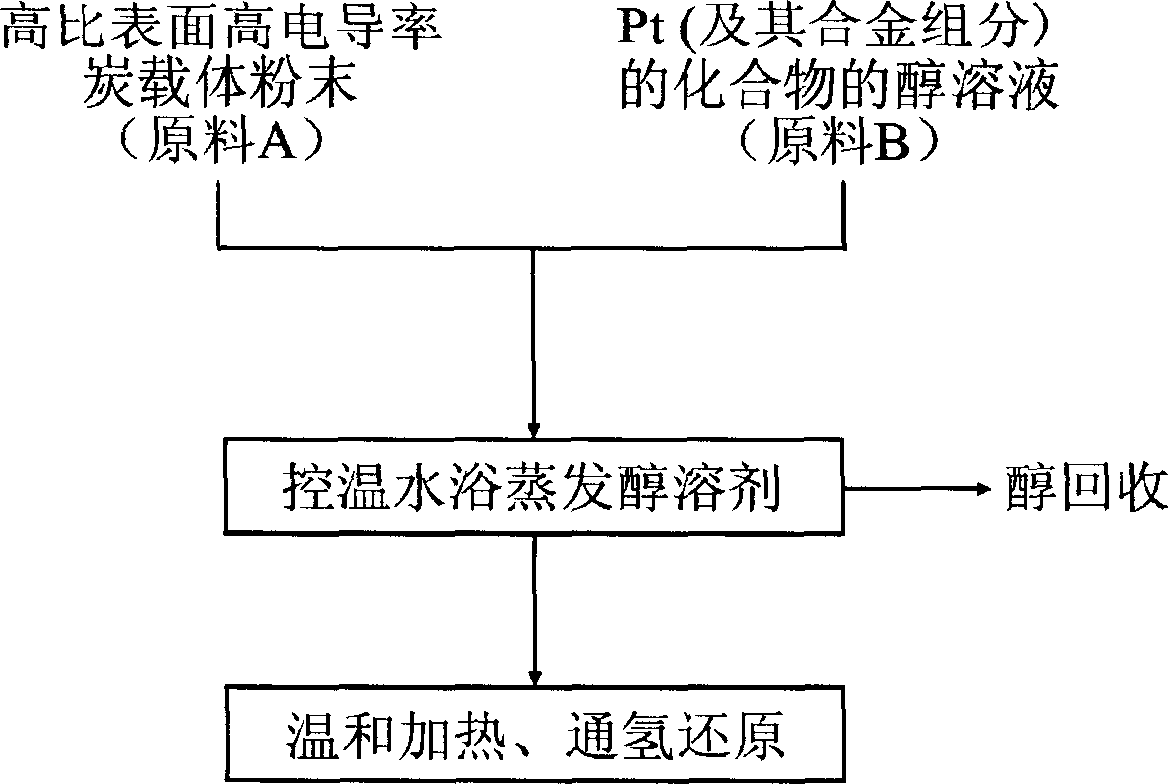
[0023] see figure 1 , the present invention adopts the following "two-step method" to prepare fuel cell carbon-supported platinum-based catalysts, the first step: the alcohol solution B (wherein the alcohol is methanol, ethanol, propanol or iso lower alcohols such as propanol) and carbon carrier A with high specific surface and high conductivity (such as VulcanXC-72 of Carbot Company) are stirred and mixed, and the alcohol solvent is slowly evaporated on a water bath at 40-100 ° C (the evaporated alcohol can be recovered ); the second step: the dry powder obtained in the previous step is used as a reducing agent at 100-300° C. to reduce the platinum or its alloy element compound on the carbon surface to a metal or alloy to obtain the desired carbon-supported platinum-based catalyst.

[0024] Taking the preparation of PtRu / C as an example, H 2 PtCl 6 with RuCl 3 Dissolve in ethanol, add carbon black (Vulcan XC-72 from Carbot Company) and stir well; evaporate ethanol in a wat...