
Preparation method of nano ZnO-SnO2 composite oxide photo-catalyst
A technology of composite oxides and photocatalysts, which is applied in the direction of catalyst activation/preparation, metal/metal oxide/metal hydroxide catalysts, physical/chemical process catalysts, etc. It can solve the problems of long washing process and achieve simple operation, fast response effect
- Summary
- Abstract
- Description
- Claims
- Application Information
AI Technical Summary
Problems solved by technology
Method used
Image

Examples
Embodiment 1
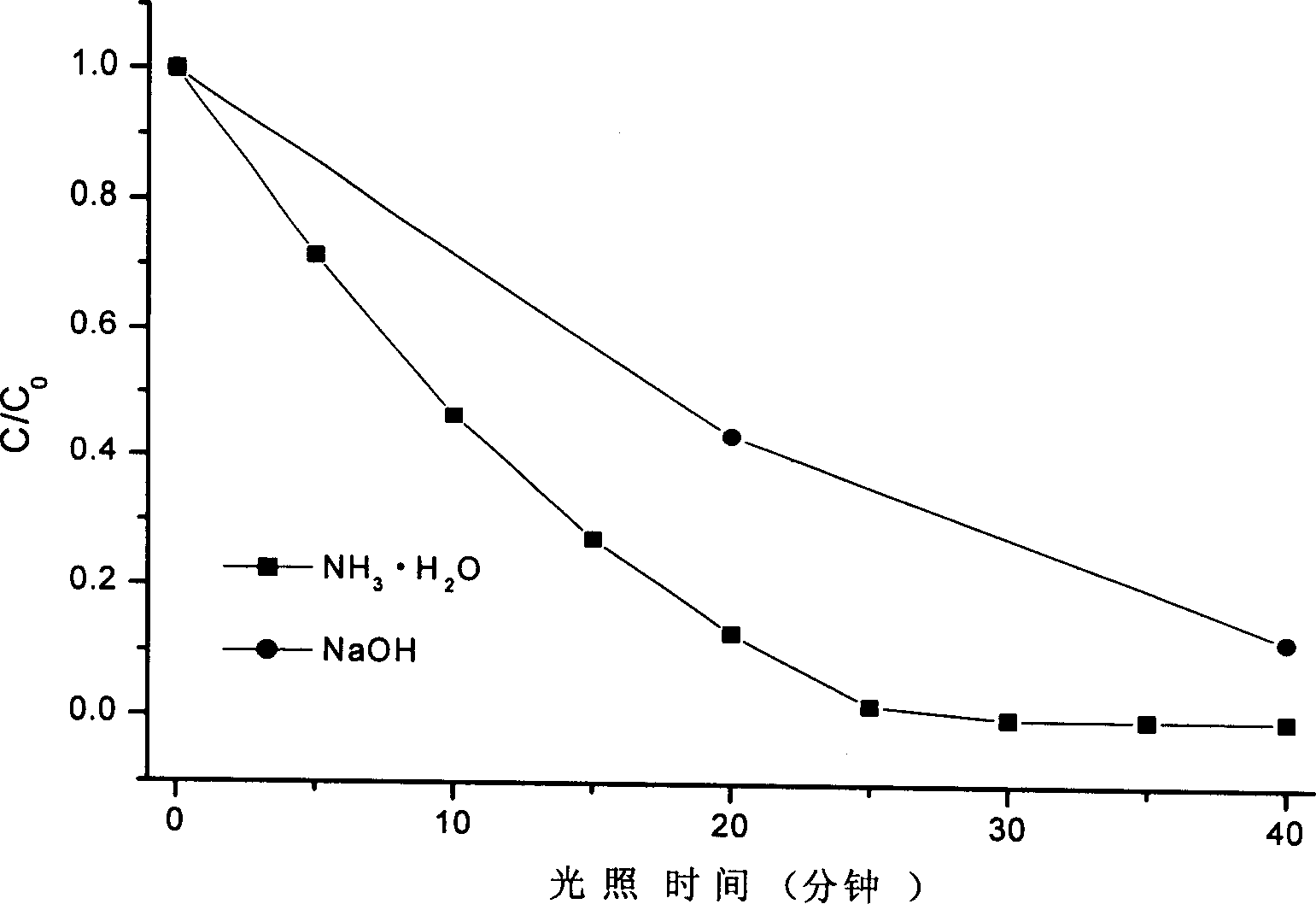
[0021] Weigh 1437.8g of analytically pure ZnSO at a molar ratio of 20:1 4 ·7H 2 O dissolved in 4000mL deionized water, 87.8g analytically pure SnCl 4 ·5H 2 O was dissolved in 400mL of deionized water, mixed thoroughly after dissolving, and analytically pure NH was added dropwise under vigorous stirring. 3 ·H 2 O solution until the pH was 7 and continued to stir for 12 hours to obtain a gel. After filtration under reduced pressure, bake at 110°C for 24 hours to dry to obtain xerogel. After fully grinding, slowly heat up to 350°C in a high-temperature box-type resistance furnace for calcination for 2 hours to obtain a specific surface area of 17.6m 2 / g ZnO-SnO 2 Composite oxide photocatalyst, the degradation rate of organic matter is 54.66%.
Embodiment 2
[0023] Weigh 71.89g of analytically pure ZnSO at a molar ratio of 1:20 4 ·7H 2 O dissolved in 300mL deionized water, 1752.9g analytically pure SnCl 4 ·5H 2 O was dissolved in 7000mL of deionized water, mixed thoroughly after dissolution, and analytically pure NH was added dropwise under vigorous stirring. 3 ·H 2 O solution until pH 7 and continued stirring for 12 hours to obtain a gel. After filtration under reduced pressure, bake at 110°C for 24 hours to dry to obtain xerogel. After fully grinding, slowly heat up to 350°C in a high-temperature box-type resistance furnace for calcination for 2 hours to obtain a specific surface area of 43.6m 2 / g ZnO-SnO 2 Composite oxide photocatalyst, the degradation rate of organic matter is 21.79%.
Embodiment 3
[0025] Weigh 143.8g of analytically pure ZnSO at a molar ratio of 2:1 4 ·7H 2 O dissolved in 400 mL of deionized water, 87.8 g of analytically pure SnCl 4 ·5H 2 O was dissolved in 400mL of deionized water, mixed thoroughly after dissolving, and analytically pure NH was added dropwise under vigorous stirring. 3 ·H 2 O solution until pH 7 and continued stirring for 12 hours to obtain a gel. After filtration under reduced pressure, bake at 110°C for 24 hours to dry to obtain a xerogel. After fully grinding, slowly heat up to 300°C in a high-temperature box-type resistance furnace for calcination for 2 hours to obtain ZnO with a size of 1.7nm and SnO 2 0.8nm powder.
PUM
| Property | Measurement | Unit |
|---|---|---|
| specific surface area | aaaaa | aaaaa |
| specific surface area | aaaaa | aaaaa |
| specific surface area | aaaaa | aaaaa |
Abstract
Description
Claims
Application Information
 Login to View More