
Method and device for polishing the surface of a gas turbine blade
A technology of gas turbine blades and ceramics, which is applied in the field of gas turbine blades, and can solve the problems of burr formation, troublesome manual guidance, contamination of impurities, etc.
- Summary
- Abstract
- Description
- Claims
- Application Information
AI Technical Summary
Problems solved by technology
Method used
Image

Examples
Embodiment Construction
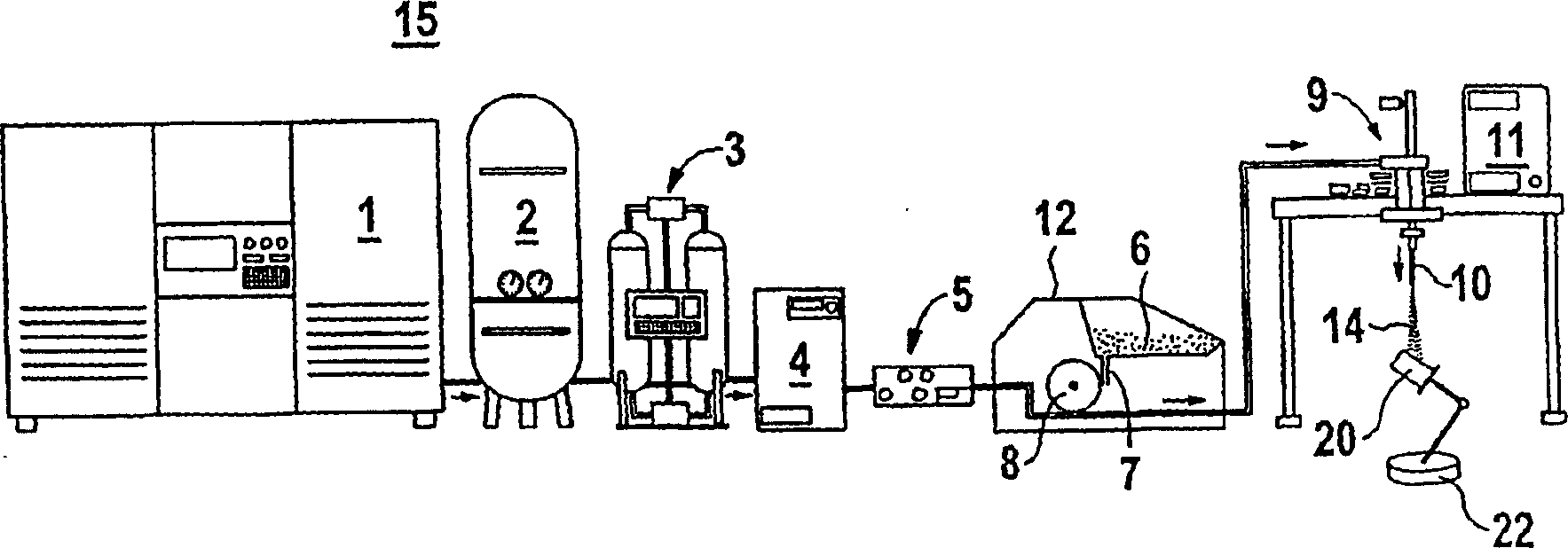
[0031] figure 1An apparatus 15 for removing ceramic material from the surface of a gas turbine blade 20 is shown. In order to generate the compressed air flow, a screw compressor 1 , an equalization tank 2 , an adsorption dryer 3 , a cooler 4 and a measuring system 5 are connected in series. In the screw compressor 1 the air is highly compressed, in particular to a pressure of 3 to 12 bar. Balance tank 2 is used to stabilize a constant mass flow. The air is dried in the adsorption dryer 3 and cooled in the cooler 4 . The measuring system 5 is used to detect compressed air parameters.
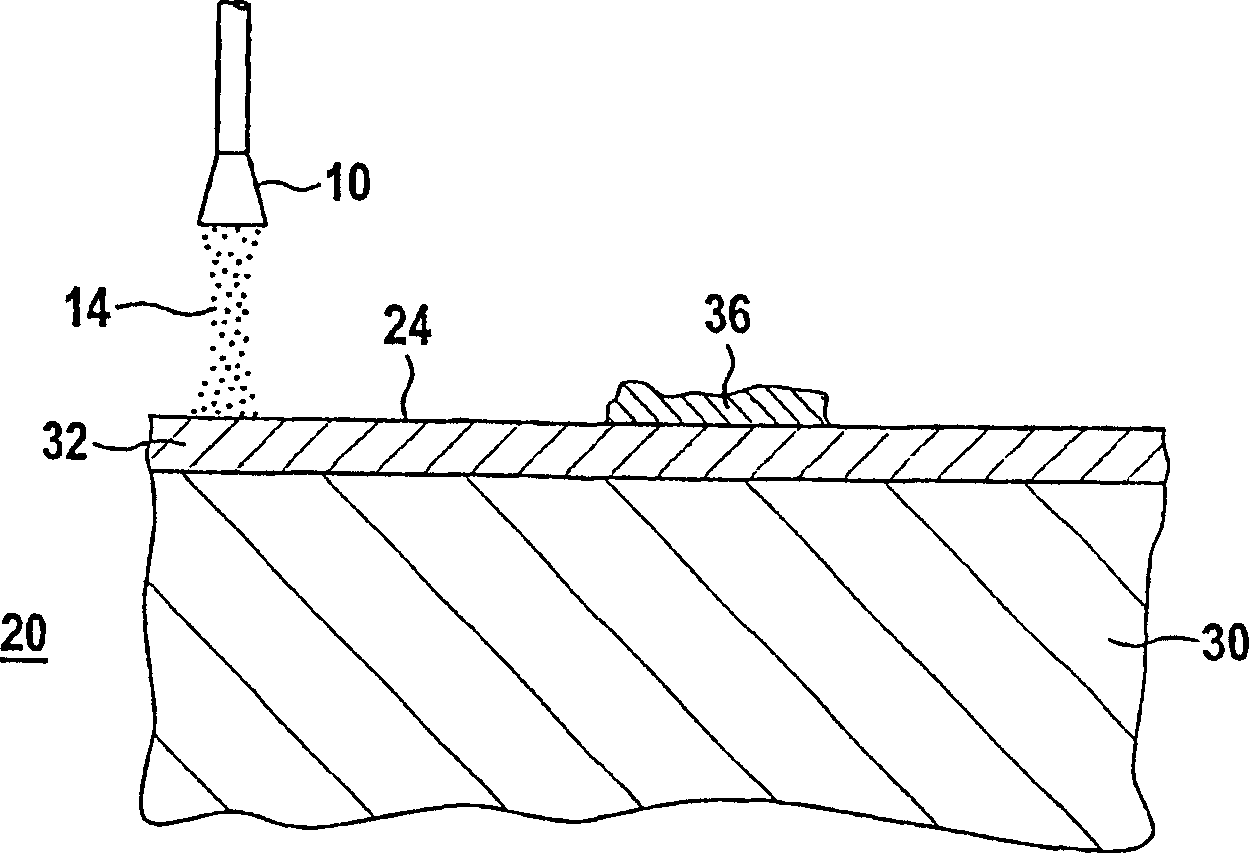
[0032] The compressed gas flow is then fed into a pellet supply device 12 . Dry ice pellets 6 are stored in the pellet supply device 2 . The dry ice pellets 6 are fed by means of a screw conveyor 7 via an impeller lock 8 into the compressed air flow and together with the compressed air flow are supplied to a Rafal nozzle 10 which is moved by a robot 9 . There they are discharged as dry ice...
PUM
 Login to View More
 Abstract
Description
Claims
Application Information
 Login to View More