
System and method for attenuation correction of a surface coil in a PET-MRI system
a surface coil and combined technology, applied in the field of positron emission tomography (“ pet”) and magnetic resonance imaging, can solve the problems of potentially distorting surface coils, mutual annihilation, and large rf coils, and achieve the effect of reducing the signal-to-noise ratio (“snr”) and reducing the number of rf coils
- Summary
- Abstract
- Description
- Claims
- Application Information
AI Technical Summary
Benefits of technology
Problems solved by technology
Method used
Image

Examples
Embodiment Construction
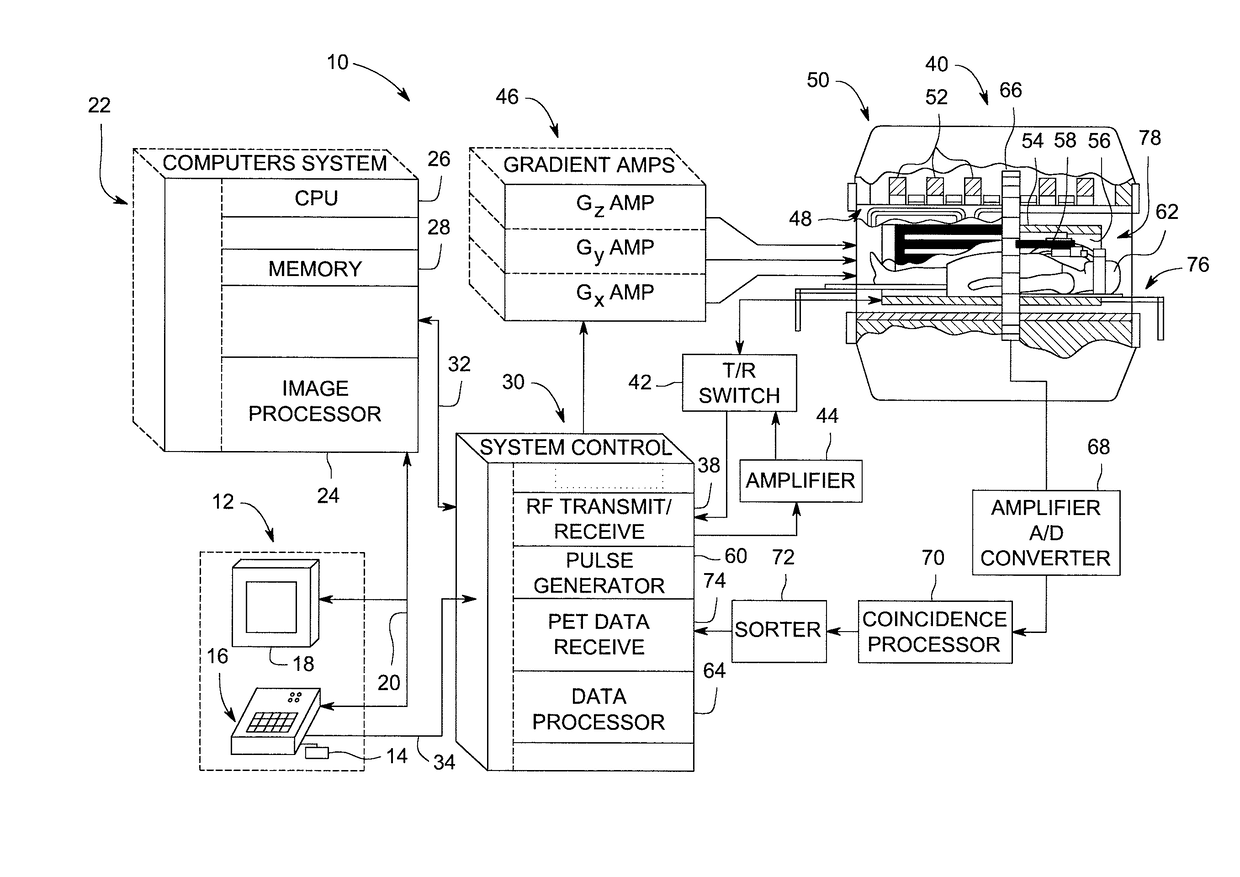
[0018]Reference will be made below in detail to exemplary embodiments of the invention, examples of which are illustrated in the accompanying drawings. Wherever possible, the same reference characters used throughout the drawings refer to the same or like parts, without duplicative description.
[0019]As used herein, the terms “substantially,”“generally,” and “about” indicate conditions within reasonably achievable manufacturing and assembly tolerances, relative to ideal desired conditions suitable for achieving the functional purpose of a component or assembly. The term “real-time,” as used herein, means a level of processing responsiveness that a user senses as sufficiently immediate or that enables the processor to keep up with an external process. As also used herein, the term “spatial location” means the location and / or orientation of an object in two-dimensional and / or three-dimensional space. As used herein, “electrically coupled”, “electrically connected”, “electrical communic...
PUM
 Login to View More
 Abstract
Description
Claims
Application Information
 Login to View More