Check patentability & draft patents in minutes with Patsnap Eureka AI!

Engineered bacterial strain that reduces antibiotic-resistant Enterococcus colonization in the GI tract

Active Publication Date: 2021-02-16
THE MEDICAL COLLEGE OF WISCONSIN INC
View PDF7 Cites 0 Cited by
  • Summary
  • Abstract
  • Description
  • Claims
  • Application Information

AI Technical Summary

Benefits of technology

The patent text describes a method for preventing the colonization of the intestine and the transfer of bacteriocin-containing plasmid between enterococci strains in the gastrointestinal tract. The method involves engineering a delivery strain that prevents stable colonization and bacteriocin conjugation while still effectively delivering the bacteriocin. The technical effect of this invention is to provide a new approach for preventing and treating enterococcal infections, particularly those caused by drug-resistant strains, without causing collateral damage to the microbiota and without promoting the horizontal genetic exchange of antibiotic resistance traits.

Problems solved by technology

Enterococci are among the three most common causes of nosocomial infections, and due to their high levels of antibiotic resistance, enterococcal infections can be difficult to treat13,14.
However, one potential caveat to this approach is that the bacteriocin delivery strain itself will take up residence in the intestinal tract and may eventually acquire additional antibiotic resistance traits through a horizontal genetic exchange, re-creating the original problem18.

Method used

the structure of the environmentally friendly knitted fabric provided by the present invention; figure 2 Flow chart of the yarn wrapping machine for environmentally friendly knitted fabrics and storage devices; image 3 Is the parameter map of the yarn covering machine
View more

Image

Smart Image Click on the blue labels to locate them in the text.
Viewing Examples
Smart Image
  • Engineered bacterial strain that reduces antibiotic-resistant <i>Enterococcus </i>colonization in the GI tract
  • Engineered bacterial strain that reduces antibiotic-resistant <i>Enterococcus </i>colonization in the GI tract
  • Engineered bacterial strain that reduces antibiotic-resistant <i>Enterococcus </i>colonization in the GI tract

Examples

Experimental program
Comparison scheme
Effect test

examples

Materials and Methods

[0076]Bacterial Strains Growth Media and Reagents.

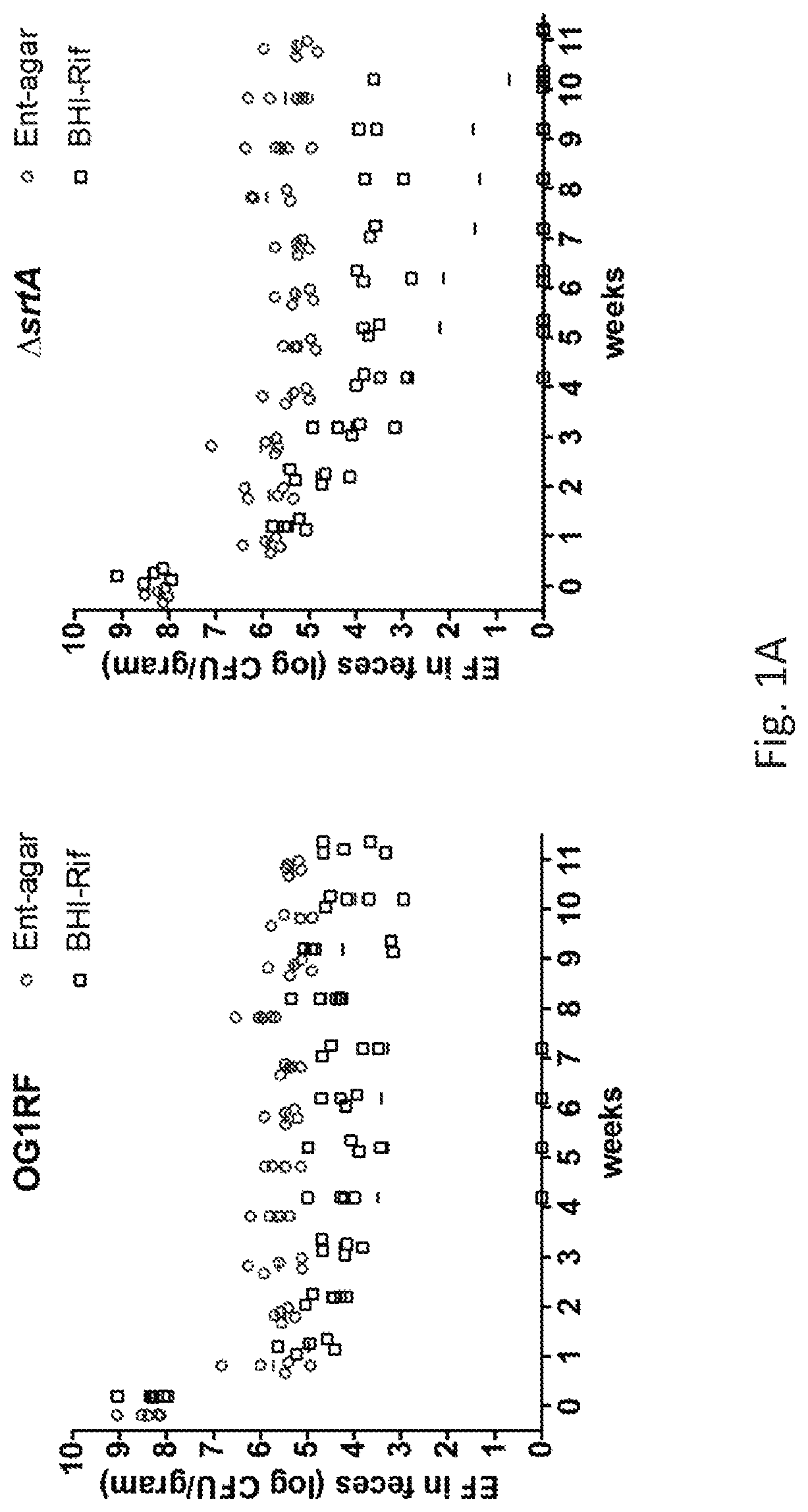
[0077]The strains used in this study are listed in Table 1. Brain-heart infusion medium (BHI) and m-Enterococcus agar (Ent-agar) (Difco) were prepared as described by the manufacturer (Becton Dickinson). Antibiotics were purchased from Sigma and used at the following concentrations: rifampicin, 200 g ml-1; spectinomycin, 500 g ml-1; chloramphenicol, 15 g ml-1. E. faecalis was cultured in BHI media at 37° C. All restriction enzymes were purchased from New England BioLabs. Phusion High-Fidelity DNA Polymerase (Thermo Scientific) was used for all PCRs performed for strain and plasmid construction. Oligonucleotides were synthesized by Fisher Scientific.

[0078]

TABLE 1ReferenceDescriptionor sourceStrainsOG1spSpontaneous mutant of OG1; Spr9OG1RFSpontaneous mutant of OG1; Rifr, Far9JL2771,231,501 rpoB H486Y; Rifr derivative9IB1 (V583r)V583 spontaneous Rifr derivative, Vanr9IB10(ΔsrtAr)OG1RF ΔsrtAunpublishedIB16 (ΔsrtAs)OG...

the structure of the environmentally friendly knitted fabric provided by the present invention; figure 2 Flow chart of the yarn wrapping machine for environmentally friendly knitted fabrics and storage devices; image 3 Is the parameter map of the yarn covering machine
Login to View More

PUM

PropertyMeasurementUnit
Compositionaaaaaaaaaa
Electrical resistanceaaaaaaaaaa
Strain pointaaaaaaaaaa
Login to View More

Abstract

The present disclosure provides engineered modified strains of Enterococcus faecalis (EF) that is able to produce bacteriocin but is inefficient at establishing long-term colonization of the GI track in an animal. Compositions comprising the modified strain and methods of use are also disclosed.

Description

CROSS-REFERENCE TO RELATED APPLICATIONS[0001]This application represents the national stage entry of PCT International Application No. PCT / US2018 / 018099 filed on Feb. 14, 2018 and claims priority to U.S. Provisional Application Nos. 62 / 459,281 and 62 / 529,713 filed on Feb. 15, 2017 and Jul. 7, 2017. respectively, the contents of which are incorporated by reference in their entireties.GOVERNMENT FUNDING STATEMENT[0002]This invention was made with government support under NIH GM099526 and NIH AI097619 awarded by National Institute of Health. The government has certain rights in the invention.BACKGROUND OF THE INVENTION[0003]Bacteriocins, ribosomally synthesized antimicrobial peptides of bacterial origin, have generated interest because of their application in medical and food-based products1-3. Bacteriocins produced by Gram-positive lactic acid bacteria (LAB) are of particular interest due to their application as probiotics, potential treatments against infectious agents and in package...

Claims

the structure of the environmentally friendly knitted fabric provided by the present invention; figure 2 Flow chart of the yarn wrapping machine for environmentally friendly knitted fabrics and storage devices; image 3 Is the parameter map of the yarn covering machine
Login to View More

Application Information

Patent Timeline
no application Login to View More
IPC IPC(8): C12N1/20C12R1/46A61P31/04C12N9/52C12N15/52
CPCC12R1/46A61P31/04C12N1/20C12N9/52C12N15/52C12R2001/46C12N1/205
Inventor SALZMAN, NITAKRISTICH, CHRISTOPHERKOMMIENI, SUSHMA
Owner THE MEDICAL COLLEGE OF WISCONSIN INC
Features
  • R&D
  • Intellectual Property
  • Life Sciences
  • Materials
  • Tech Scout
Why Patsnap Eureka
  • Unparalleled Data Quality
  • Higher Quality Content
  • 60% Fewer Hallucinations
Social media
Patsnap Eureka Blog
Learn More