Check patentability & draft patents in minutes with Patsnap Eureka AI!

Synthesis and characterization of MoO2 nanoparticles and their ability to decontaminate water

a technology which is applied in the field of synthesis and characterization of moosub>2 /sub> nanoparticles and their ability to decontaminate water, moo2 nanoparticles, etc., and can solve problems such as more problems

Active Publication Date: 2021-11-02
UNIV OF SOUTH FLORIDA
View PDF6 Cites 0 Cited by
  • Summary
  • Abstract
  • Description
  • Claims
  • Application Information

AI Technical Summary

Benefits of technology

The present patent is about a new type of decontaminant that contains functionalized MoO2 nanoparticles. The decontaminant can be used to remove pollutants from fluids by chemically reacting with them. The patent also describes a method for producing the decontaminant by heating a mixture of MoO3 and a reducing agent in water. The technical effects of this invention are that it provides a more effective and efficient way to decontaminate fluids and reduce pollutants, which is important for environmental and healthcare applications.

Problems solved by technology

Not only are these dyes toxic, carcinogenic and mutagenic, but the presence of these dyes in water can cause a depletion of dissolved oxygen, causing even more issues.

Method used

the structure of the environmentally friendly knitted fabric provided by the present invention; figure 2 Flow chart of the yarn wrapping machine for environmentally friendly knitted fabrics and storage devices; image 3 Is the parameter map of the yarn covering machine
View more

Image

Smart Image Click on the blue labels to locate them in the text.
Viewing Examples
Smart Image
  • Synthesis and characterization of MoO<sub>2 </sub>nanoparticles and their ability to decontaminate water
  • Synthesis and characterization of MoO<sub>2 </sub>nanoparticles and their ability to decontaminate water
  • Synthesis and characterization of MoO<sub>2 </sub>nanoparticles and their ability to decontaminate water

Examples

Experimental program
Comparison scheme
Effect test

example 1

and Methods

[0064]MoO3, ammonium molybdate (AM), and ethylene glycol (EG) were purchased from Sigma Aldrich and used without any modification unless otherwise noted.

[0065]Synthesis of Nanostructured Molybdenum Trioxide (AM-MoO3) Ammonium molybdate was heated in an oven at 350° C. for 12 hours to form nanostructured MoO3, which was labeled AM-MoO3 to distinguish it from the commercially produced MoO3 from Sigma Aldrich.

[0066]Synthesis of Molybdenum Dioxide (MoO2) Two sets of experiments were conducted to synthesize MoO2; one set of experiments using MoO3, and the other set of experiments using the nanostructured AM-MoO3.

[0067]Initially 75 mg of either MoO3 or AM-MoO3 was continuously stirred into 7.5 mL of deionized water and 2.5 mL of ethylene glycol. The mixture was added to a Teflon lined stainless steel pressure, sealed, and heated at 180° C. for 12 hours. The resulting reaction produced a black powder that was subsequently separated via centrifugation and cleaned with ethanol and...

example 2

Microscopy

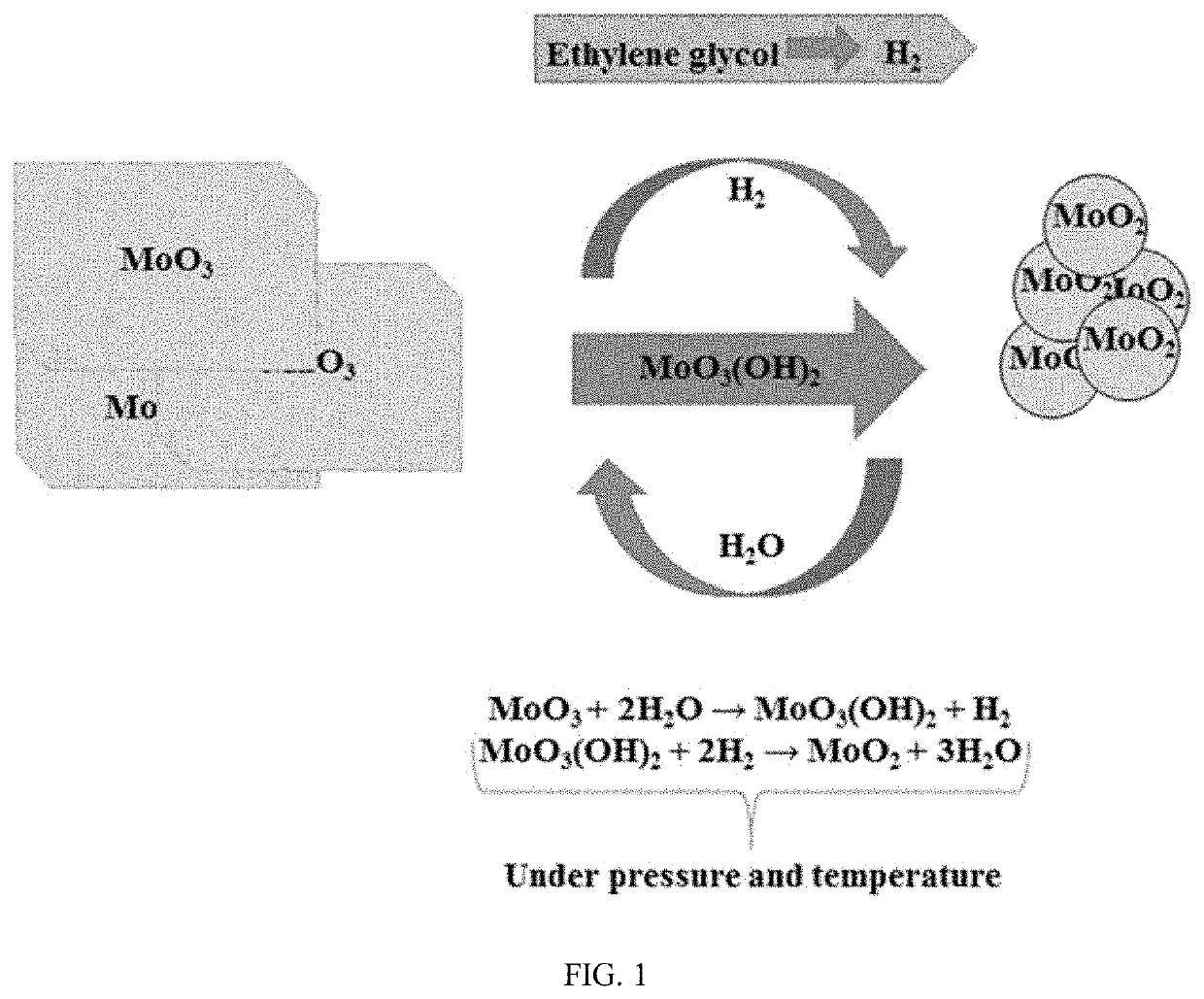
[0071]The MoO2 nanoparticles were synthesized using a single step hydrothermal synthesis technique using MoO3 or nanostructured AM-MoO3 as the molybdenum precursor. The MoO2 nanoparticles were washed with ethanol and DI water, and then dried in an oven. MoO3 reduction to MoO2 nanoparticles using ethylene glycol as the reducing agent formed MnO2 nanoparticles. The MoO2 nanoparticles obtained from the process required no further processing once dried.

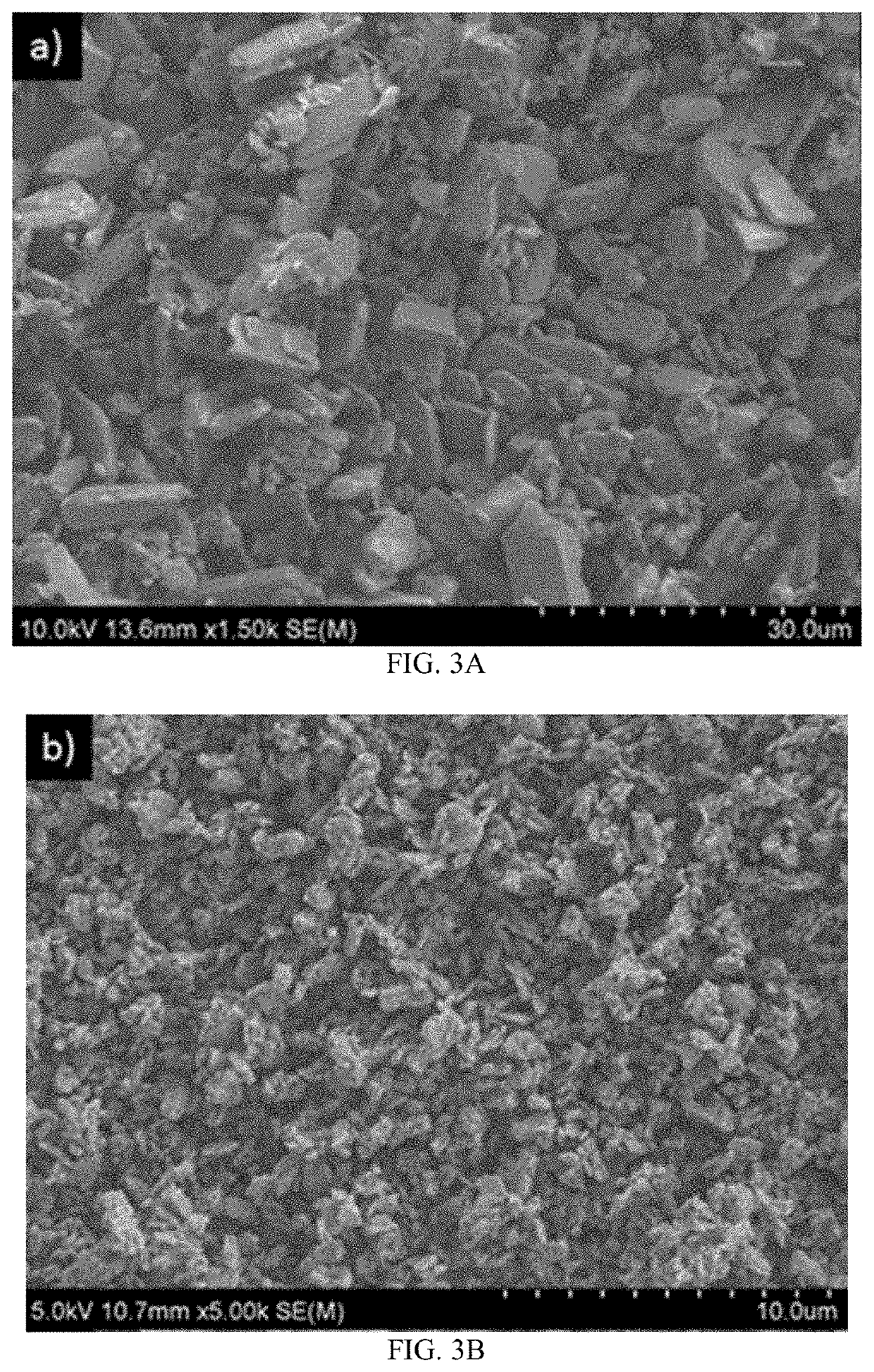
[0072]An SEM image of the commercial MoO3 is shown in FIG. 3A. The image revealed that the material had a platelet like structure, with large particles up to 20 μm long. Meanwhile, an SEM image of the AM-MoO3 is shown in FIG. 3B, where is the image clearly revealed that the AM-MoO3 had the same platelet-like structure as the commercial MoO3, except the platelets were nano-sized. The nanostructured AM-MoO3 platelets were a few hundred nanometers wide, with the largest particles around 1p m long. It was also clear from the SEM ima...

example 3

fraction (XRD)

[0075]XRD patterns for MoO3, AM-MoO3, MoO2, and AM-MoO2 are shown in FIG. 6. Both the MoO3 and AM-MoO3 powders were indexed to the orthorhombic phase of MoO3; with major characteristic diffraction peaks at 12.77°, 23.33°, 25.70°, 27.32°, and 38.97°, which correspond to the (020), (110), (040), (021), and (060) planes, respectively. The diffraction peaks for AM-MoO3 were less intense and slightly broader that the diffraction peaks for MoO3, indicating the AM-MoO3 had a smaller crystallite / particle size, as later confirmed by SEM. The diffraction patterns for both MoO2 and AM-MoO2 were indexed to the monoclinic phase of MoO2, with major characteristic peaks at 26.11°, 36.75°, 53.69°, which correspond to the (−111), (200), and (022) planes, respectively. Again it was clear that the diffraction peaks for both MoO2 and AM-MoO2 had an even lower intensity and were even broader than the diffraction peaks for AM-MoO3, indicating even smaller crystallite / particle size, as later...

the structure of the environmentally friendly knitted fabric provided by the present invention; figure 2 Flow chart of the yarn wrapping machine for environmentally friendly knitted fabrics and storage devices; image 3 Is the parameter map of the yarn covering machine
Login to View More

PUM

PropertyMeasurementUnit
Temperatureaaaaaaaaaa
Fractionaaaaaaaaaa
Pressureaaaaaaaaaa
Login to View More

Abstract

The disclosure provides a decontaminant comprising MoO2. The disclosure also provides methods to produce a decontaminant comprising MoO2 and methods for decontamination of a fluid comprising us of a decontaminant comprising MoO2.

Description

CROSS-REFERENCE TO RELATED APPLICATIONS[0001]This application claims the benefit of U.S. Provisional Patent Application No. 62 / 618,373, filed Jan. 17, 2018, which is incorporated herein by reference in its entirety.TECHNICAL FIELD[0002]This disclosure relates to compositions and methods for decontaminating water with at least one MoO2 nanoparticle.BACKGROUND OF THE INVENTION[0003]The decontamination of wastewater containing pollutants, such as organic dyes, specifically from the textile industry, has become a huge research area. Worldwide, the textile industry is responsible for up to 20% of the dyes used, followed by paper printing, leather production, photography, coating, and photochemical industries. Not only are these dyes toxic, carcinogenic and mutagenic, but the presence of these dyes in water can cause a depletion of dissolved oxygen, causing even more issues. Some estimates show that 10-15% of the dye used in the textile processing industry are lost into the effluent. Ther...

Claims

the structure of the environmentally friendly knitted fabric provided by the present invention; figure 2 Flow chart of the yarn wrapping machine for environmentally friendly knitted fabrics and storage devices; image 3 Is the parameter map of the yarn covering machine
Login to View More

Application Information

Patent Timeline
no application Login to View More
IPC IPC(8): B01J20/06B01J23/28C02F1/72C01G39/02B01J20/28B01J20/30B01J35/00B01J37/16C07F11/00C02F1/28C02F1/32C02F101/30C02F103/30
CPCB01J23/28B01J20/06B01J20/28007B01J20/28016B01J20/3085B01J35/004B01J35/0013B01J37/16C01G39/02C02F1/281C02F1/32C02F1/725C07F11/005C01P2002/72C01P2002/82C01P2002/84C01P2004/03C01P2004/04C01P2004/64C02F2101/308C02F2103/30C02F2305/10C02F2305/08C02F1/30C01G45/02B01J35/23B01J35/40B01J35/39
Inventor MCCRORY, MICHAEL SCOTTRAM, MANOJ KUMAR
Owner UNIV OF SOUTH FLORIDA
Features
  • R&D
  • Intellectual Property
  • Life Sciences
  • Materials
  • Tech Scout
Why Patsnap Eureka
  • Unparalleled Data Quality
  • Higher Quality Content
  • 60% Fewer Hallucinations
Social media
Patsnap Eureka Blog
Learn More