Check patentability & draft patents in minutes with Patsnap Eureka AI!

Circulatory assistance device

a technology of circulatory assistance and heart valve, which is applied in the direction of circulatory assistance devices, intravenous devices, blood pumps, etc., can solve the problems of inability to compensate for weak heart pumping power, inability to choose management options in cases of impaired cardiac function, and inability to have other than heart transplantation adequate treatment, etc., to achieve simple design and high efficiency

Active Publication Date: 2022-01-25
FRIEDRICH ALEXANDER UNIV ERLANGEN NUERNBERG
View PDF9 Cites 0 Cited by
  • Summary
  • Abstract
  • Description
  • Claims
  • Application Information

AI Technical Summary

Benefits of technology

The invention is a device that helps people with circulatory issues. It is designed to be simple and work well. This is its technical effect.

Problems solved by technology

About one-third of these patients have such severe heart failure that they die within two years due to a lack of adequate treatment possibilities.
The selection of management options in cases of impaired cardiac function is very small.
For a long time there was no possibility other than heart transplantation for adequate treatment in the case of life-threatening deterioration of cardiac function.
Up to now, however, it has only been possible to compensate for weak pumping power of the heart by direct acceleration of the blood using an external pump.
As a result of the strong activation of the coagulation system, this always results in a great increase in the risk for thrombus formation.
Furthermore, the implantation of the input and output tubing systems in the large blood vessels increases the risk of sudden hemorrhage.
A system of this type is very vulnerable and always serves only as an interim solution until heart transplantation or regeneration of the heart can take place, so it is not possible to discharge the patient from the hospital while still receiving this therapy.
In addition, the periodic radial compression of a blood vessel initially produces blood flow in both axial directions of the blood vessel, which makes it appear principally suited for use in veins with venous valves, but even there, interferes with the efficiency of the pump.
One drawback here is that the dielectric elastomer membranes are relatively short, and thus only small contraction strokes are possible.
A second arrangement takes a lot of space outside of the heart, which is disadvantageous.
When power is lost, the cuff contracts and remains in this state, which can lead to an immediate, massive, life-threatening disturbance.
Thus, advantageously a blood pressure drop is combated, which precisely in the first moments after loss of the circulatory assistance device could result in life-threatening circulatory weakness.
However, if no power or only inadequate power is supplied to through the valve, by way of the opened valve, this would lead to a loss of the liquid between the heart and the membrane, so that the now contracted membrane cannot impede the heart's own residual function.

Method used

the structure of the environmentally friendly knitted fabric provided by the present invention; figure 2 Flow chart of the yarn wrapping machine for environmentally friendly knitted fabrics and storage devices; image 3 Is the parameter map of the yarn covering machine
View more

Image

Smart Image Click on the blue labels to locate them in the text.
Viewing Examples
Smart Image
  • Circulatory assistance device
  • Circulatory assistance device
  • Circulatory assistance device

Examples

Experimental program
Comparison scheme
Effect test

first embodiment

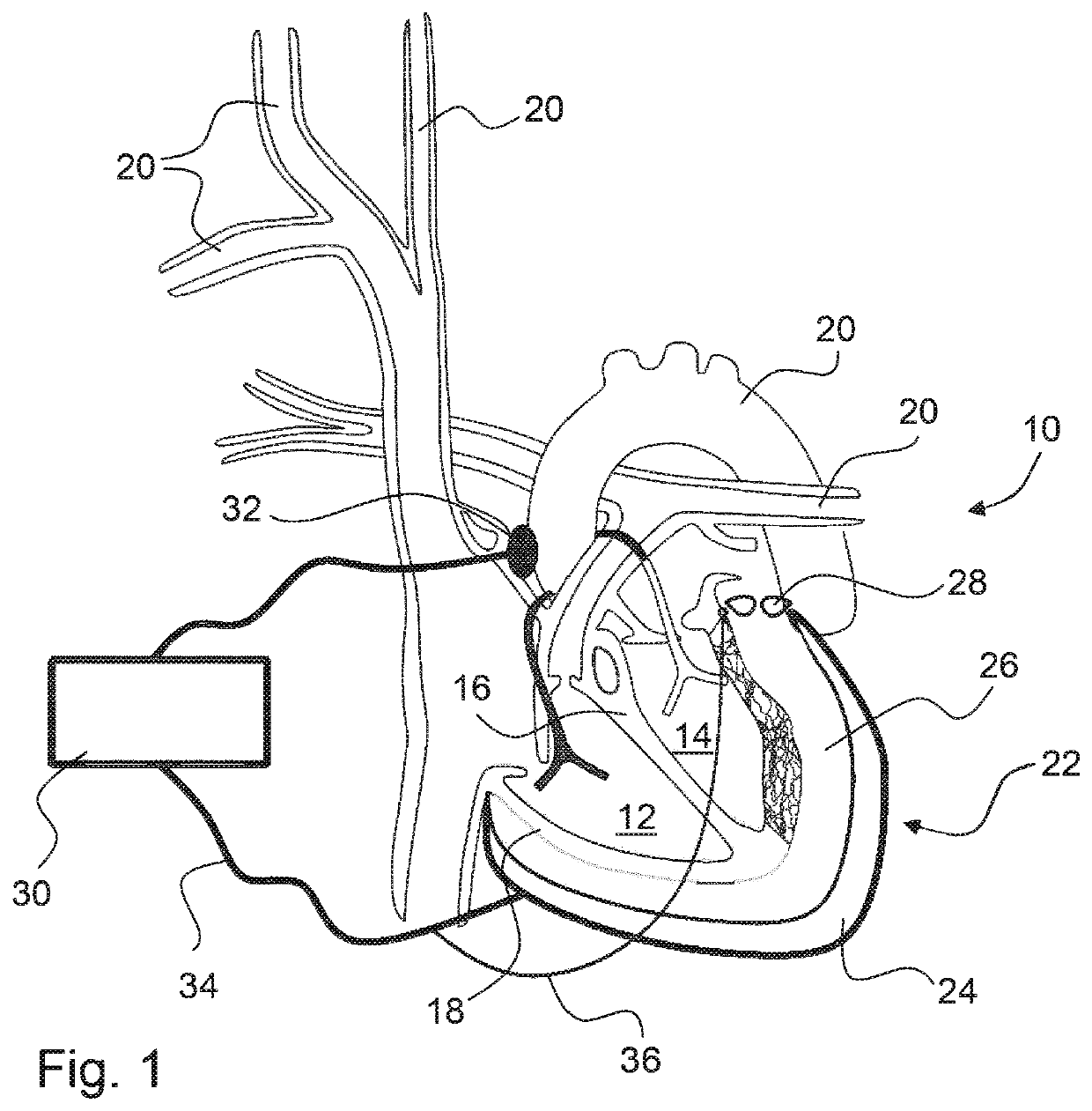
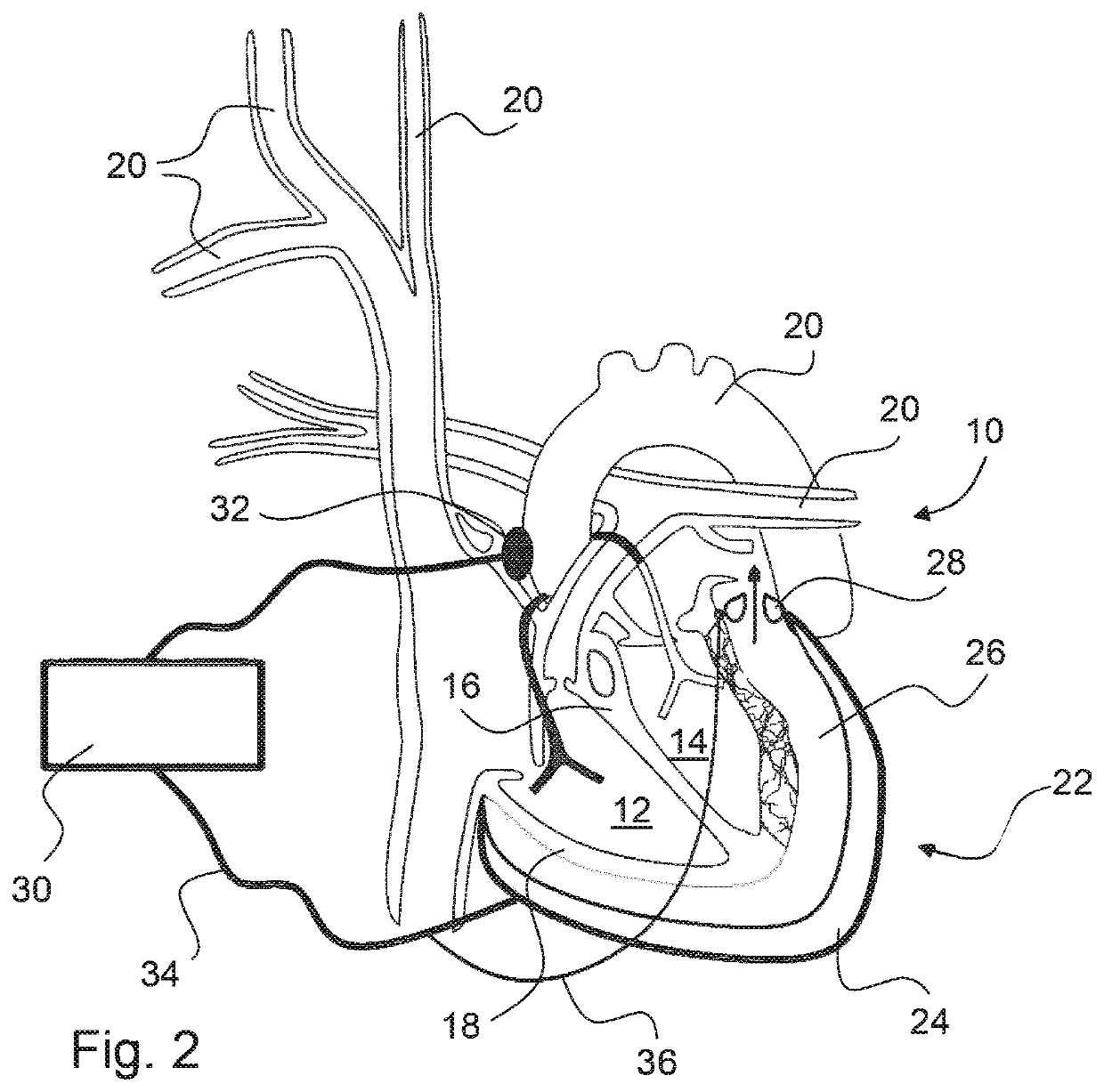
[0042]A cuff 22 of a circulatory assistance device in a first embodiment fits closely around the heart 10 during the diastolic phase of the cardiac cycle. The cuff includes an outer contraction layer 24 and an inner padding layer 26. In the interior of the contraction layer 24 there is at least one elastic elastomer membrane, which preferably has a closed annular shape, or as shown in FIGS. 1 and 2, a tulip shape. In the cuff 22, several dielectric elastomer membranes may be arranged adjacent to or one on top of the other. The elastomer membranes are preferably closed, but within the scope of the invention it is also possible to arrange several separately controlled annular elastomer membranes alongside one another.

[0043]Materials that may be considered for the contraction layer 24 include, for example, PDMS, polyurethane, and acrylates (e.g., VHB from 3M). Particularly suitable is a silicone with polydimethyl siloxane as the polymer component and acrylic polymers and natural rubber...

second embodiment

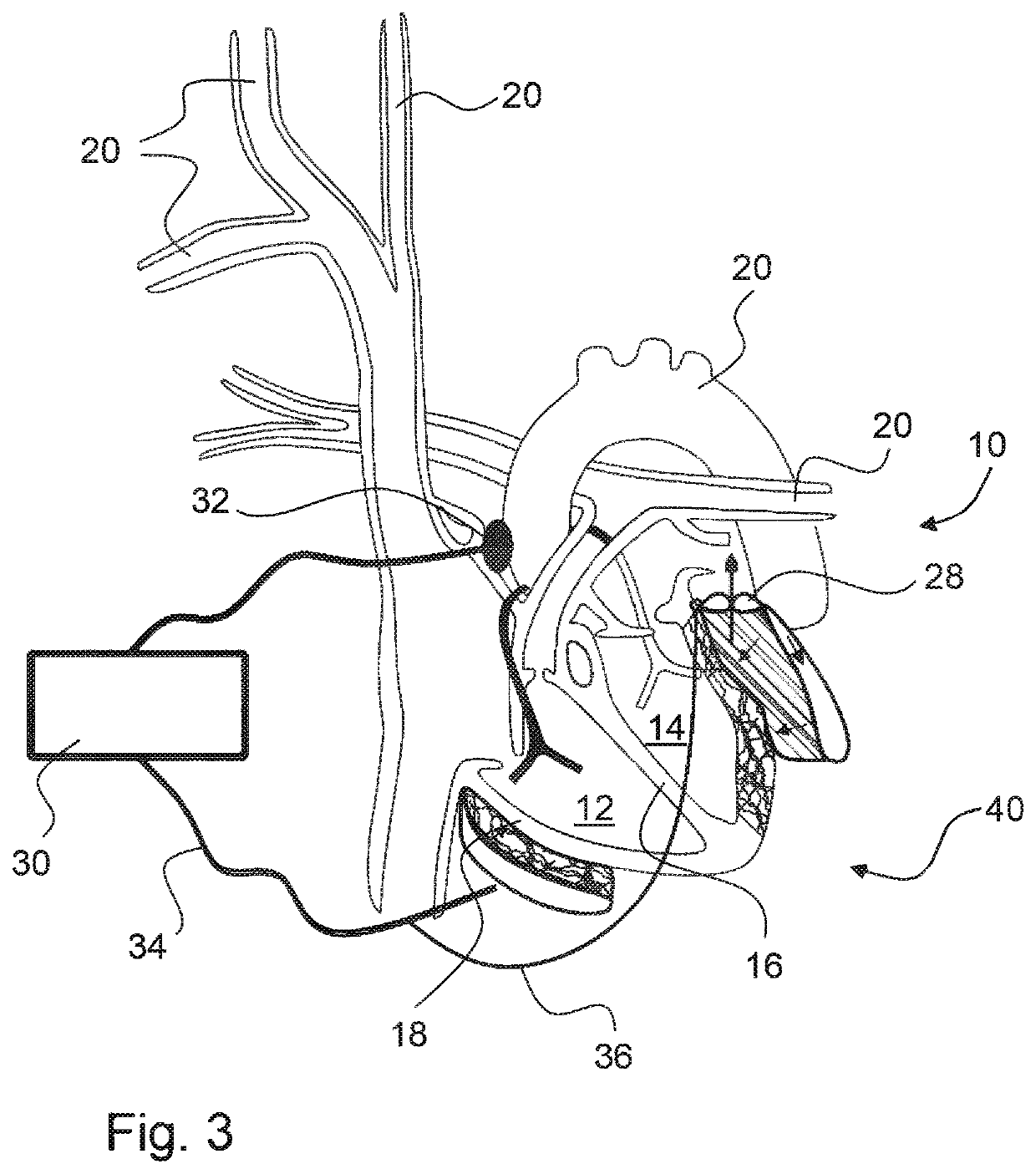
[0047]In FIG. 3, a circulatory assistance system in the form of an annular cuff 40 is shown. Aside from the fact that this cuff 40 does not surround the apex of the heart 10, this has structurally and functionally the same design as the cuff 22.

[0048]As can be seen in FIGS. 1 to 3, the cuff 22 or 40 preferably extends along the entire ventricular wall 18 and is fastened to it by means not shown, preferably mounted in an annular shape.

[0049]In normal operation the sensor 32 detects the cardiac cycle of the heart 10. In an initial state the heart 10 is in the diastolic phase, in which it is relaxed and occupies the largest volume, wherein the two ventricles fill with blood. In this state the contraction layer 24 is supplied with power so that this is in the state of greatest possible expansion. The padding layer 26 filled with an incompressible fluid at this time is located internally against the ventricular wall 18 and externally against the contraction layer 24. As soon as the contr...

third embodiment

[0051]In FIG. 4, a third embodiment is shown, which differs from the previous embodiments in that the contraction layer 24 includes a number of adjacent annular sections 41, each of which is individually controlled by the control device 30, which for the sake of clarity is only shown for the annular section marked with reference symbol 41′. This is normally a film that is subdivided into rings. Alternatively, individual film rings connected together may be provided.

[0052]Correspondingly, the padding layer 26 located beneath it is subdivided into a number of adjacent annular regions 44 separated by expandable partitions 42. Each annular region 44 has its own outlet valve 46, controlled by the control device 30 (for the sake of clarity, only shown here for one outlet valve 46′) into the environment.

[0053]The annular sections 41 are separately supplied with power by the control device 30 in a time-staggered sequence, synchronous with the cardiac contraction spreading from the cardiac a...

the structure of the environmentally friendly knitted fabric provided by the present invention; figure 2 Flow chart of the yarn wrapping machine for environmentally friendly knitted fabrics and storage devices; image 3 Is the parameter map of the yarn covering machine
Login to View More

PUM

No PUM Login to View More

Abstract

Circulatory assistance device for a heart of a living being, including a cuff for periodically applying pressure to the heart by at least one dielectric elastomer membrane which is controllable by a control device in synchronization with a cardiac beat in order to convey blood in pulses, wherein the cuff is designed to be pulled over the outside of the heart and for this purpose has an inner shape that is adapted to the outer contour of the heart at least in the region outside the ventricles, wherein the cuff is composed of an outer contraction layer including the dielectric elastomer membrane and an inner padding layer, and the inner padding layer is filled with an incompressible liquid and has at least one outlet valve, which is closed in a normal state and opened in an emergency state.

Description

CROSS-REFERENCE TO RELATED APPLICATIONS[0001]This application is the U.S. National Phase of International Patent Application No. PCT / EP2017 / 071422, filed on 25 Aug. 2017, which claims benefit of German Patent Application No. 10 2016 115 940.9, filed on 26 Aug. 2016, the contents of which are incorporated herein by reference in their entirety.BACKGROUNDField[0002]The invention relates to a circulatory assistance device for the heart of a living being.Related Art[0003]Each year about 300,000 adults in Germany become ill with heart failure. About one-third of these patients have such severe heart failure that they die within two years due to a lack of adequate treatment possibilities.[0004]In children, congenital heart defects are the most frequent cause of cardiocirculatory diseases. The criteria used to evaluate the severity of the defect are cardiac function and structural abnormalities. The most common structural defects can be treated surgically. The selection of management option...

Claims

the structure of the environmentally friendly knitted fabric provided by the present invention; figure 2 Flow chart of the yarn wrapping machine for environmentally friendly knitted fabrics and storage devices; image 3 Is the parameter map of the yarn covering machine
Login to View More

Application Information

Patent Timeline
no application Login to View More
Patent Type & Authority Patents(United States)
IPC IPC(8): A61M1/12A61M60/268A61M60/40A61M60/148A61M60/50
CPCA61M60/268A61M60/148A61M60/40A61M60/50A61M60/892A61M60/289A61M60/839A61M60/569A61M60/191A61M60/486
Inventor ALKASSAR, MUHANNAD
Owner FRIEDRICH ALEXANDER UNIV ERLANGEN NUERNBERG
Features
  • R&D
  • Intellectual Property
  • Life Sciences
  • Materials
  • Tech Scout
Why Patsnap Eureka
  • Unparalleled Data Quality
  • Higher Quality Content
  • 60% Fewer Hallucinations
Social media
Patsnap Eureka Blog
Learn More