

EP4 receptor selective agonists in the treatment of osteoporosis
a technology of ep4 receptor and selective agonist, which is applied in the direction of drug compositions, biocide, heterocyclic compound active ingredients, etc., can solve the problems of estrogen not restoring bone back to young adult levels in the established osteoporotic skeleton, the risk of osteoporosis is the greatest among the elderly, and the risk is predicted to increase significantly. , to achieve the effect of slow continuous loading
- Summary
- Abstract
- Description
- Claims
- Application Information
AI Technical Summary
Benefits of technology
Problems solved by technology
Method used
Image

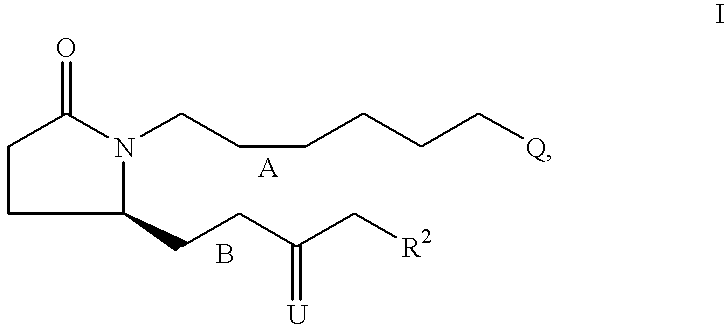
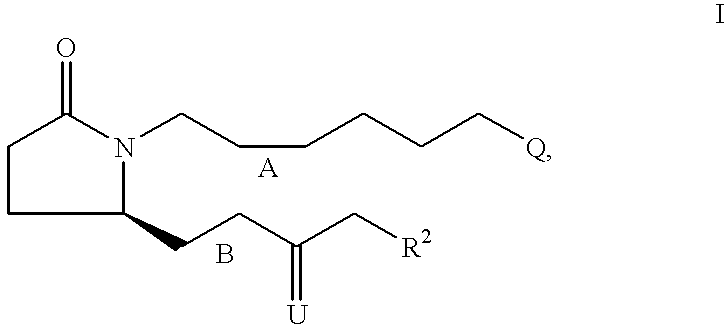

Examples
example 2
7-{2S-[3R-Hydroxy-4-(3-trifluoromethyl-phenyl)-butyl]-5-oxo-pyrrolidin-1-y-l}-heptanoic acid
[0116] 7
[0117] Step A: 7-{2-Oxo-5R-[3-oxo-4-(3-trifluoromethyl-phenyl)-but-1-enyl]--pyrrolidin-1-yl}-heptanoic acid ethyl ester. Following the procedure described for Example 1, Step A, the anion derived from [2-oxo-3-(3-trifluoromethyl-phenyl)-propyl]-phosphonic acid dimethyl ester (4.16 g, 13.40 mmol) and NaH (60% in oil, 590 mg, 14.7 mmol) was reacted with 7-(2R-formyl-5-oxo-pyrrolidin-1-yl)-heptanoic acid ethyl ester (assumed 14.74 mmol) over 24 h. Purification by medium pressure chromatography (solvent gradient 20% EtOAc in hexanes to EtOAc) provided 7-{2-oxo-5R-[3-oxo-4-(3-trifluoromethyl-phenyl)-but-1-enyl]-pyrrolidin-1--yl}-heptanoic acid ethyl ester (4.29 g). .sup.1H NMR (CDCl.sub.3) .delta.7.52 (d, 1H), 7.44 (m, 2H), 7.37 (d, 1H), 6.67 (dd, 1H), 6.22 (d, 1H), 4.80 (m, 1H), 4.08 (q, 2H), 3.90 (s, 2H), 3.54 (m, 1H), 2.70 (m, 1H), 2.37 (m, 2H), 2.24 (m, 3H), 1.78 (m, 1H), 1.56 (m, 2H),...
example 3
5S-[4-(3-Chloro-phenyl)-3-hydroxy-butyl]-1-[6-(2H-tetrazol-5-yl)-hexyl]-py-rrolidin-2-one
[0122] 8
[0123] Step A: 7-{2R-[4-(3-Chloro-phenyl)-3-oxo-but-1-enyl]-5-oxo-pyrrolid-in-1-yl}-heptanenitrile. Following the procedure described for Example 1, Step A, the anion derived from [3-(3-chloro-phenyl)-2-oxo-propyl]-phospho-nic acid dimethyl ester (3.35 g, 12.12 mmol) and NaH (60% in oil, 533 mg, 13.3 mmol) was reacted with 7-(2R-formyl-5-oxo-pyrrolidin-1-yl)-heptaneni-trile (assumed 13.3 mmol) over 18 h. Purification by medium pressure chromatography (20% EtOAc in hexanes to 80% EtOAc in hexanes) provided 7-{2R-[4-(3-chloro-phenyl)-3-oxo-but-1-enyl]-5-oxo-pyrrolidin-1-yl}-hepta-nenitrile (1.52 g). .sup.1H NMR (CDCl.sub.3) .delta.7.24 (m, 2H), 7.17 (s, 1H), 7.06 (m, 1H), 6.64 (dd, 1H), 6.20 (d, 1H), 4.15 (m, 1H), 3.80 (s, 2H), 3,50 (m, 1H), 2.72 (m, 1H), 2.46-2.20 (m, 5H), 1.78 (m, 1H), 1.59 (m, 2H), 1.40 (m, 4H), 1.24 (m, 2H).
[0124] Step B: 7-{2S-[4-(3-Chloro-phenyl)-3-oxo-butyl]-5-oxo-p...
example 4
5S-[3R-Hydroxy-4-(3-trifluoromethyl-phenyl)-butyl]-1-[6-(2H-tetrazol-5-yl)--hexyl]-pyrrolidin-2-one
[0127] 9
[0128] Step A: 7-{2-Oxo-5R-[3-oxo-4-(3-trifluoromethyl-phenyl)-but-1-enyl]--pyrrolidin-1-yl}-heptanenitrile. Following the procedure described for Example 1, Step A, the anion derived from [2-oxo-3-(3-trifluoromethyl-phe-nyl)-propyl]-phosphonic acid dimethyl ester (2.68 g, 8.64 mmol) and NaH (60% in oil, 400 mg, 10 mmol) was reacted with 7-(2R-formyl-5-oxo-pyrroli-din-1-yl)-heptanenitrile (assumed 10 mmol) over 18 h. Purification by medium pressure chromatography (30% EtOAc in hexanes to 80% EtOAc in hexanes) provided 7-{2-oxo-5R-[3-oxo-4-(3-trifluoromethyl-phenyl)-but-1-e-nyl]-pyrrolidin-1-yl}-heptanenitrile (1.2 g). .sup.1H NMR (CDCl.sub.3) .delta.7.52 (m, 1H), 7.45 (m, 2H), 7.37 (m, 1H), 6.67 (dd, 1H), 6.23 (d, 1H), 4.18 (m, 1H), 3.90 (s, 2H), 3.53 (m, 1H), 2.73 (m, 1H), 2.45-2.23 (m, 5H), 1.79 (m, 1H), 1.60 (m, 2H), 1.41 (m, 4H), 1.24 (m, 2H); MS 407.2 (M+1), 405.3 (M-1).
[0...
PUM
| Property | Measurement | Unit |
|---|---|---|
| Mass | aaaaa | aaaaa |
| Selectivity | aaaaa | aaaaa |
Abstract
Description
Claims
Application Information
 Login to View More