These perforated sheet meshes have limited flexibility and limited three-dimensional contourability due to their generally
solid or closed structures.
Accordingly, they are difficult to three-dimensionally contour to irregular or intricate portions of skeletal
anatomy in some cases and are prone to kinking.
Kinking is undesirable because it causes
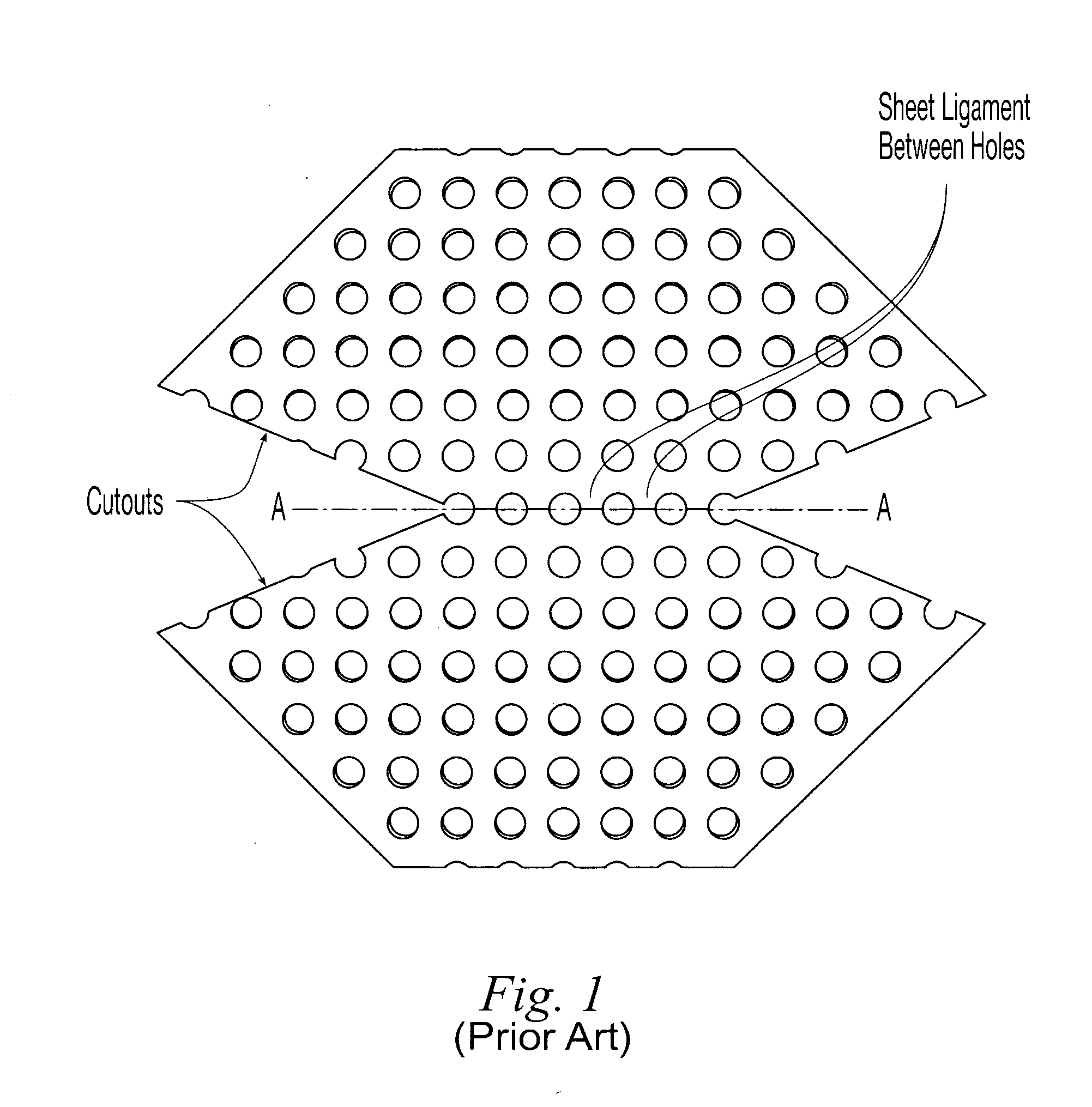
soft tissue irritation and other problems. FIG. 1 shows an example of such a prior art
solid perforated sheet mesh having triangular relief cuts typically made by surgeons for applying this type of mesh to the frontal part of the
skull.
One drawback of making such customized relief cutouts is the process extends surgical time.
Another drawback is that the cutouts themselves reduce the strength of the final mesh construct because the narrow section at the center of the mesh along line A-A has decreased
flexural rigidity, discussed in more detail below.
The more highly contourable open-structured metallic meshes dicussed above, however, may not be suitable for all surgical applications and have some disadvantages.
In addition to extending surgical time, such
cutting tends to leave sharp metallic burrs that can cause
soft tissue irritation and patient discomfort.
Still another
disadvantage of metallic meshes are that the arms interconnecting the
fastener holes sometimes tend to protrude upwards when contoured in three dimensions, thereby creating raised portions or points which do not lie flat against the bone, and may cause
soft tissue irritation.
Significantly, a major drawback of the open-structured metallic meshes is that they sometimes require a second surgical procedure to remove the mesh after the bone has fully mended.
Allowing the metallic meshes to remain
in vivo may be undesirable for other reasons, including that the meshes can sometimes be seen and felt by the patient, particularly where
skin coverage over the bone is thin.
Thus, the general
perception has been that the inherently weaker
resorbable polymers rendered them generally unsuitable and impractical for use in making the more intricate and delicate open-structured implants, such as the highly contourable meshes discussed above that heretofore were made of
metal.
Moreover, thicknesses comparable to the relatively thin open-structured metallic meshes may be difficult to achieve without sacrificing strength.
Therefore, although resorbable meshes of the closed-structured perforated sheet type may have some disadvantages when applied to an irregularly and intricately contoured part of the skeletal
anatomy (i.e., kinking, relief cutouts needed decreasing strength of the mesh and increasing surgical time, etc.), those type meshes continued to be widely used heretofore in such surgical applications.


 Login to View More
  Login to View More