Fuel components and their selective manufacturing methods
a technology of isobutene and fuel components, which is applied in the direction of hydrocarbon preparation catalysts, separation processes, organic chemistry, etc., can solve the problems of intensive accumulation of oligomers and polymers in conventional dimerizing and etherification (mtbe) catalysts, and achieve the effect of prolonging the service life of the catalys
- Summary
- Abstract
- Description
- Claims
- Application Information
AI Technical Summary
Benefits of technology
Problems solved by technology
Method used
Image


Examples
example 1
[0053] In the example, a mixture of isobutene / isopentane is dimerized as a semi batch mode in 35 ml ampoules at a temperature of 80° C. by means of various catalysts. The properties of the catalysts used in the comparison are shown in the appended table. The reaction mixture was replaced daily. Feed 1 was used to carry out two sets of tests, the one of which lasted 2 weeks, and the other one 5 weeks. The amount of dry catalyst per fresh feeding solution that was replaced daily was about 57 g / l. The composition of the Feed 1 used in the tests (in FIG. 1 2 week and 5 weeks) was as follows:
Isobutene 30%N-butane 1.2%Isobutane 3.2%1-butene 0.1%Isopentane59.9%Tertiary butyl 0.5%alcohol (TBA)N-pentane 5.1%
[0054] Furthermore, a dimerization test of one day (in the figure 0 weeks) was conducted as a batch test by using the feed presented below:
Isobutene36%Isobutane60%Tertiary butyl 4%alcohol (TBA)
[0055] The amount of dry catalyst per fresh feeding solution in Feed 2 was about 35 g / l. Th...
example 2
[0057] In the example, a typical refinery feed was dimerized continuously in a reactor tube, the composition being as follows:
isobutene 15% by weightn-butane 11% by weight isobutane23.5% by weight 1-butene14.5% by weight cis-2-butene10.5% by weight trans-2-butene15.5% by weight tertiary butyl 1.3% by weight alcohol (TBA)sec-butanol 0.7% by weight other C2-C6 8.0% by weight
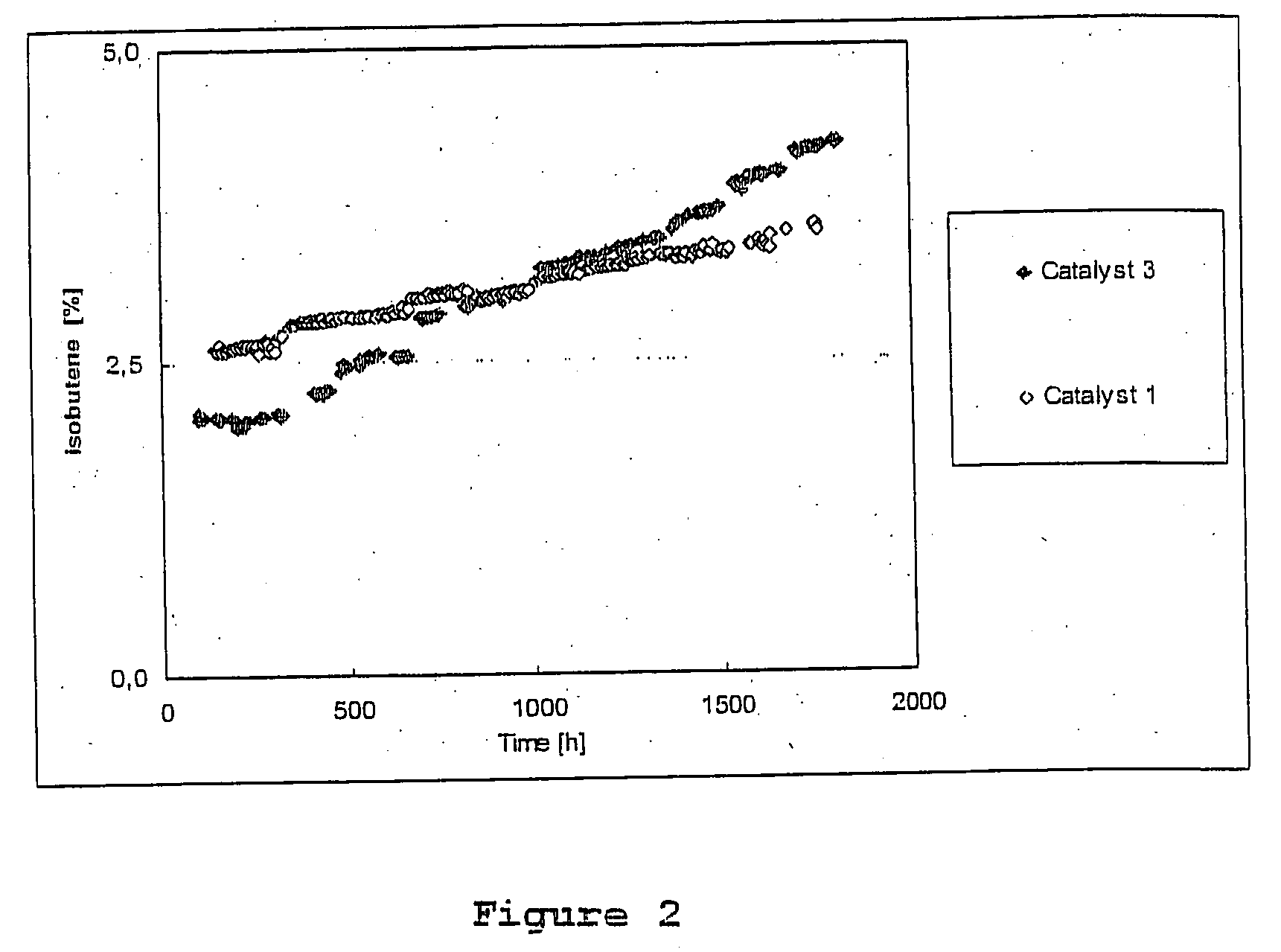
[0058] The temperature was 82° C. Catalyst 3 and Catalyst 1 were used as catalysts. FIG. 2 presents the increase in the isobutene content at the output of the reactor as a function of time.
[0059] The results indicate that Catalyst 1, which has the said properties, maintains its activity for a considerably longer time than Catalyst 3, which has no said properties.
[0060] The results also indicate that because of the larger number of active sites of Catalyst 3, the isobutene reacts more at the beginning than with Catalyst 1. However, the loss of activity of Catalyst 3 already at about the 1000th hour is so grea...
example 3
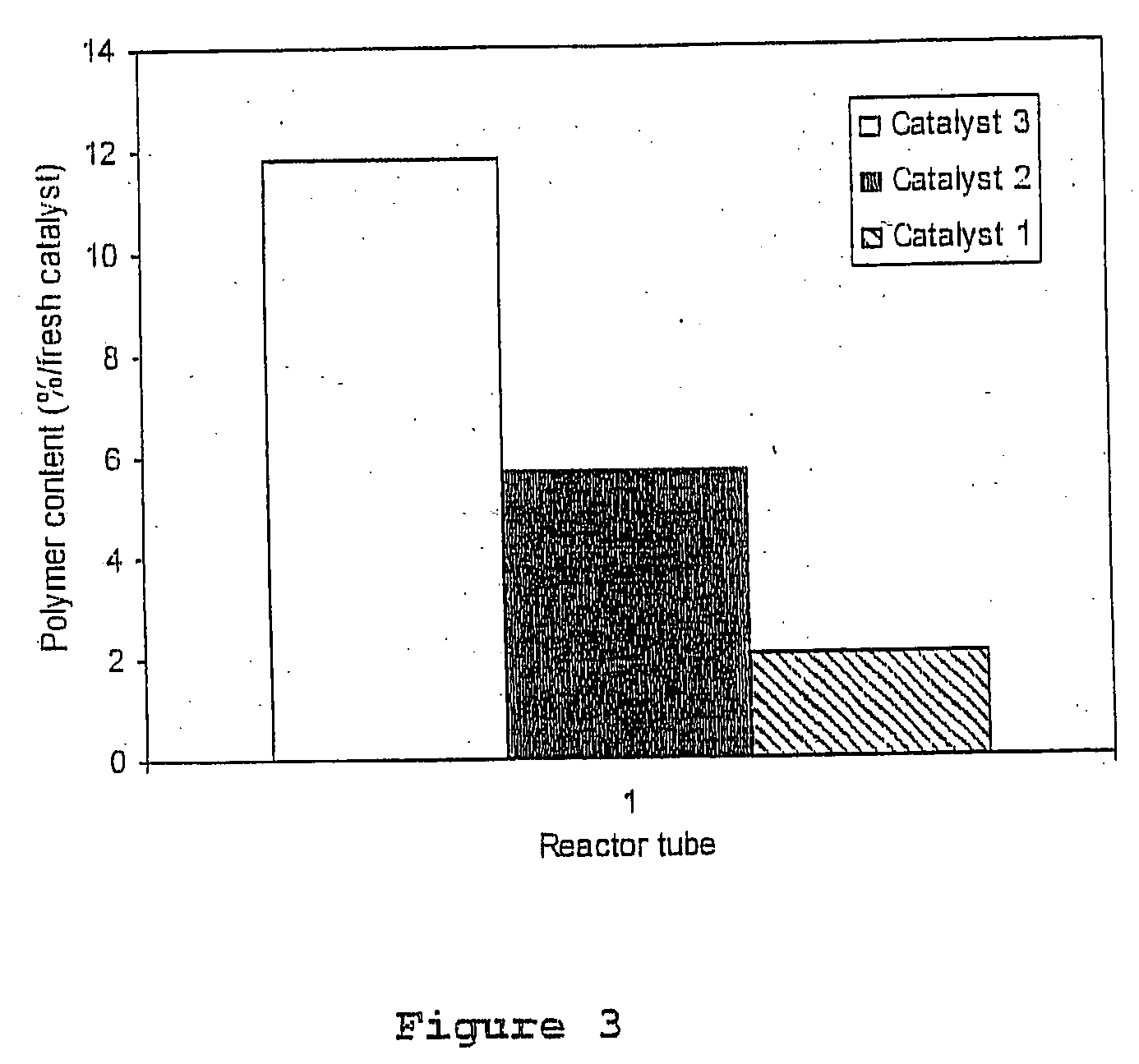
[0061] In the example, a mixture of isobutene / isobutane was dimerized continuously in an isothermal reactor tube, where part of the reactor's product was recycled back to the reactor's feed. In this way, in addition to the isobutene, also its oligomers were obtained in the reactor's feed, whereby the deactivation of the catalyst was accelerated. In this way, it was possible to examine the deactivation in a shorter period of time.
[0062] The composition of the feed was as follows:
Isobutene 30% by weightIsobutane 69% by weight Hexane0.5% by weight Tertiary butyl0.5% by weight alcohol
[0063] The test was carried out using Catalyst 1, Catalyst 2, and Catalyst 3 at a temperature of 80° C. The duration of the test was 7 days. The polymer content was analysed by the 13C CPMAS NMR method and calculated per dry catalyst. A catalyst sample was taken from the last part of the reactor. The results are shown in FIG. 3.
[0064] The results indicate that when using Catalyst 1, an amount correspond...
PUM
| Property | Measurement | Unit |
|---|---|---|
| diameter | aaaaa | aaaaa |
| diameter | aaaaa | aaaaa |
| Octane Number | aaaaa | aaaaa |
Abstract
Description
Claims
Application Information
 Login to View More
 - R&D
- Intellectual Property
- Life Sciences
- Materials
- Tech Scout
- Unparalleled Data Quality
- Higher Quality Content
- 60% Fewer Hallucinations
Browse by: Latest US Patents, China's latest patents, Technical Efficacy Thesaurus, Application Domain, Technology Topic, Popular Technical Reports.
© 2025 PatSnap. All rights reserved.Legal|Privacy policy|Modern Slavery Act Transparency Statement|Sitemap|About US| Contact US: help@patsnap.com