This helps you quickly interpret patents by identifying the three key elements:
Problems solved by technology
Method used
Benefits of technology
Benefits of technology
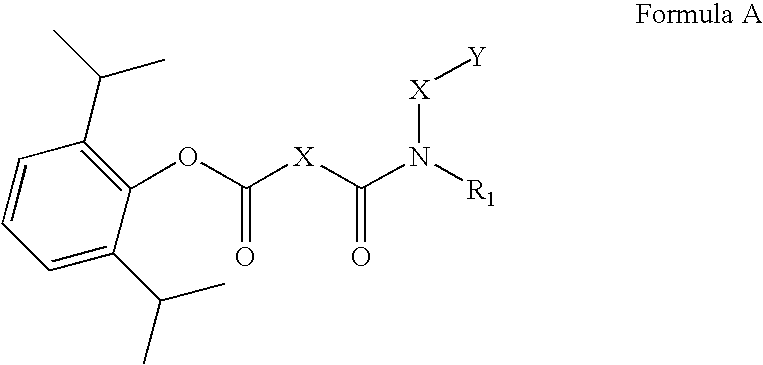
[0013] Specifically, the compounds of the present invention convert to 2,6-diisopropylphenol in vivo and can be used as hypnotic agents, anti-convulsives, anti-pruritics, and anti-emetics. Other uses include treatment of oxidative tissue damage, inflammation and cancer. The prodrug compounds of the present invention have many advantages over 2,6-diisopropylphenol by virtue of increased aqueous solubility and increased stability towards oxidation over the parent compound thus making them particularly suitable for intravenous (i.v.) formulations. Therefore when used in a mammalian subject, the compounds of this invention replicate every therapeutic application that has been described for 2,6-diisopropylphenol. Other advantages of the compounds of the present invention include low toxicity and high therapeutic-to-toxicity index.
Problems solved by technology
The aforementioned formulations have many limitations.
They cause allergic side effects and pain upon injection.
Their preparation is difficult and costly and most importantly they cannot be sterilized and hence anti-microbial agents must be added to the formulations.
The low water solubility of this compound presents a significant formulation challenge.
The currently approved mode of administration for Propofol is an emulsion that has many disadvantages including costly preparation and sterilization procedures.
Oxidation of Propofol to unwanted side-products in the presence of oxygen and light drastically shortens the shelf life of such formulations.
In addition, the oil-in-water emulsions cause a number of clinical side effects including pain on injection and pulmonary embolism.
Method used
the structure of the environmentally friendly knitted fabric provided by the present invention; figure 2 Flow chart of the yarn wrapping machine for environmentally friendly knitted fabrics and storage devices; image 3 Is the parameter map of the yarn covering machine
View more
Image
Smart Image Click on the blue labels to locate them in the text.
Viewing Examples
Smart Image
Click on the blue label to locate the original text in one second.
Reading with bidirectional positioning of images and text.
Smart Image
Examples
Experimental program
Comparison scheme
Effect test
example 1
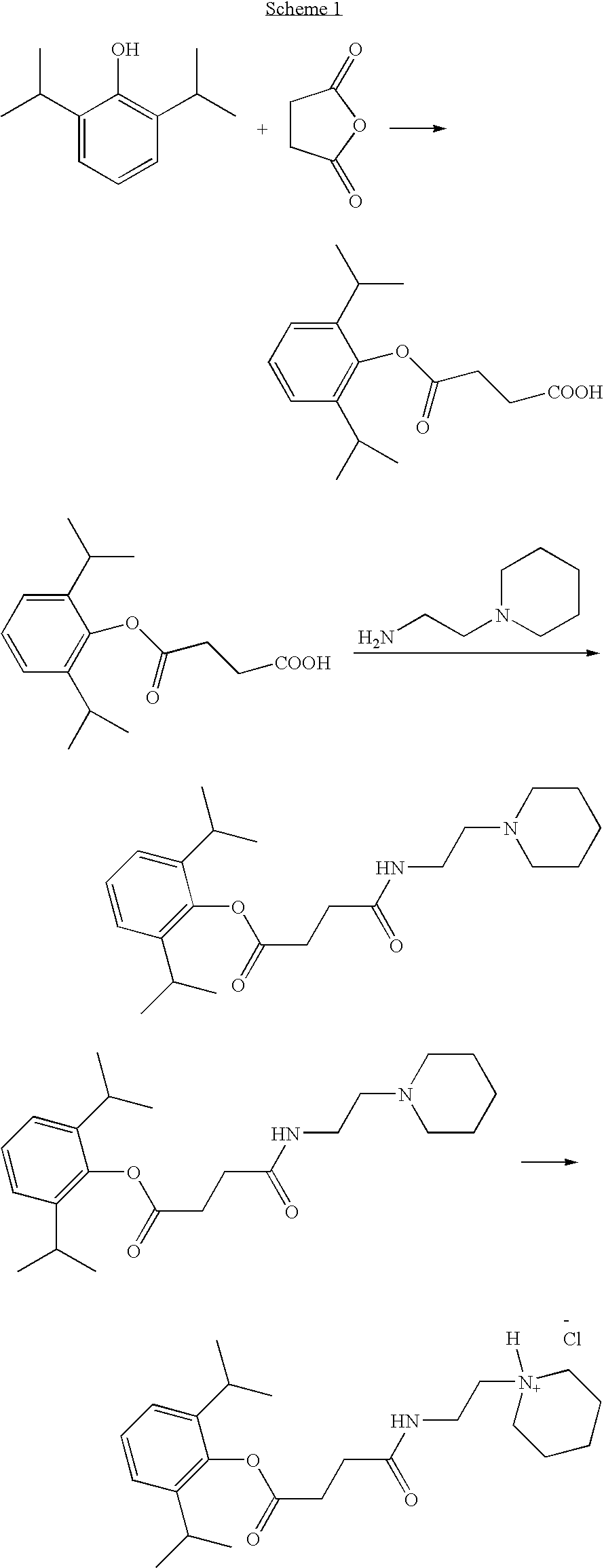
Propofol Hemisuccinate
[0157]
[0158] To a solution of 2,6-diisopropylphenol (4.0 g, 22.4 mmol) in 15 mL of Et3N was added succinic anhydride (2.8 g, 28 mmol) and a catalytic amount of DMAP (10 mg) under N2 atmosphere. The reaction mixture was stirred at ambient temperature overnight. The solvent was removed under vacuum and the residue was dissolved in water (30 mL) and added to a cold solution of 1 N HCl (150 mL). The precipitate was filtered and dried. Recrystallization from ethanol-water (2:1) mixture gave 2,6-diisopropylphenyl hemisuccinate as a white crystalline solid. Yield: 5.8 gram (94%).
[0161] To a solution of propofol hemisuccinate (2.0 g, 7.2 mmol) in THF—CH2Cl2 (1:1, 60 mL) was added EDCl (1.72 g, 9 mmol) followed by HOBt (1.37 g, 9 mmol). The reaction mixture was stirred at ambient temperature for 15 min and 1-(2-aminoethyl)pyrrolidine (0.912 g, 8 mmol) was added and stirring was maintained overnight. 10% aqueous citric acid (50 ml) was added and the mixture was extracted with CH2Cl2 (100 ml×2). The organic layer was washed with brine and dried over anhydrous MgSO4. The solvent was removed and the product was purified by silica gelcolumn chromatography using acetone with 1% Et3N. Removal of the solvent gave the product as an oil. Yield: 2.47 gram (92%)
the structure of the environmentally friendly knitted fabric provided by the present invention; figure 2 Flow chart of the yarn wrapping machine for environmentally friendly knitted fabrics and storage devices; image 3 Is the parameter map of the yarn covering machine
Login to View More
PUM
Property
Measurement
Unit
Mass
aaaaa
aaaaa
Mass
aaaaa
aaaaa
Concentration
aaaaa
aaaaa
Login to View More
Abstract
The present invention is directed to water-soluble derivatives of 2,6-diisopropylphenol (Propofol). The compounds act as prodrugs of 2,6-diisopropylphenol and metabolize rapidly to Propofol thereby providing an alternative to the water-insoluble 2,6-diisopropylphenol. Pharmaceutical compositions comprising these compounds, methods of induction and maintenance of anesthesia or sedation as well as methods of treating neurodegenerative diseases utilizing pharmaceutical compositions comprising these compounds and methods of preparing them are also disclosed.
Description
FIELD OF THE INVENTION [0001] The invention relates generally to prodrugs and more specifically to water-soluble derivatives of 2,6-diisopropylphenol (Propofol). BACKGROUND OF THE INVENTION [0002] 2,6-diisopropylphenol is highly lipophilic and is practically insoluble in water. For intravenous applications, it is formulated in water using a variety of solubilizing agents and / or emulsifiers. Examples of such formulations include Cremophor™, Intralipid™, Diprivan™, Disoprofol™, Disoprivan™, and Rapinovet™. The aforementioned formulations have many limitations. They cause allergic side effects and pain upon injection. Their preparation is difficult and costly and most importantly they cannot be sterilized and hence anti-microbial agents must be added to the formulations. [0003] Propofol or 2,6-diisopropylphenol is a short acting anesthetic that is administered intravenously (i.v.) to mammalian subjects. The low water solubility of this compound presents a significant formulation challe...
Claims
the structure of the environmentally friendly knitted fabric provided by the present invention; figure 2 Flow chart of the yarn wrapping machine for environmentally friendly knitted fabrics and storage devices; image 3 Is the parameter map of the yarn covering machine
Login to View More
Application Information
Patent Timeline
Application Date:The date an application was filed.
Publication Date:The date a patent or application was officially published.
First Publication Date:The earliest publication date of a patent with the same application number.
Issue Date:Publication date of the patent grant document.
PCT Entry Date:The Entry date of PCT National Phase.
Estimated Expiry Date:The statutory expiry date of a patent right according to the Patent Law, and it is the longest term of protection that the patent right can achieve without the termination of the patent right due to other reasons(Term extension factor has been taken into account ).
Invalid Date:Actual expiry date is based on effective date or publication date of legal transaction data of invalid patent.


 Login to View More