
Organic bistable memory and method of manufacturing the same
a memory and organic technology, applied in thermoelectric devices, instruments, nanoinformatics, etc., can solve the problems of increasing the on/off current ratio of the memory, prolonging the retention time, and difficult control of the organic bistable memory
- Summary
- Abstract
- Description
- Claims
- Application Information
AI Technical Summary
Benefits of technology
Problems solved by technology
Method used
Image

Examples
second embodiment
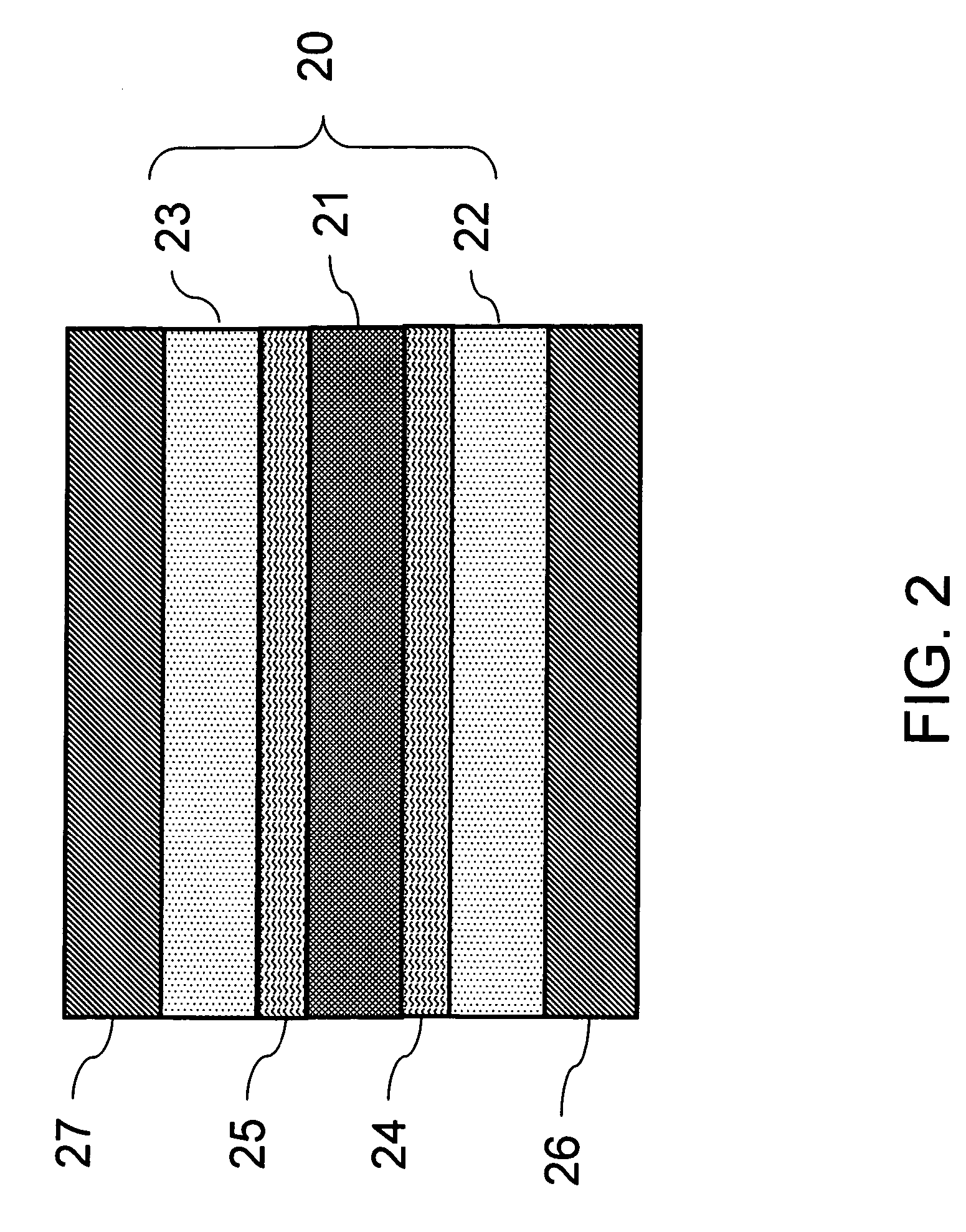
[0029] Reference is made to FIG. 2, which is a structural schematic of the organic bistable memory according to the invention. The embodiment comprises a bistable body 20 with a conductive layer 21, a first organic layer 22 and a second organic layer 23. On two sides of the conductive layer 21, a first dielectric layer 24 and a second dielectric layer 25 are respectively formed. The side of the first organic layer 22 not in contact with the bistable body 20 is formed with a first electrode 26, and the side of the second organic layer 23 not in contact with the bistable body 20 is formed with a second electrode 27.
third embodiment
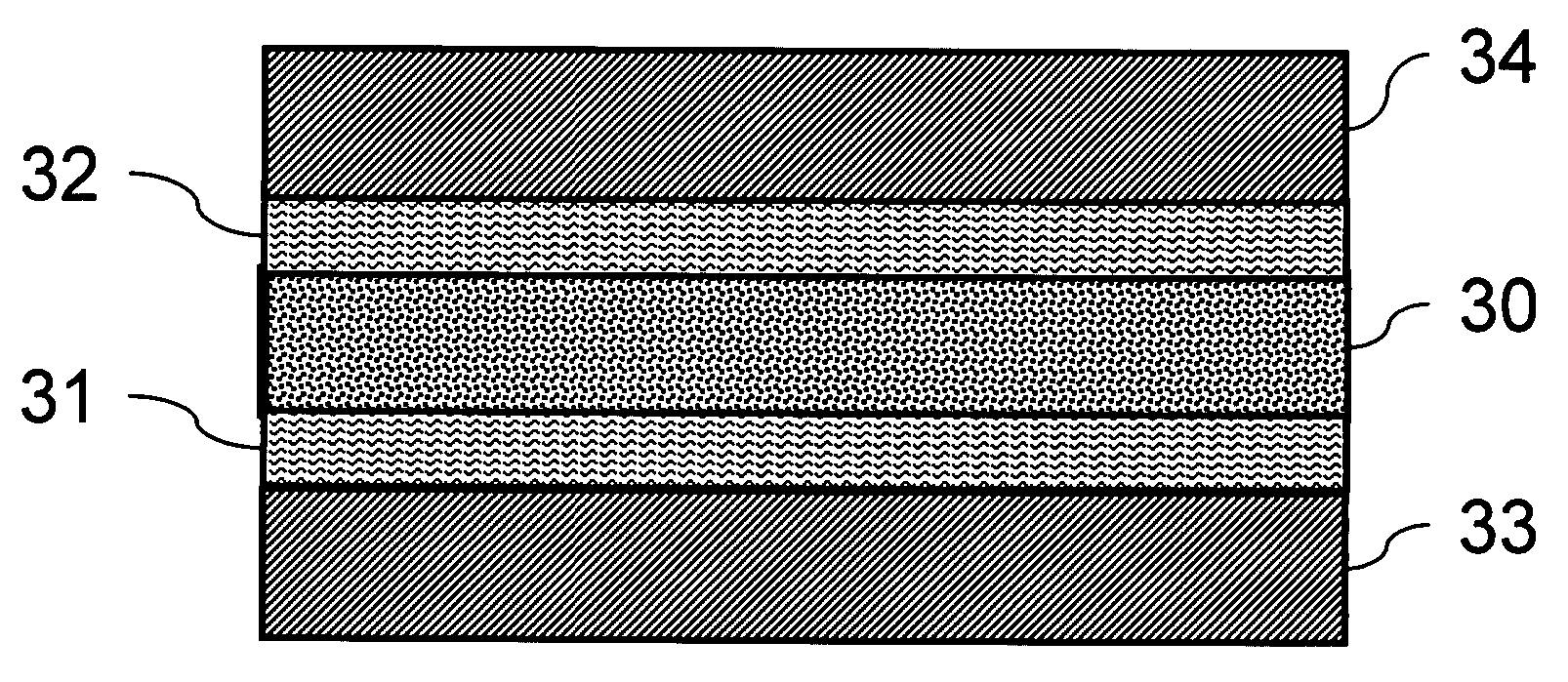
[0030] Refer to FIG. 3, which is a structural schematic of the organic bistable memory according to the invention. This embodiment comprises a bistable body 30 composed of a material with nanoparticles of high conduction and a material of low conduction. On two sides of the bistable body 30, a first dielectric layer 31 and a second dielectric layer 32 are formed. The side of the first dielectric layer 31 not in contact with the bistable body 30 is formed with a first electrode 33, and the side of the second dielectric layer 32 not in contact with the bistable body 30 is formed with a second electrode 34.
[0031] According to the invention, the conductive layers and the organic layers in the first, second, and third embodiments are the same. The conductive layer may be a material of high conduction, such as metal and super-conductive material, which may be aluminum, copper or silver. Other materials with high work function such as gold and nickel, materials with middle work function su...
PUM
| Property | Measurement | Unit |
|---|---|---|
| Time | aaaaa | aaaaa |
| Thickness | aaaaa | aaaaa |
| Thickness | aaaaa | aaaaa |
Abstract
Description
Claims
Application Information
 Login to View More