Point of load regulator having a pinstrapped configuration and which performs intelligent bus monitoring

a load regulator and pinstrap technology, applied in the direction of electric controllers, instruments, ignition automatic control, etc., can solve the problems of not being able to route high-current signals through the system, the power supply design is now a much more critical and difficult task, and the delivery of power is new and significant problems, so as to reduce the overall cost of implementation

a load regulator and pinstrap technology, applied in the direction of electric controllers, instruments, ignition automatic control, etc., can solve the problems of not being able to route high-current signals through the system, the power supply design is now a much more critical and difficult task, and the delivery of power is new and significant problems, so as to reduce the overall cost of implementation

US20060149396A1Active Publication Date: 2006-07-06INTERSIL INC

Image

Smart Image Click on the blue labels to locate them in the text.
Viewing Examples
Smart Image
  • Point of load regulator having a pinstrapped configuration and which performs intelligent bus monitoring
  • Point of load regulator having a pinstrapped configuration and which performs intelligent bus monitoring
  • Point of load regulator having a pinstrapped configuration and which performs intelligent bus monitoring

Examples

Experimental program
Comparison scheme
Effect test

Embodiment Construction

[0059] As used herein, a “trigger” signal is defined as a signal that is used to initiate, or “trigger”, an event or a sequence of events in a digital system. A trigger signal is said to be in a “triggering state” at a time when it initiates a desired event, or sequence of events. A periodic trigger signal may commonly be referred to as a “clock”. In a “synchronous” digital system, generally a clock, commonly referred to as a “system clock”, may be used for initiating most events, or sequences of events. An example of a triggering state may be, but is not limited to, a rising edge of a pulse of a clock in a synchronous digital system. A “frequency” of pulses refers to a number of pulses that may appear within a selected unit period of time. For example, if twenty pulses appear within duration of one second, then the frequency of the pulses is 20 Hz.

[0060] When an event, or a sequence of events, is said to be initiated “in response to” receiving a stimulus signal, it may be implied ...

the structure of the environmentally friendly knitted fabric provided by the present invention; figure 2 Flow chart of the yarn wrapping machine for environmentally friendly knitted fabrics and storage devices; image 3 Is the parameter map of the yarn covering machine
Login to View More

PUM

No PUM Login to View More

Abstract

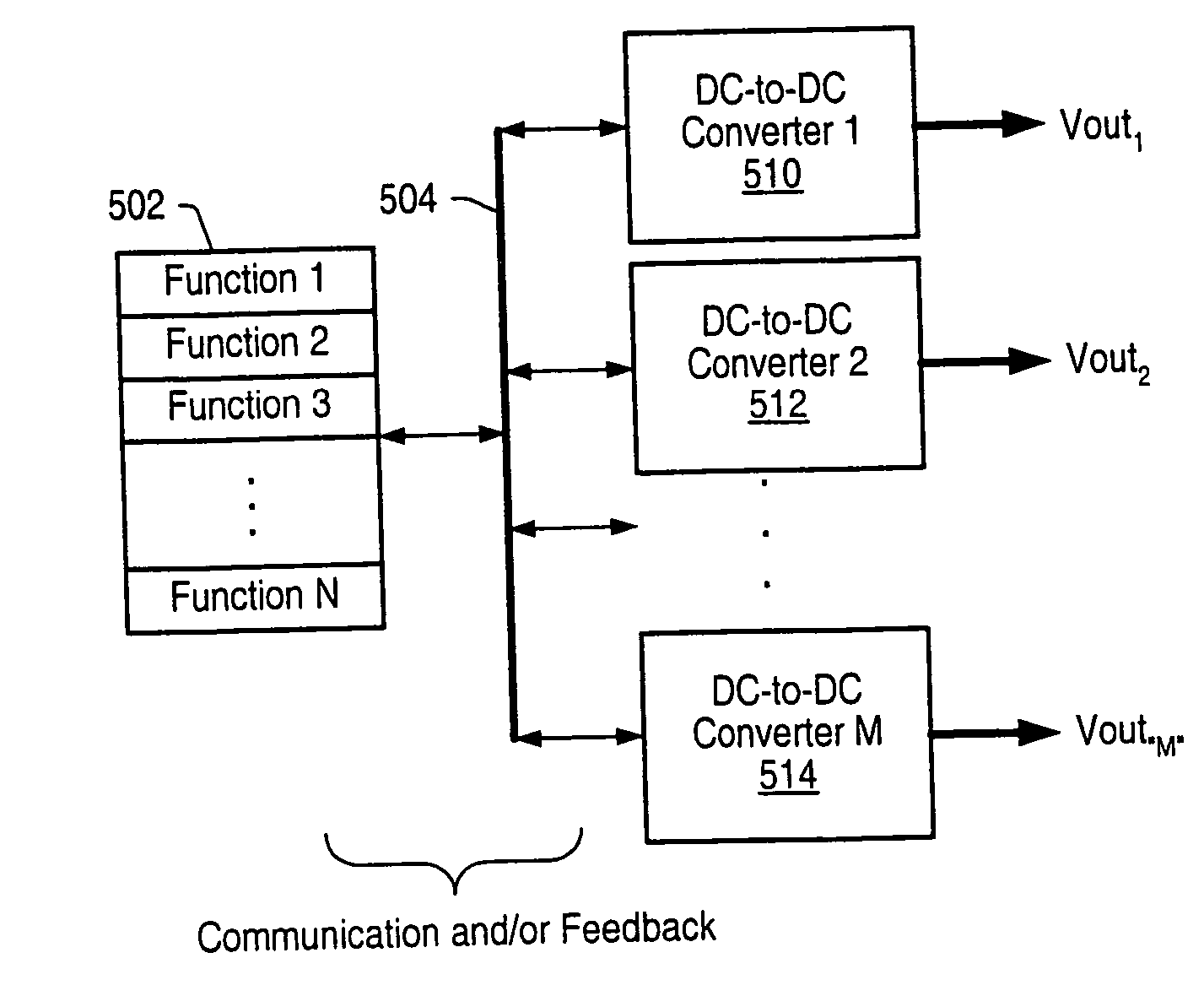
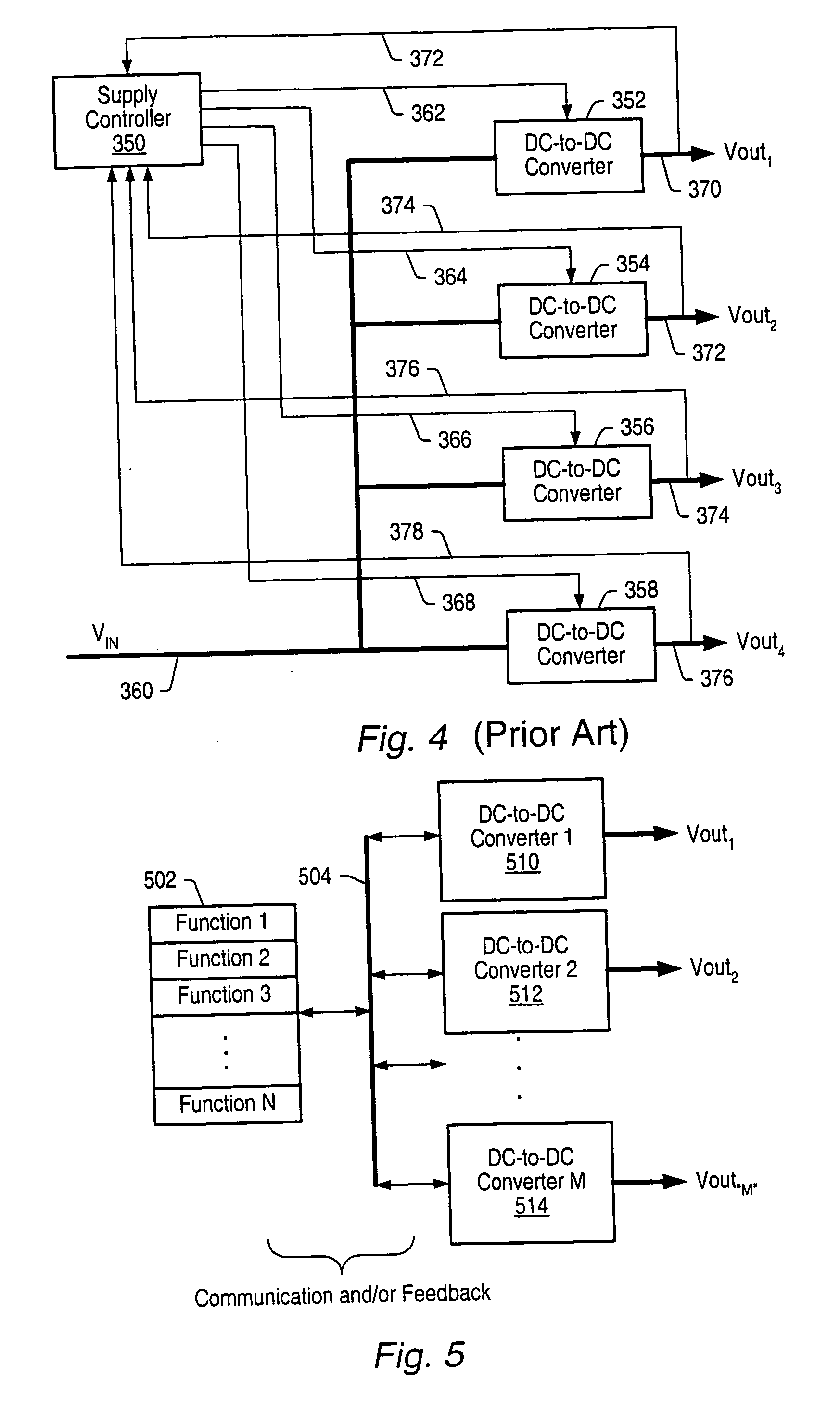
A new system-level approach to managing the delivery of DC voltage and current. Several system level functions may be enabled without requiring separate ICs to perform those functions. Supervisory functions for a voltage converter may be performed by a central control module or chip that may be coupled to point-of-load voltage converters comprised in digital power management devices (DPMD) through a serial digital bus. The DPMDs may also use the high-speed serial digital bus to provide real-time feedback information to the central control module or chip. Single DPMDs may be combined together in a current sharing configuration in a “plug-and-play” fashion, where the control logic in each DPMD is capable of automatically establishing control loops required a multi-phase supply. Feedback necessary for establishing control may be transmitted across the digital bus coupling the devices. The supervisory functions may be included in each DPMD, which may communicate with each other over a serial digital bus, where the DPMDs singly or together may operate to perform control of their respective POLs, enabling configurations that do not require a central control module.

Description

PRIORITY CLAIM [0001] This application is a continuation of co-pending application Ser. No. 10 / 820,976 filed on Apr. 8, 2004 titled “Method And Apparatus For Improved DC Power Delivery, Management And Configuration”, whose inventor was James W. Templeton, which claims benefit of priority of provisional application Ser. No. 60 / 462,414 titled “Method And Apparatus For Improved DC Power Delivery, Management And Configuration” and filed Apr. 11, 2003, which are both hereby incorporated by reference as though fully and completely set forth herein.BACKGROUND OF THE INVENTION [0002] 1. Field of the Invention [0003] The present invention relates generally to power systems. More specifically, the present invention provides an improved method and apparatus for DC power delivery, management and configuration. [0004] 2. Description of the Related Art [0005] From 1995 to 2001, the highest density processors from manufacturers such as Intel went from a power consumption rate of about 30 Watts at ...

Claims

the structure of the environmentally friendly knitted fabric provided by the present invention; figure 2 Flow chart of the yarn wrapping machine for environmentally friendly knitted fabrics and storage devices; image 3 Is the parameter map of the yarn covering machine
Login to View More

Application Information

Patent Timeline
06 Jul 2006
Publication
US20060149396A1
IPC
G05B11/01; H02J1/10; H02J13/00
CPC
H02J1/102; H02J13/0003; H02J1/001; H02J13/00002; H02J13/00016; Y04S10/30; Y02E60/00
Inventors
TEMPLETON, JAMES W.