Differential to single-ended converter
a converter and single-ended technology, applied in the field of electronic converters, can solve the problems of reducing the common mode rejection ratio of the converter, asymmetry, and burdening the approach, and achieve the effect of large common mode rejection ratio (cmrr)
- Summary
- Abstract
- Description
- Claims
- Application Information
AI Technical Summary
Benefits of technology
Problems solved by technology
Method used
Image

Examples
Embodiment Construction
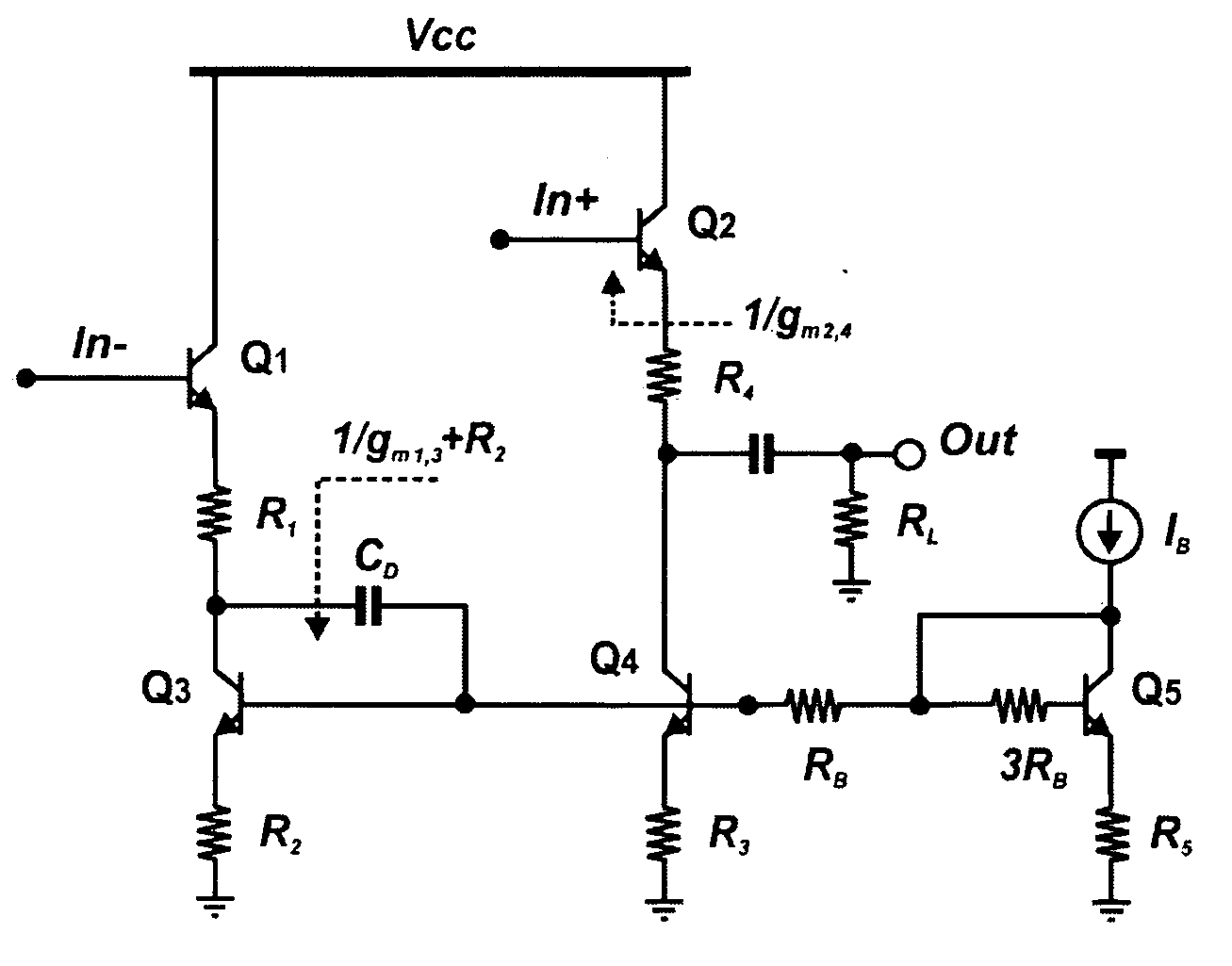
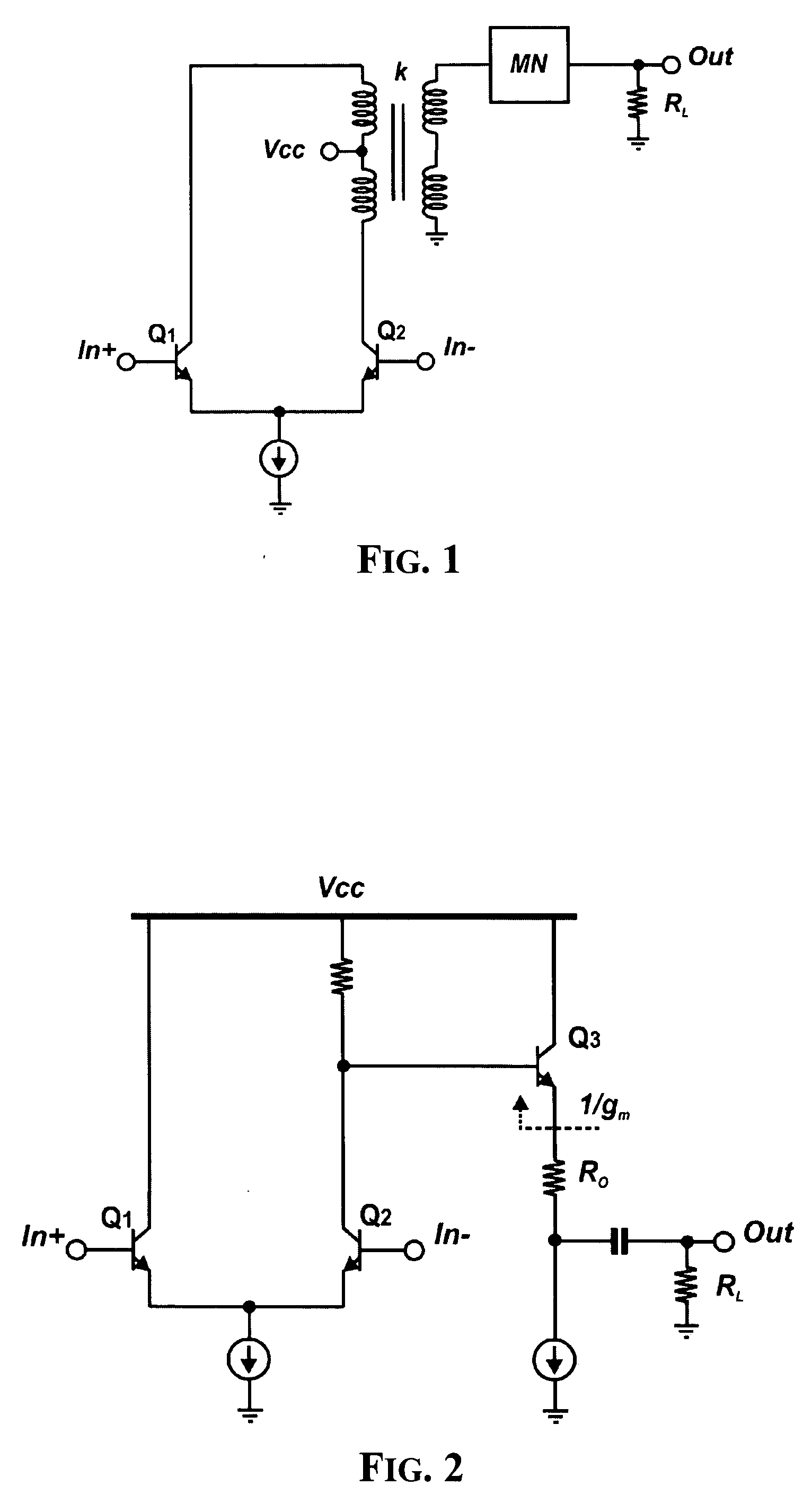
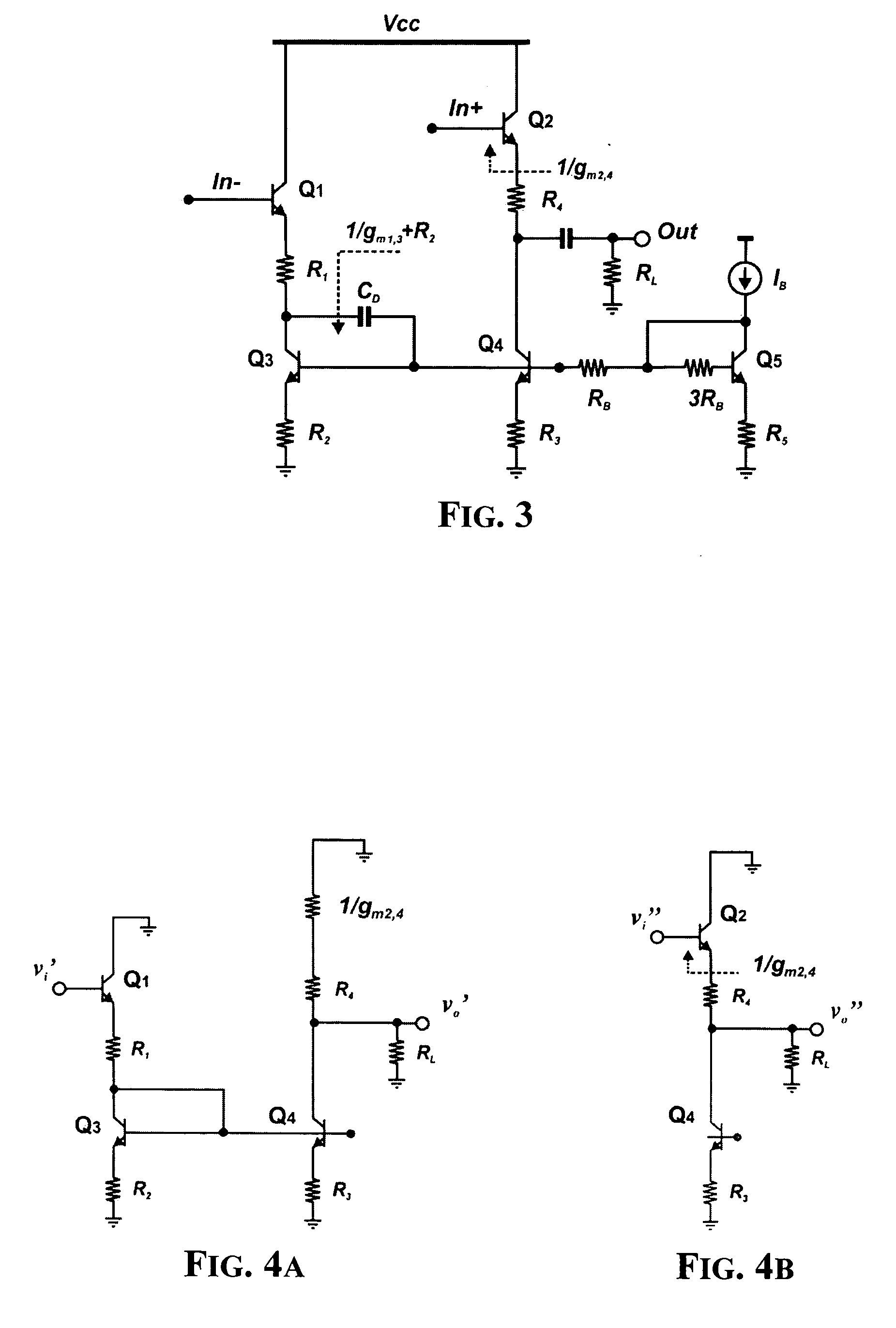
[0022] An embodiment of the converter of this invention is depicted in FIG. 3. By way of example, the converter is realized in BJT technology, but the considerations that will be made apply mutatis mutandis to a similar converter realized in MOS technology and to equivalent circuits in which the conductivity type of the transistors employed is reversed. The converter employs a differential pair of transistors Q1, Q2 in an emitter follower configuration, each biased by a respective current generator Q3, Q4. Preferably, these current generators are implemented by mirroring the two transistors Q3, Q4 to a same transistor Q5 biased with a reference current IB.
[0023] Resistors R2, R3 and R5 are dimensioned such that the gain of the converter for each of the two input nodes be the same. Resistor R4 is used for matching the output impedance and its value is determined by the following equation: RL=R4+1gm 2,4(2)
The two resistors R2 and R3 must satisfy the following equation:
R2·gm2,4=R...
PUM
 Login to View More
 Abstract
Description
Claims
Application Information
 Login to View More
 - R&D
- Intellectual Property
- Life Sciences
- Materials
- Tech Scout
- Unparalleled Data Quality
- Higher Quality Content
- 60% Fewer Hallucinations
Browse by: Latest US Patents, China's latest patents, Technical Efficacy Thesaurus, Application Domain, Technology Topic, Popular Technical Reports.
© 2025 PatSnap. All rights reserved.Legal|Privacy policy|Modern Slavery Act Transparency Statement|Sitemap|About US| Contact US: help@patsnap.com