Position determination using carrier phase measurements of satellite signals

a satellite signal and carrier phase technology, applied in surveying and navigation, instruments, navigation instruments, etc., can solve the problems of ambiguity resolution, the difference in the phase delay of a carrier signal received by the base and rover receivers may substantially exceed one cycle, and it is not possible to measure the integer number of cycles from the incoming satellite signal, so as to improve the relative position determination accuracy, without the cost and complexity of rtk systems

a satellite signal and carrier phase technology, applied in surveying and navigation, instruments, navigation instruments, etc., can solve the problems of ambiguity resolution, the difference in the phase delay of a carrier signal received by the base and rover receivers may substantially exceed one cycle, and it is not possible to measure the integer number of cycles from the incoming satellite signal, so as to improve the relative position determination accuracy, without the cost and complexity of rtk systems

US20070052583A1Active Publication Date: 2007-03-08TOPCON GPS

Image

Smart Image Click on the blue labels to locate them in the text.
Viewing Examples
Smart Image
  • Position determination using carrier phase measurements of satellite signals
  • Position determination using carrier phase measurements of satellite signals
  • Position determination using carrier phase measurements of satellite signals

Examples

Experimental program
Comparison scheme
Effect test

first embodiment

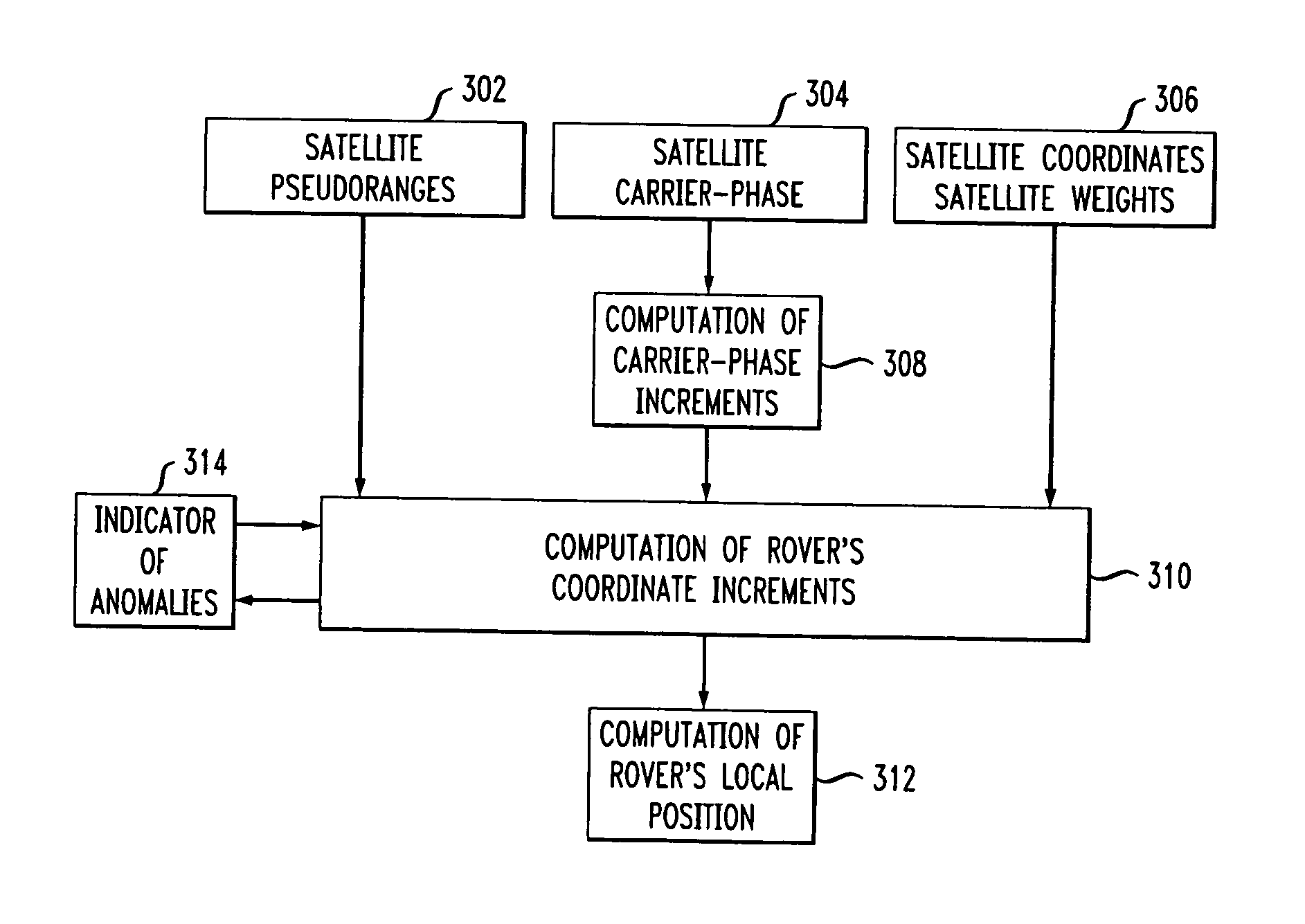
[0077] The first embodiment is discussed in conjunction with the flowchart of FIG. 6. The algorithm computes residuals NEVi[j] in step 601 as described above in conjunction with processing block 509 (FIG. 5). In each satellite channel, the magnitudes of residuals (after completion of iterations) are compared to the threshold in step 602. If the threshold is not exceeded by the residual modulo of any channels (as determined in step 604) then the algorithm ends. If the threshold is exceeded by the residual modulo on at least one channel, then in step 606 a search is performed for the satellite channel with the maximum residual. In step 608 the channel weight for the current and following epoch is set to zero for the satellite channel identified in step 606. (In an alternate embodiment, the channel weight for only the current epoch is set to zero if the residual of the satellite channel identified in step 606 is below another defined threshold.) Matrix G is then recomputed in step 610 ...

second embodiment

[0078] The second embodiment is discussed in conjunction with the flowchart of FIG. 7. The algorithm computes residuals NEVi[j] in step 701 as described above in conjunction with processing block 509 (FIG. 5). In step 700, the sum of residuals squares (S NEVi) over all satellite channels is computed. The sum of residuals squares is compared to the threshold in step 702. If the threshold is not exceeded (as determined in step 704) then the algorithm ends. If the threshold is exceeded, then in step706 a search is performed for the satellite channel with the maximum residual. In step 708 the channel weight for the current and following epoch is set to zero for the satellite channel identified in step 706. (In an alternate embodiment, the channel weight for only the current epoch is set to zero if the residual of the satellite channel identified in step 706 is below another defined threshold.) Matrix G is then recomputed in step 710 while eliminating the satellite channel identified in ...

the structure of the environmentally friendly knitted fabric provided by the present invention; figure 2 Flow chart of the yarn wrapping machine for environmentally friendly knitted fabrics and storage devices; image 3 Is the parameter map of the yarn covering machine
Login to View More

PUM

No PUM Login to View More

Abstract

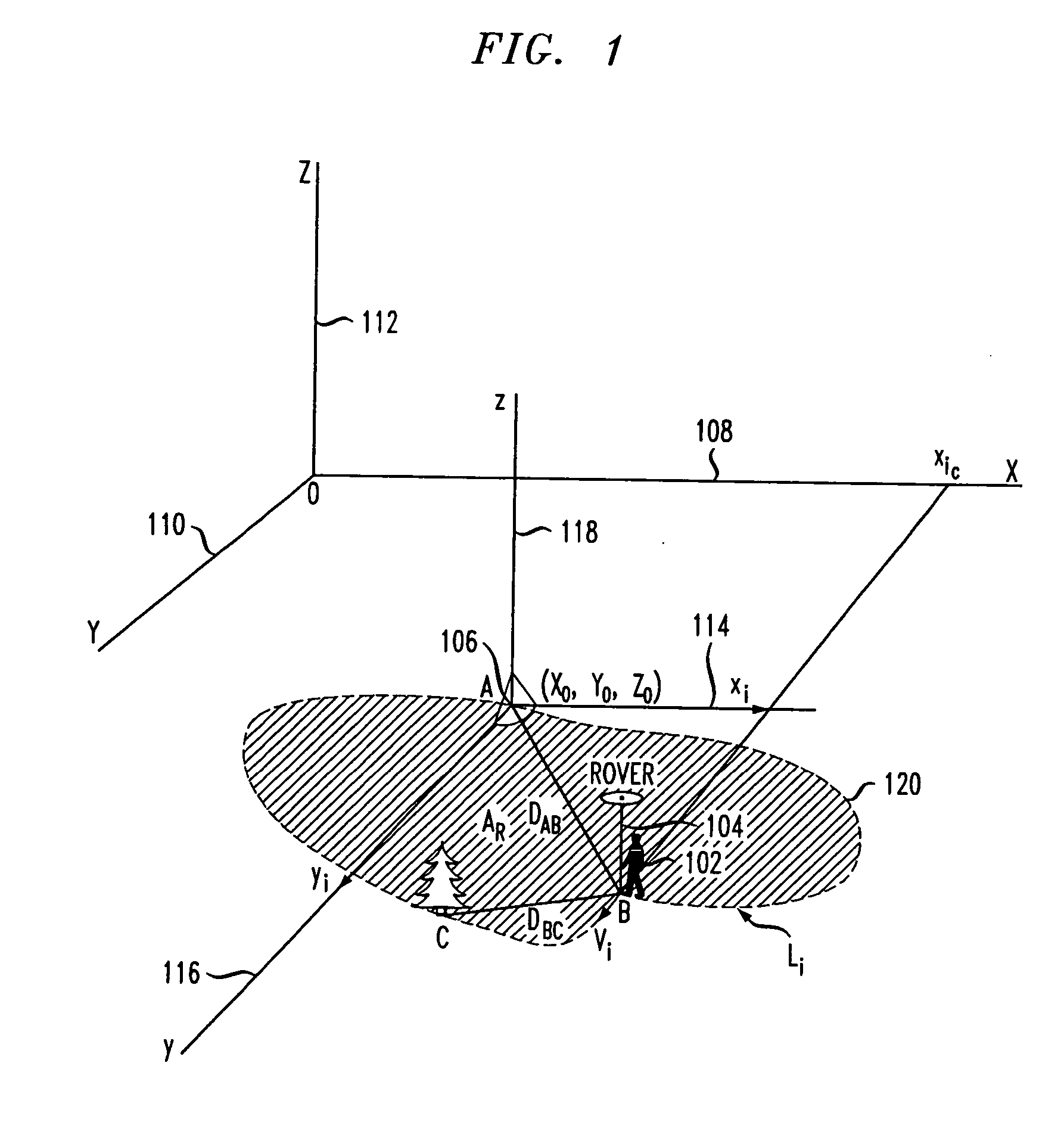
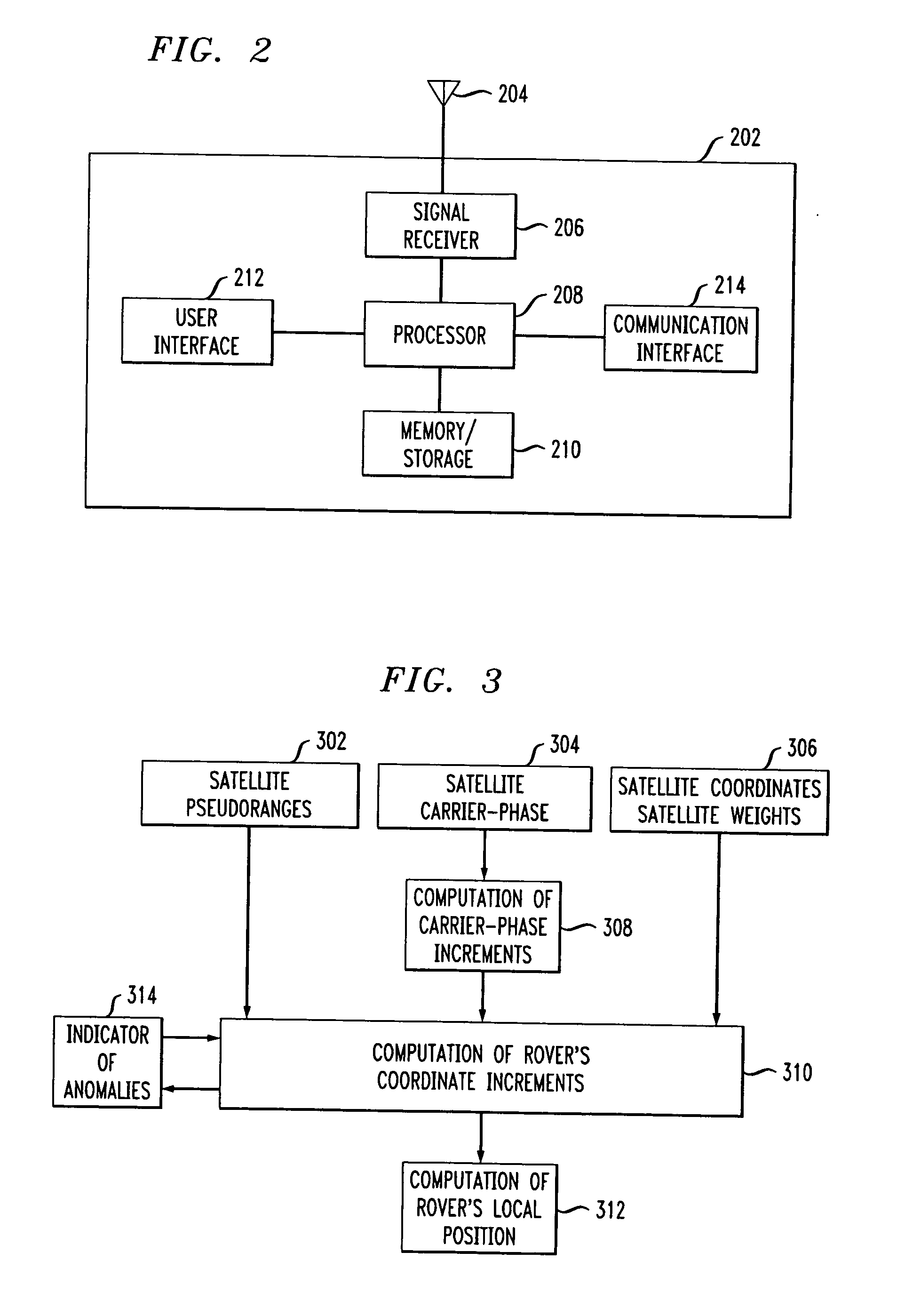
Disclosed is a method and apparatus for determining the relative position of a mobile unit that moves from an initial location to a plurality of successive positions. The mobile unit receives signals from a plurality of navigation satellites and tracks the carrier phases of the signals during movement. For each of the received signals, carrier phase increments are calculated over a plurality of epochs. Anomalous carrier phase increments are determined and eliminated from further calculations. The non-eliminated carrier phase increments are then used to calculate coordinate increments for each of the time epochs. If, after elimination, the remaining number of carrier-phase increments is less than a threshold for a particular epoch, then coordinate increments for the particular epoch may be extrapolated using data from prior epochs. In various embodiments, least squares method and Kalman filtering may be used to calculate the coordinate increments. The coordinate increments may then be summed over a plurality of time epochs in order to determine a position of the mobile unit relative to its initial position.

Description

BACKGROUND OF THE INVENTION [0001] The present invention relates generally to position determination using satellite signals, and more particularly to relative position determination using carrier phase measurements of satellite signals. [0002] Satellite positioning systems, such as GPS (USA) and GLONASS (Russia), are well known in the art and are intended for highly accurate self-positioning of users possessing special navigation receivers. A navigation receiver receives and processes radio signals transmitted by satellites located within line-of-sight distance of the receivers. The satellite signals comprise carrier signals that are modulated by pseudo-random binary codes. The receiver measures the time delay of the received signal relative to a local reference clock or oscillator. These measurements enable the receiver to determine the so-called pseudo-ranges between the receiver and the satellites. The pseudo-ranges are different from the ranges (distances) between the receiver ...

Claims

the structure of the environmentally friendly knitted fabric provided by the present invention; figure 2 Flow chart of the yarn wrapping machine for environmentally friendly knitted fabrics and storage devices; image 3 Is the parameter map of the yarn covering machine
Login to View More

Application Information

Patent Timeline
08 Mar 2007
Publication
US20070052583A1
IPC
G01S5/14; G01S19/05; G01S19/07; G01S19/20; G01S19/41; H04W64/00
CPC
G01C21/00; G01S19/51; G01S19/43
Inventors
ZHODZISHSKY, MARK I.; VEITSEL, VICTOR A.