This helps you quickly interpret patents by identifying the three key elements:
Problems solved by technology
Method used
Benefits of technology
Benefits of technology
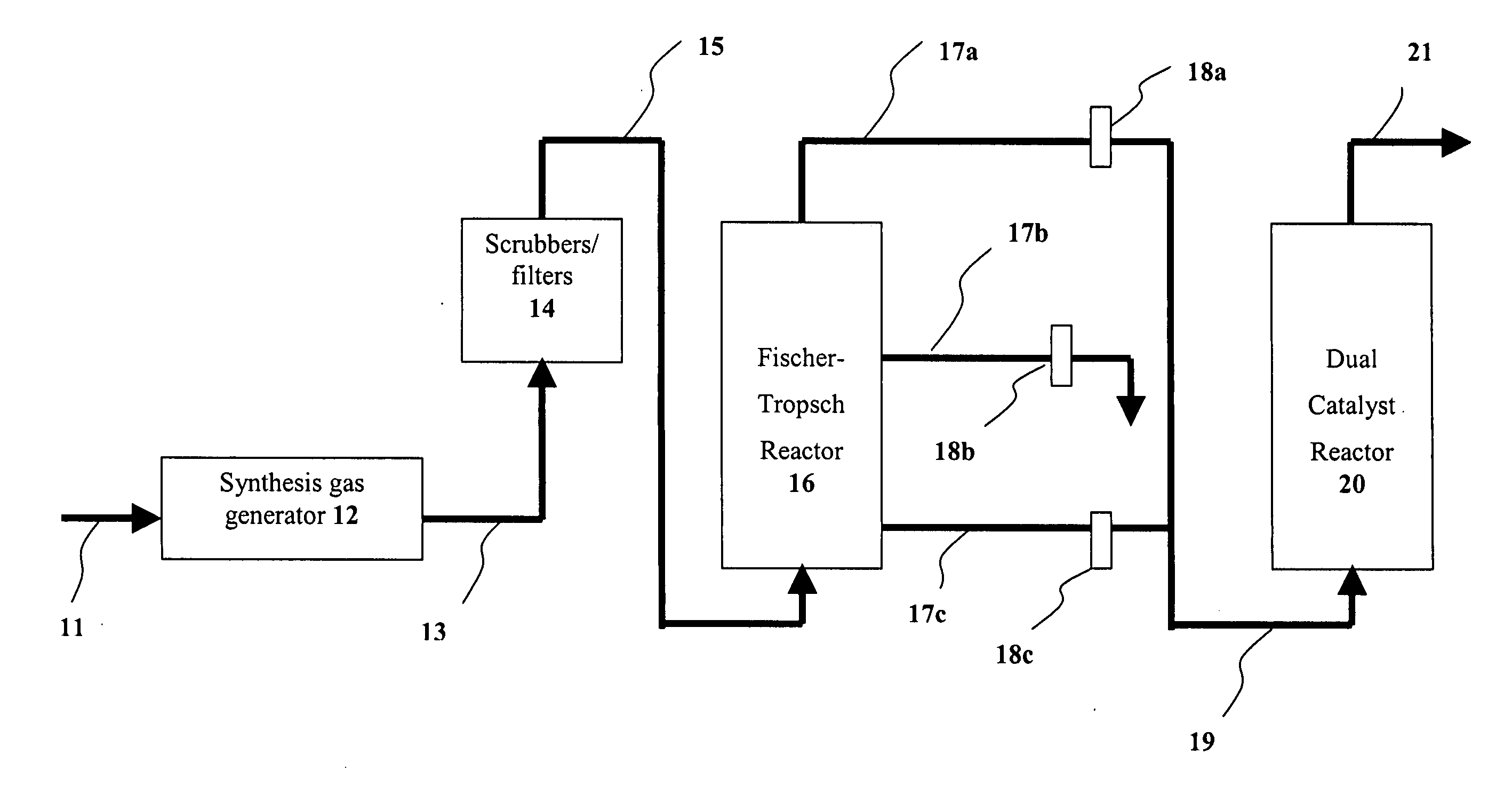
[0007] A first aspect of the present invention is a method of converting at least one first alkane to a mixture of at least one low molecular weight alkane (optionally also including additional lower and/or higher molecular weight alkanes) and at least one high molecular
Problems solved by technology
Fischer-Tropsch catalysis, however, produces a mixture of alkanes, many of which are of lower molecular weight and unsuitable for use as liquid hydrocarbon fuels such as gasoline and diesel fuels.
These techniques have not been widely implemented.
Method used
the structure of the environmentally friendly knitted fabric provided by the present invention; figure 2 Flow chart of the yarn wrapping machine for environmentally friendly knitted fabrics and storage devices; image 3 Is the parameter map of the yarn covering machine
View more
Image
Smart Image Click on the blue labels to locate them in the text.
Viewing Examples
Smart Image
Click on the blue label to locate the original text in one second.
Reading with bidirectional positioning of images and text.
Smart Image
Examples
Experimental program
Comparison scheme
Effect test
example 1
Synthesis of {C6H3-2,6-[OP(t-Bu)2]2}Ir(C2H4)
[0065] {C6H3-2,6-[OP(t-Bu)2]2}Ir(H)(Cl) (1.5 g, 2.4 mmol) and NaO-t-Bu (277 mg, 2.89 mmol) were weighed into a flame-dried Schlenk flask and put under a flow of argon. Toluene (40 mL) was added to the flask via syringe, and the resulting suspension was stirred for 10 min at room temperature. Ethylene was bubbled through the solution for 1-2 hours. The solution was cannula-filtered through a pad of Celite, volatiles were evaporated under vacuum, and the resulting red solid was dried under vacuum overnight to give 867 mg (59% yield) of pure product. 1H NMR (C6D6): δ 1.24 (t, J=6.8 Hz, 36H), 3.10 (t, J=2.4 Hz, 4H), 6.91-6.94 (m, 2H), 7.01-7.06 (m, 1H). 13C NMR (C6D6): δ28.93 (m, 12C), 36.13 (s, 2C), 41.92 (t, J=11.2 Hz, 4C), 103.98 (t, J=6.0 Hz, 2C), 127.45 (s), 145.19 (t, J=8.5 Hz), 168.17 (t, J=8.4 Hz, 2C). 31P{1H}NMR (C6D6): δ 181.7 (s). Anal. Calc'd for C24H43O2P2Ir; C, 46.65; H, 7.03. Found: C, 46.64; H, 7.15.
example 2
Synthesis of {C6H3-2,6-[OP(t-Bu)2]2}Ir(C2H4) Supported on Alumina
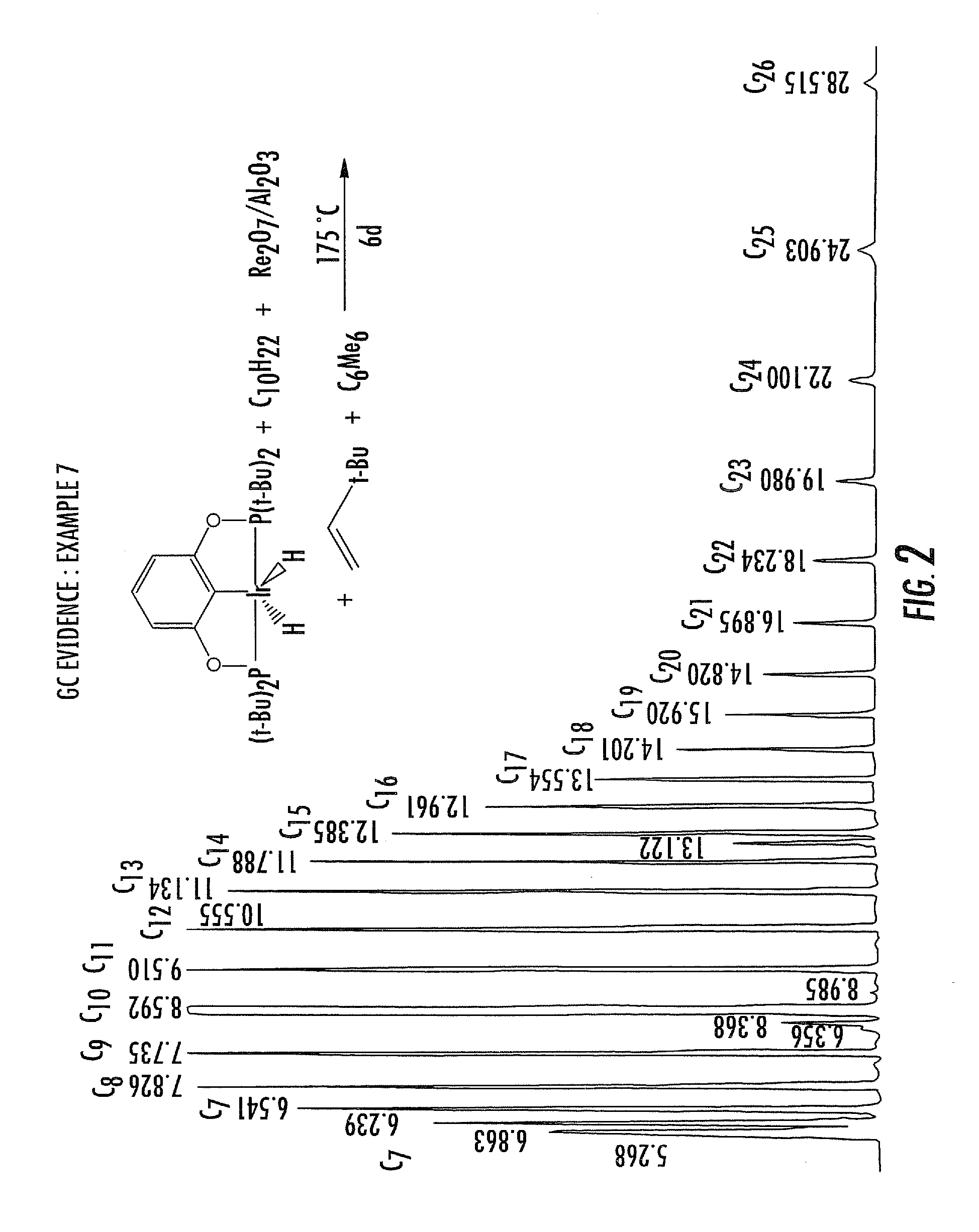
[0066] {C6H3-2,6-[OP(t-Bu)2]2}Ir(C2H4) (150 mg, 0.242 mmol) and γ-alumina (2.50 g, 24.5 mmol; previously calcined at 500° C.) were weighed into a Schlenk flask and put under a flow of argon. Pentane (10 mL) was added via syringe, and the suspension was stirred gently at room temperature for 2 hours. The rust-coloredsolid was filtered and washed with pentane until the washings were colorless, and was dried under vacuum to yield 2.49 g (94% yield) of supported catalyst.
[0067] The following procedure was adapted from literature procedure (Mol, J. C. Catal. Today 1999, 51, 289-299). In a vial, 1.20 g (4.47 mmol) of NH4Re2O4 was dissolved in 30 mL distilled water. This solution was added to 10 g (98 mmol) of γ-Al2O3. The suspension was swirled by hand for about a minute, then allowed to stand undisturbed at room temperature for 30 min. This cycle of swirling and standing was repeated until all of the water was absorbed by the alumina. The solid was dried in a 120° C. oven overnight, then calcined at 550° C. for 3 hours under a flow of O2 and for 3 hours under a flow of Ar. After cooling to room temperature under an Ar flow, the solid was brought into the drybox and stored there.
the structure of the environmentally friendly knitted fabric provided by the present invention; figure 2 Flow chart of the yarn wrapping machine for environmentally friendly knitted fabrics and storage devices; image 3 Is the parameter map of the yarn covering machine
Login to View More
PUM
Property
Measurement
Unit
Time
aaaaa
aaaaa
Time
aaaaa
aaaaa
Time
aaaaa
aaaaa
Login to View More
Abstract
A method of converting at least one first alkane to a mixture of at least one low molecular weight alkane (optionally also including additional lower and / or higher molecular weight alkanes) and at least one high molecular weight alkane, comprising: reacting a first alkane in the presence of dual catalyst system comprising a first catalyst (i.e., a hydrogen transfer catalyst and preferably an iridium pincer complex catalyst) and a second catalyst (i.e., a metathesis catalyst) to produce a mixture of low and high molecular weight alkanes.
Description
RELATED APPLICATIONS [0001] This application claims the benefit of U.S. Provisional Patent Application Ser. No. 60 / 697,667, filed Jul. 8, 2005, the disclosure of whic is incorporated by reference herein in its entirety.[0002] This invention was made with Government support under Grant No. CHE-0434568 from the National Science Foundation. The United States Government has certain rights to this invention.FIELD OF THE INVENTION [0003] The present invention concerns methods of converting alkanes to higher molecular weight alkanes and fuels such as diesel fuel, along with catalyst systems and apparatus useful in such methods. BACKGROUND OF THE INVENTION [0004] Rising demand for fuels and potentially diminishing supplies of crude oil (or at least limits in or volatility in the capacity to manufacture fuels from crude oil) have spurred increased interest in the production of fuels from alternative sources. [0005] Coal, natural gas and biomass can be converted to synthesis gas (generally co...
Claims
the structure of the environmentally friendly knitted fabric provided by the present invention; figure 2 Flow chart of the yarn wrapping machine for environmentally friendly knitted fabrics and storage devices; image 3 Is the parameter map of the yarn covering machine
Login to View More
Application Information
Patent Timeline
Application Date:The date an application was filed.
Publication Date:The date a patent or application was officially published.
First Publication Date:The earliest publication date of a patent with the same application number.
Issue Date:Publication date of the patent grant document.
PCT Entry Date:The Entry date of PCT National Phase.
Estimated Expiry Date:The statutory expiry date of a patent right according to the Patent Law, and it is the longest term of protection that the patent right can achieve without the termination of the patent right due to other reasons(Term extension factor has been taken into account ).
Invalid Date:Actual expiry date is based on effective date or publication date of legal transaction data of invalid patent.


 Login to View More