
Sheath liquid for particle analyzer
a particle analyzer and sheath liquid technology, applied in the direction of material analysis, chemical methods analysis, instruments, etc., can solve the problems of high production cost, disassembly of the device, and accumulation of precipitate in the interior of the device, so as to reduce the production cost, less likely to be produced, and less likely to be corroded
- Summary
- Abstract
- Description
- Claims
- Application Information
AI Technical Summary
Benefits of technology
Problems solved by technology
Method used
Image

Examples
example 1
[0044]The following substances were dissolved in 1 kg of purified water to prepare a sheath liquid.
[0045]Tris(hydroxymethyl)aminomethane 1.51 g
[0046]Hydrochloric acid 6 mol
[0047]EDTA-2K 0.2 g
[0048]RHEODOL TW0120V 0.75 g
[0049]TOMICIDE S 0.2 g
[0050]Proxel GXL 0.2 g
[0051]Different kinds of refractive-index adjustment agents were added to the above-mentioned sheath liquid. Then we examined how much refractive-index adjustment agents should be added in order to adjust the refractive index of sheath liquid to 1.342. Digital refractometer RX-5000 α (ATAGO CO., LTD.) was used for measurements of refractive index. The refractive index was measured at 25° C.
[0052]As a result of our examination, it was found that, in the case where glycerol was used as a refractive-index adjustment agent, addition of glycerol at a concentration of 79 g / L to the sheath liquid allowed the adjustment of the refractive index to 1.342.
[0053]It was found that, in the case where thioglycerol was used as a refractive-...
example 2
[0062]Different kinds of refractive-index adjustment agents were added to the sheath liquid in Example 1 in order to adjust the refractive index of sheath liquid to 1.342, and then the electrical conductivity was measured. Electrical Conductivity Meter DS-8F (HORIBA, Ltd.) was used for measurements of electrical conductivity.
[0063]7.1 g / L of sodium chloride and 69.1 g / L glycerol were added as refractive-index adjustment agents to the sheath liquid, and a sheath liquid A was prepared. The electrical conductivity of the sheath liquid A was 11 mS.
[0064]7.1 g / L of sodium chloride, 28.45 g / L of sodium sulfate, and 34 g / L glycerol were added as refractive-index adjustment agents to the above-mentioned sheath liquid to prepare a sheath liquid B. The electrical conductivity of the sheath liquid B was 35 mS.
[0065]79 g / L of glycerol was added as a refractive-index adjustment agent to the sheath liquid to prepare a sheath liquid C. The electrical conductivity of the sheath liquid C was 1.1 mS....
example 3
[0067]We examined whether precipitation of salts would be observed using the sheath liquid A prepared in Example 2. As a control, to the sheath liquid in Example 1, sodium chloride was added at a concentration of 55 g / L as a refractive-index adjustment agent in order to prepare a sheath liquid D.
[0068]100 μL of the sheath liquid A and 100 μL of the sheath liquid D were dropped on slide glasses, respectively, which were dried at 25° C.
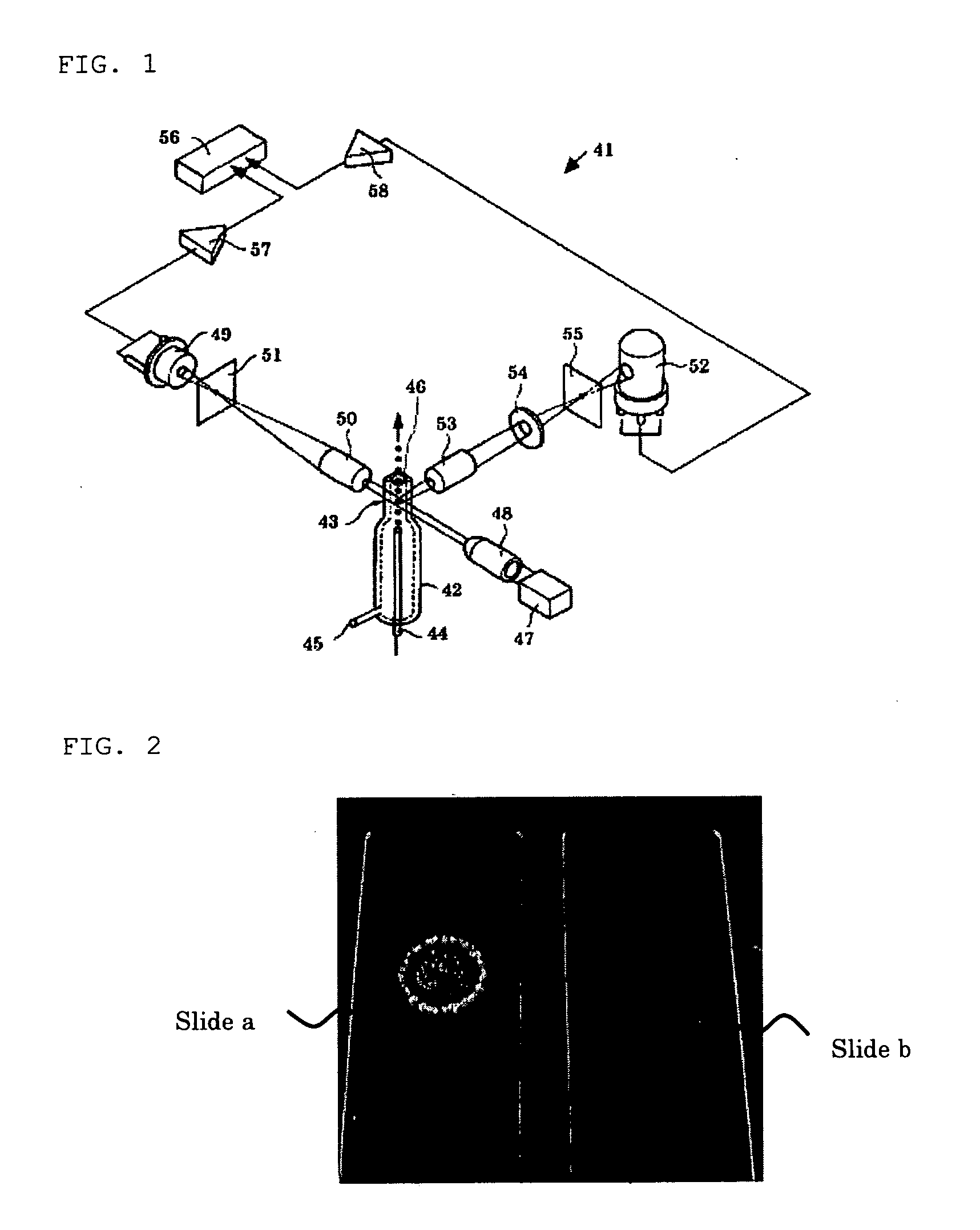
[0069]A photograph of the slide glasses after dryness is shown in FIG. 2. A slide a indicates the slide glass on which the sheath liquid D was dropped, and a slide b indicates the slide glass on which the sheath liquid A was dropped. As shown in FIG. 2, when the sheath liquid D was dried, precipitation of salts was observed. However, when the sheath liquid A was dried, little precipitation was observed. As mentioned above, it is considered that the tube is less clogged with precipitation of salts in the case where the sheath liquid A is used for the par...
PUM
| Property | Measurement | Unit |
|---|---|---|
| refractive index | aaaaa | aaaaa |
| concentration | aaaaa | aaaaa |
| concentration | aaaaa | aaaaa |
Abstract
Description
Claims
Application Information
 Login to View More