
Mass analysis system
a mass analysis and mass technology, applied in the field of mass analysis system, can solve the problems of inability to label isotopically, inability to use methods for specimens, and inability to identify, etc., and achieve the effect of high speed and without wasting measurement tim
- Summary
- Abstract
- Description
- Claims
- Application Information
AI Technical Summary
Benefits of technology
Problems solved by technology
Method used
Image

Examples
example 1
[0036]Hereinafter, the first example of the present invention wilt be explained.
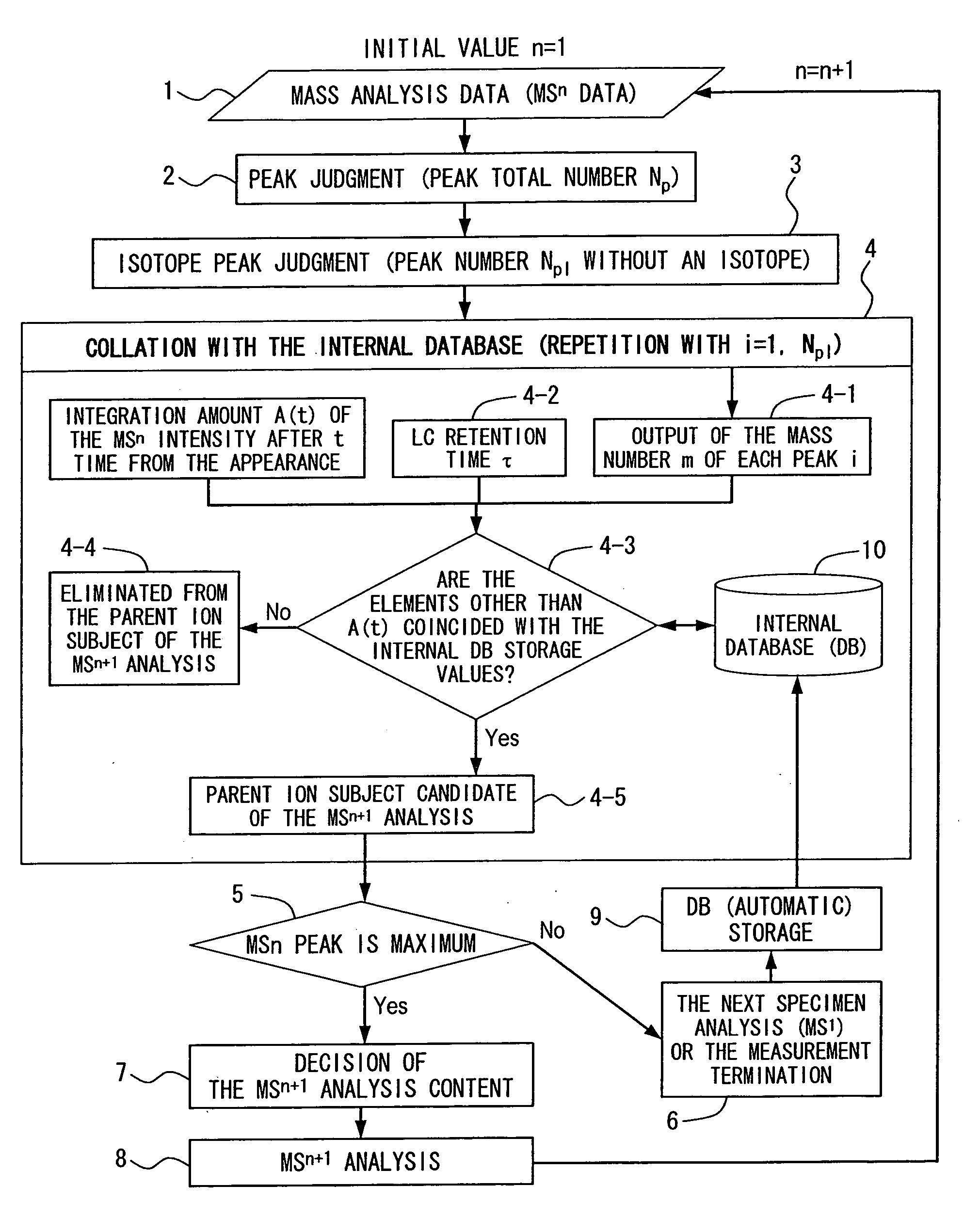
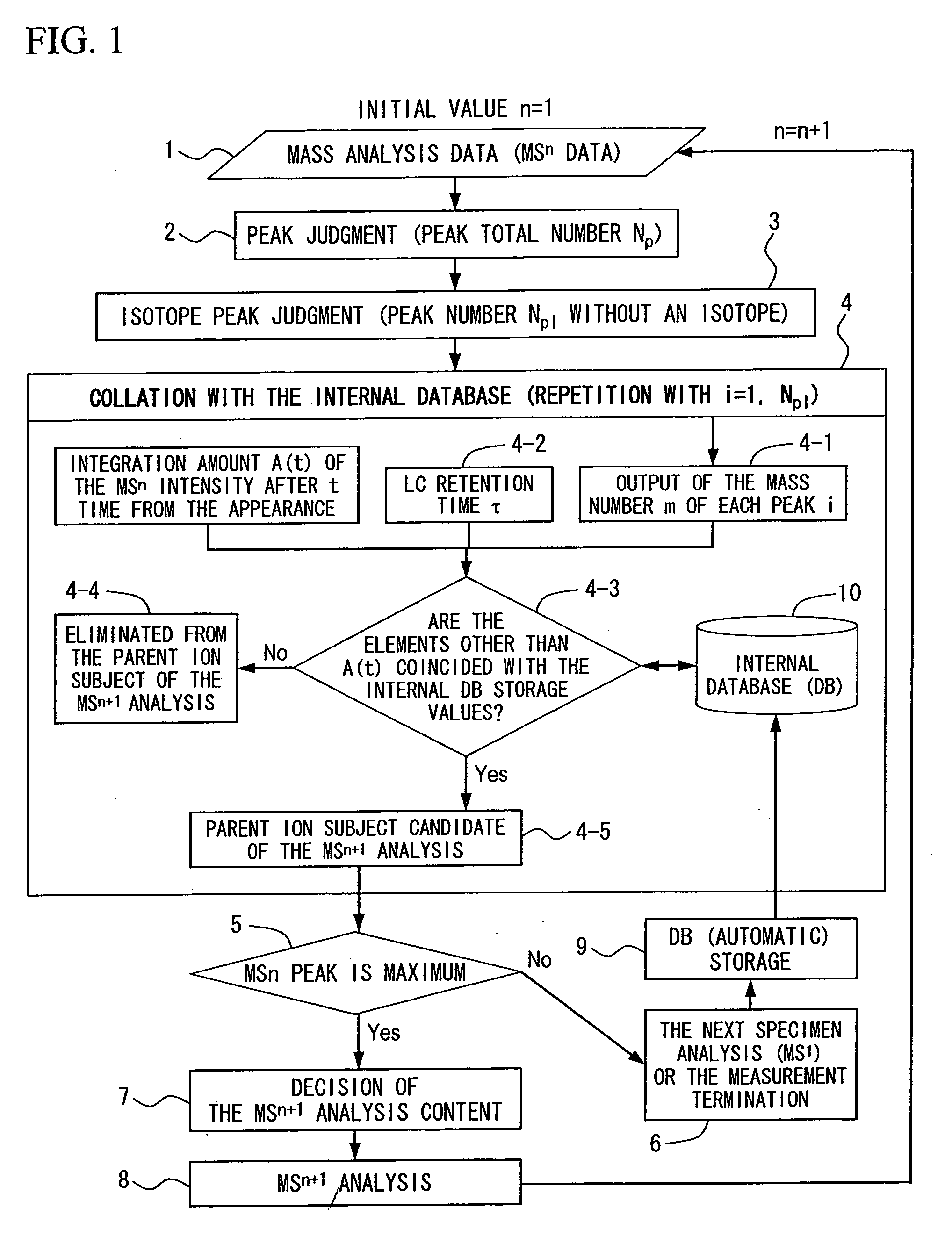
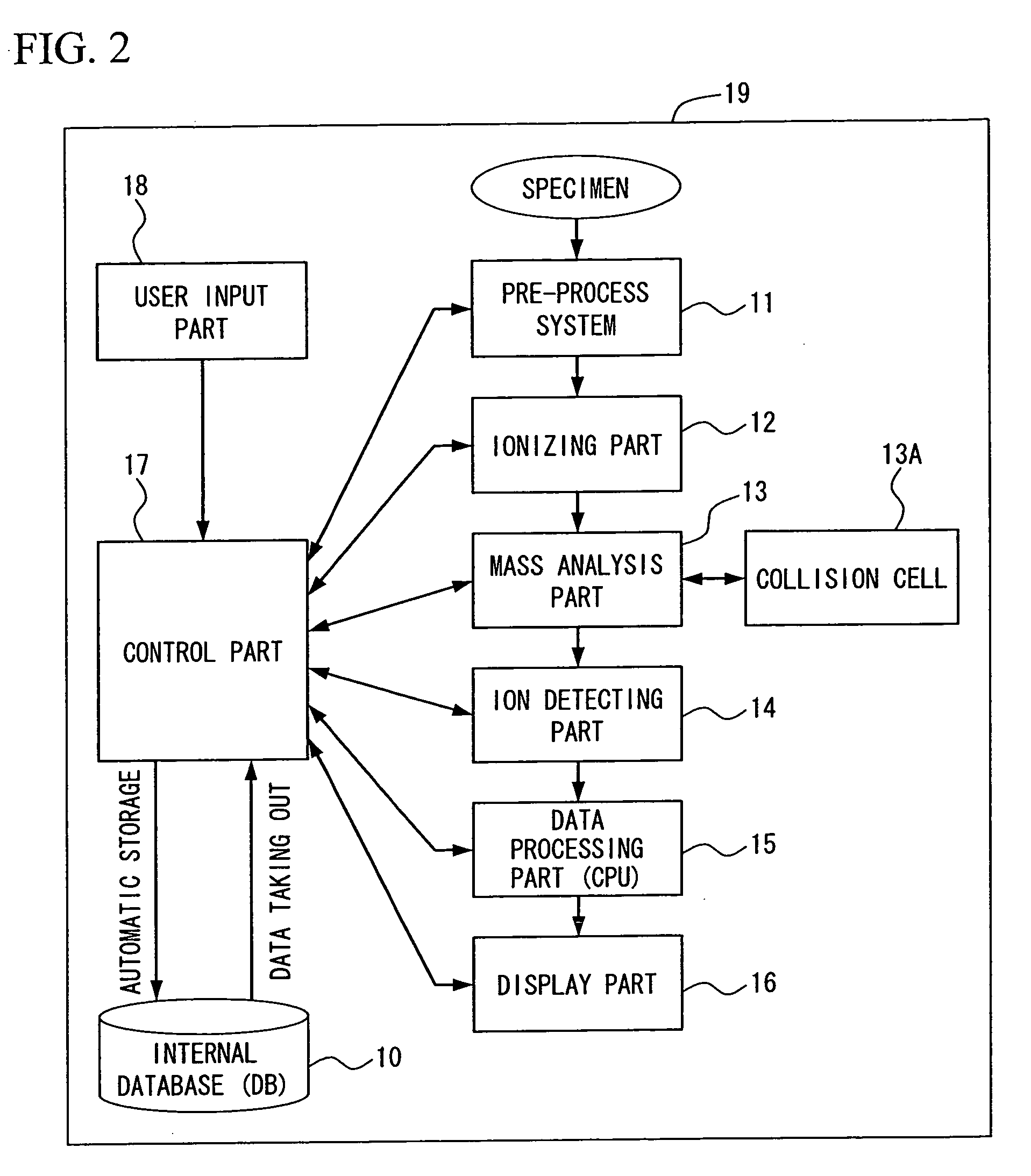
[0037]FIG. 1 is a flow chart of the automatic judging process of the analysis content in a mass analysis system as the first example of the present invention. The mass analysis data 1 refers to the data measured by the mass analysis system 19 shown in FIG. 2. In the mass analysis apparatus 19, the specimen as the analysis subject is pre-processed by a pre-process system 11 such as a liquid chromatography. For example, in the case of a protein as the original specimen, it is decomposed to the size of a polypeptide by a digestive enzyme so as to be separated and sectioned by the liquid chromatography (LC) in the pre-process system 11. Thereafter, it is ionized in an ionizing part 12, and separated according to the mass to charge ratio m / z of the ion in a mass analysis part 13. Here, m is the ion mass, and z is the charge valence number of the ion. The separated ion is detected in an ion detecting part 14, ...
example 2
[0045]Hereinafter, the example 2 of the present invention will be explained with reference to FIGS. 6A and 6B.
[0046]In this example, as the first analysis, the MS1 analysis data of the peptide derived from the specimen are collected and stored in the internal DB with respect to a living body specimen of a healthy person (blood, urine, phlegm). Then, in the second analysis, the MS1 analysis data of a living body specimen (blood, urine, phlegm) of a patient are collected. Here, using the internal DB with the specimen of the healthy person stored, in the case the MS1 peak intensity integrations differ between the two, the peak is selected for the target of the following tandem mass analysis. In FIG. 6A, the first MS1 peak intensity is F1(t), and the second one is F2(t). Here, in the case the correlation coefficients of F1(t) and F2(t) between the time T0 to T1 (present point) is 0.5 or less in the second measurement, the MS2 of the peptide 1 is carried out immediately after the peak in...
example 3
[0048]Hereinafter, the example 3 of the present invention will be explained with reference to FIG. 7.
[0049]Here, an ion trap type mass analysis part is provided as the mass analysis part. In this case, since the ion trap itself plays the role of the collision cell, the collision cell needs not to be provided independently. Since the tandem analysis MSn can be carried out with n≧3 according to the ion trap, a system of automatically judging the next target as the present invention is extremely effective.
PUM
 Login to View More
 Abstract
Description
Claims
Application Information
 Login to View More