Unlock instant, AI-driven research and patent intelligence for your innovation.

Method and circuit for efficient caching of reference video data

a video data and reference technology, applied in the field of methods and circuits for efficient caching of reference video data, can solve the problems of high power consumption and costs, low cache hit rate, high inefficiency, etc., and achieve the effect of reducing power consumption and cost, minimizing address lookups, and low power consumption

Active Publication Date: 2007-10-11
NVIDIA CORP
View PDF97 Cites 12 Cited by
  • Summary
  • Abstract
  • Description
  • Claims
  • Application Information

AI Technical Summary

Benefits of technology

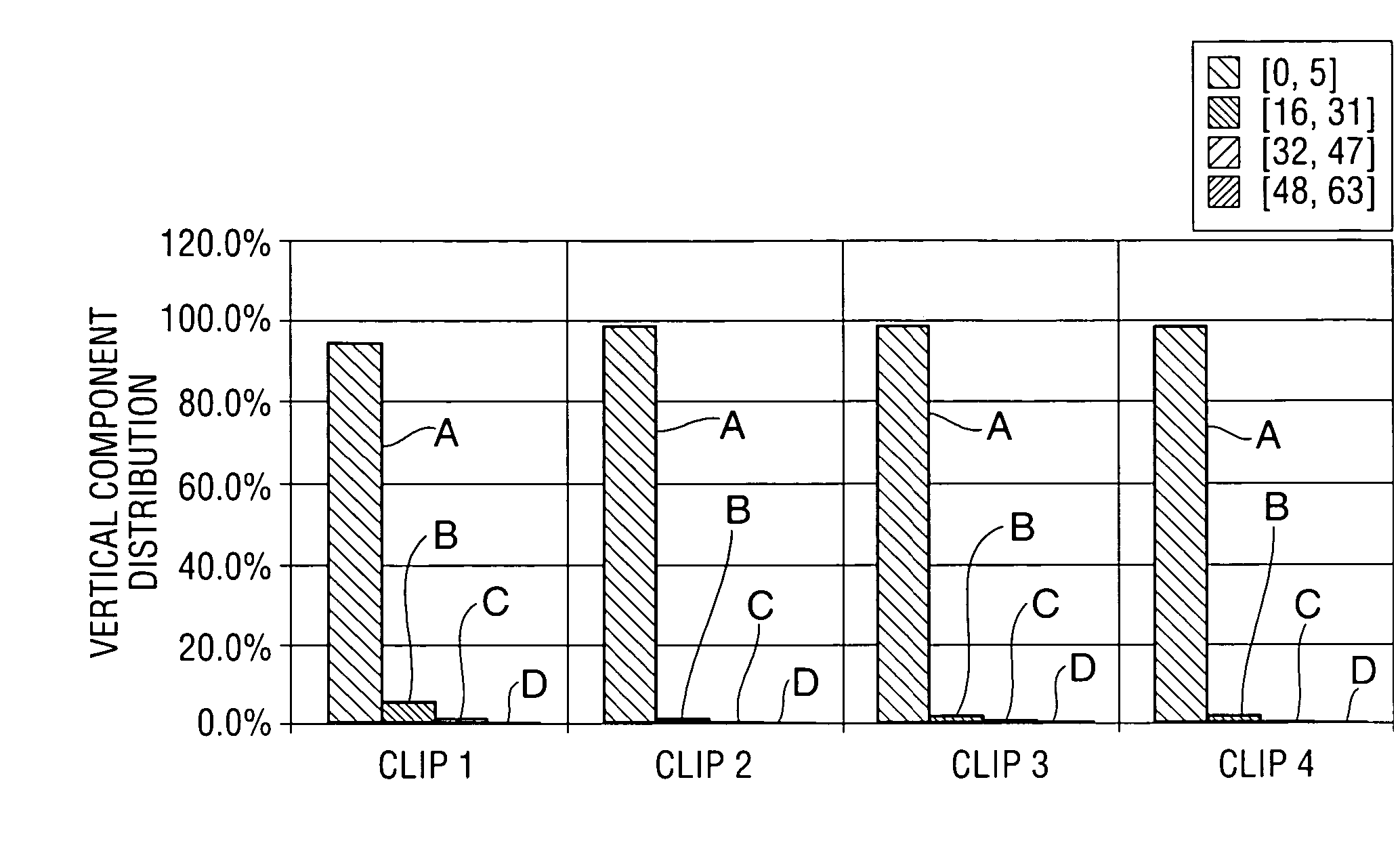
[0012] Preferably, the inventive system is programmable (e.g. with firmware) or pre-configurable to perform a sequence of pre-caches of reference data in a predetermined manner independent of which read requests for the reference data are actually asserted. For example, a memory controller of the system may be programmed with firmware to pre-cache a sequence of predetermined N-line subsets (slices) of each M-line reference frame (where M>N), each such pre-caching operation to be performed at an appropriate predetermined time (e.g., so that each slice is pre-cached just before the start of processing of a sequence of current blocks likely to require reference data included in the cached slice, and so that each slice remains cached throughout the entire duration of processing of such sequence of current blocks). Performing pre-caching in this way avoids the need for hardware associated with typical L2 caches.
[0018] In typical embodiments, the inventive system pre-caches reference data and responds to requests from a video processor for blocks of reference data in a manner consuming low power. The power required to perform these operations is preferably reduced by minimizing address lookups, avoiding LRU updates (updates of least recently used quantities), and pre-caching all reference data likely to be used (so as to reduce accesses to external memory to retrieve needed non-cached reference data).

Problems solved by technology

Conventional media processors often cache video data during decoding or other processing, but are typically highly inefficient in several ways including in that the data cache hit rate is low, power consumption and costs are high, and performance is low.
Even with the availability of huge on-chip RAM, it may not be feasible to cache all the necessary data on the chip on which the processor is implemented.
As a result, most current media processor designs do not use caches for referencing pixel data.
In typical operation, an MCU consumes much data bandwidth.
These accesses are typically very expensive for several critical reasons, including the following: (1) most of the reference pixel data (pixels of reference frames) are in external SDRAM (SDRAM external to the chip in which the MCU is implemented) and hence, accessing such data consumes much power; (2) two-dimensional blocks of reference pixel data are needed at any pixel boundary, and due to restrictions on operation of SDRAM and memory controllers for controlling accesses to SDRAM, the actual pixel bandwidth is higher than the data actually requested by the MCU; and (3) latency to bring data into an MCU from external SDRAM is also high and hence, accesses to the external SDRAM result in performance loss.
However, this caching technique consumes undesirably large amounts of power in typical applications, since maintaining each tag RAM and performing address comparisons (i.e., comparing requested data addresses with tag block address ranges in response to each read request for a block of data) consumes much power (the calculations and address mapping need to be made on every block transaction).
Even with a large amount of on-chip RAM (“IRAM”) available for caching reference pixel data, it may not be practical to store complete reference frames in such IRAM.
For example, many encoding schemes (e.g., MPEG-2) require that an MCU employ two reference frames during operation, and since a single reference frame at 720×480 resolution would consume 720×480*1.5 bytes=518 Kbytes, caching the large amount of data comprising two reference frames is typically not practical.
As a result, most conventional caching schemes do not cache reference data in IRAM when the resolution of the video data undergoing processing is greater than a certain limit (e.g., 352×288 pixels).
The inventors have recognized that caching of partial reference frames also presents its own set of problems.
However, if the MCU requests a block of reference data that is only partially cached (e.g., a boundary block), fulfilling the request is inherently complicated and requires accessing of at least some requested data from external memory.

Method used

the structure of the environmentally friendly knitted fabric provided by the present invention; figure 2 Flow chart of the yarn wrapping machine for environmentally friendly knitted fabrics and storage devices; image 3 Is the parameter map of the yarn covering machine
View more

Image

Smart Image Click on the blue labels to locate them in the text.
Viewing Examples
Smart Image
  • Method and circuit for efficient caching of reference video data
  • Method and circuit for efficient caching of reference video data
  • Method and circuit for efficient caching of reference video data

Examples

Experimental program
Comparison scheme
Effect test

Embodiment Construction

[0040] A class of embodiments of the inventive system will be described with reference to FIG. 2. FIG. 2 is a block diagram of a processing system having video decoding capability that can be implemented in accordance with the invention. The FIG. 2 system can be a portable media player (or another portable data processing system or a data processing system not intended to be portable) and can include additional elements that are not shown in FIG. 2.

[0041] The FIG. 2 system includes host processor 5 (which functions as the system's CPU and typically includes cache memory), media co-processor and accelerator unit 4, on-chip RAM (“IRAM”) units 7 and 8, crossbar 6 (coupled between elements 4, 5, 7, and 8), bus 10 (which can be implemented as an Advanced Microprocessor Bus Architecture High-performance Bus, or “AHB”), bus 12 (which can also be implemented as an AHB), bridge unit 9 (coupled between bus 10 and crossbar 6), RAM 18 (which is a bulk SRAM in a preferred implementation), exter...

the structure of the environmentally friendly knitted fabric provided by the present invention; figure 2 Flow chart of the yarn wrapping machine for environmentally friendly knitted fabrics and storage devices; image 3 Is the parameter map of the yarn covering machine
Login to View More

PUM

No PUM Login to View More

Abstract

In some embodiments, a video processing system including video processor, an external memory, and an integrated circuit that implements both a memory controller (having embedded intelligence) and an internal memory coupled to the memory controller. The memory controller is configured to pre-cache in the internal memory partial frames of reference video data in the external memory (e.g., N-line slices of M-line reference frames, where M>N), and to respond to requests (e.g., from the video processor) for blocks of reference video data including by determining whether each requested block (or each of at least two portions thereof) has been pre-cached in the internal memory, causing each requested cached block (or portion thereof) to be read from the internal memory, and causing each requested non-cached block (or portion thereof) to be read from the external memory. Preferably, the pre-caching is performed in a predetermined manner independent of which read requests for the reference data are actually asserted, and exploits known correlation between two-dimensional pixel locality of each block (“current block”) of data to undergo processing (e.g., decoding) using reference data, two-dimensional pixel locality of each block of reference data that may be requested to process the current block, and probability that each such reference data block will be needed to process the current block. Other aspects are memory controllers for use in such a system and methods performed during operation of any such system or memory controller.

Description

FIELD OF THE INVENTION [0001] The invention pertains to methods and circuitry for caching video data (e.g., during decoding or other processing of the video data by a multimedia processor in the presence of on-chip memory). BACKGROUND OF THE INVENTION [0002] Throughout the disclosure, the term “block” of video data is used to denote a subset of the data comprising a frame of video data having spatial location within a rectangular region the frame. A block of video data can but need not consist of compressed (or otherwise encoded) video data. Examples of blocks of video data are the conventionally defined macroblocks of MPEG-encoded video frames. [0003] Conventional media processors often cache video data during decoding or other processing, but are typically highly inefficient in several ways including in that the data cache hit rate is low, power consumption and costs are high, and performance is low. Even with the availability of huge on-chip RAM, it may not be feasible to cache a...

Claims

the structure of the environmentally friendly knitted fabric provided by the present invention; figure 2 Flow chart of the yarn wrapping machine for environmentally friendly knitted fabrics and storage devices; image 3 Is the parameter map of the yarn covering machine
Login to View More

Application Information

Patent Timeline
no application Login to View More
IPC IPC(8): H04N11/04
CPCH04N19/51H04N19/433H04N19/61
Inventor SRIRAM, PARTHASARATHYCHOU, HAN
Owner NVIDIA CORP