Power Capacitor

US20070242413A1Inactive Publication Date: 2007-10-18ABB TECH AG
10 Cites 12 Cited by

Patent Information

Authority / Receiving Office
US · United States
Current Assignee / Owner
Publication Date
2007-10-18
Estimated Expiration
Not applicable · inactive patent

Smart Images

  • Figure 1
    Figure 1
  • Figure 2
    Figure 2
  • Figure 3
    Figure 3
Patent Text Reader

Abstract

A power capacitor including at least one capacitor element enclosed in a container, wherein the container is of a material which substantially includes a first polymer material. Further, the container is cylindrical and provided in its surface with creepage distance extending protrusions of a second polymer material. The protrusions are formed with respect to their thickness and radial length so as to cool the capacitor. In a method for manufacturing such a power capacitor, a substantially cylindrical container is made of a material which substantially includes a first polymer material. The container is provided on its envelope surface with creepage distance-extending protrusions of a second polymer material and the capacitor elements are encapsulated in the container.
Need to check novelty before this filing date? Find Prior Art

Description

TECHNICAL FIELD

[0001] The present invention relates, from a first aspect, to a power capacitor of the kind that comprises at least one capacitor element enclosed in a container and surrounded by at least one insulating medium. From a second aspect, the invention also relates to a method for manufacturing such a capacitor.

[0002] The power capacitor according to the invention is primarily intended for a rated voltage that exceeds 1 kV, for example 5 kV, preferably at least 10 kV. BACKGROUND ART

[0003] Power capacitors are important components in systems for transmission and distribution of electric power for both alternating current and direct current. Power capacitor installations are mainly used for increasing the power-transmission capacity through parallel and series compensation, for voltage stabilization through static var systems and as filters for eliminating harmonics.

[0004] Capacitors have a phase angle that is close to 90° and therefore generate reactive power. By connec...

Examples

Embodiment Construction

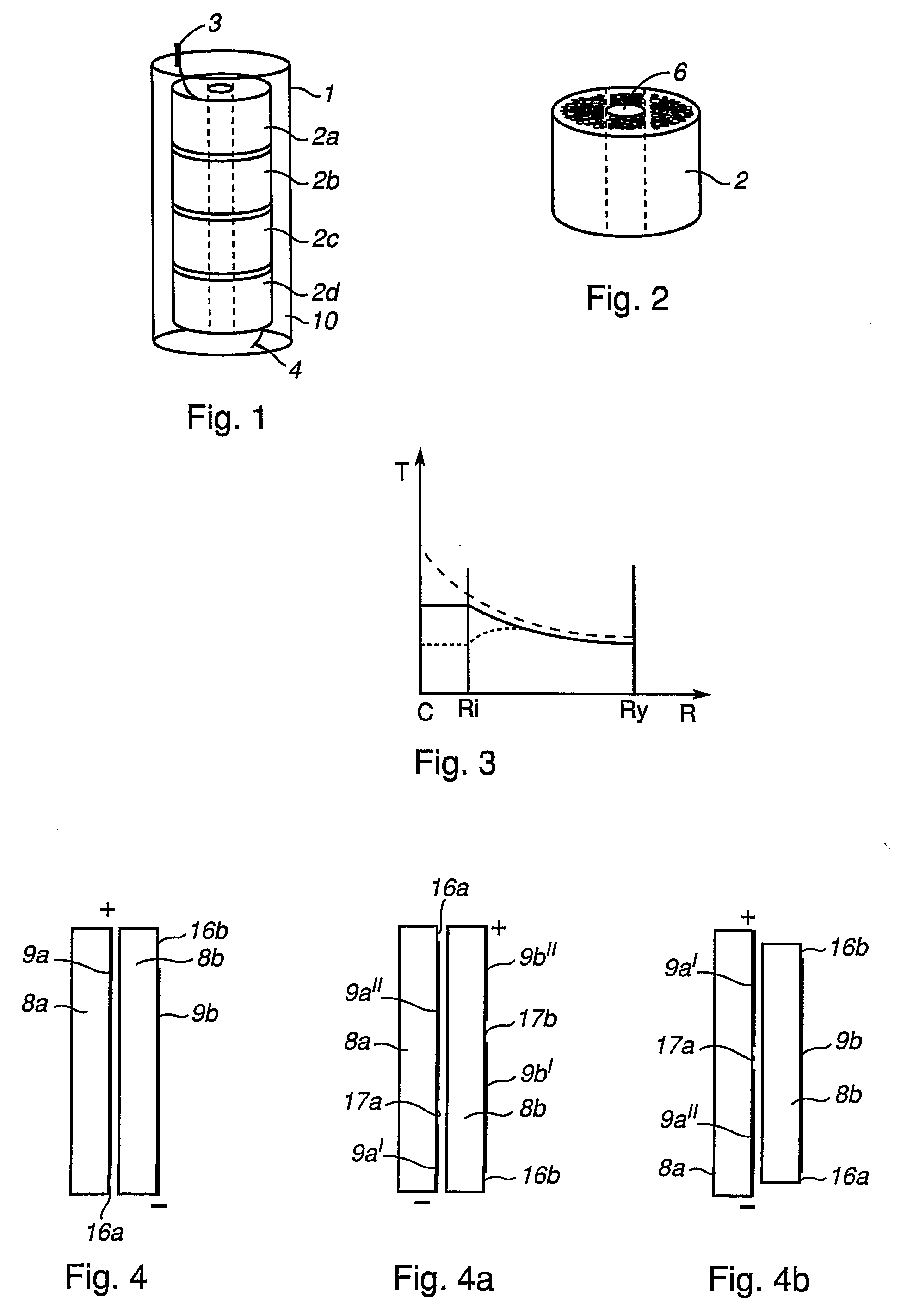
[0060]FIG. 1 shows the fundamental design of a capacitor according to the invention. It comprises an outer container 1 of polyethylene, in this case surrounding four capacitor elements 2a-2d. The container 1, as well as the capacitor elements 2a-2d, is circularly cylindrical. The capacitor elements 2a-2d are connected in series. At each end of the capacitor, a connection terminal 3, 4 is arranged. Each terminal consists of a conductive foil which is attached to the material of the container and extends therethrough. Between the capacitor elements 2a-2d and the container, a gel 10 is arranged. The gel serves as electrical insulation and as a thermal conductor.

[0061]FIG. 2 shows an individual capacitor element. This consists of metal-coated polymer films tightly rolled in a roll. The capacitor element 2 has a central axial through-hole 6 that may be used for cooling of the element. Typical dimensions of such a capacitor element is a diameter of 20-400 mm, preferably 150-250 mm, a bor...