Multi-wavelength, multimode optical fibers

a multi-mode, optical fiber technology, applied in the field of optical fibers, can solve the problems of not actually identifying specific materials that have dispersive properties, difficult to achieve adequate bandwidth to meet customer specifications, and difficult to develop materials and processes capable of satisfying requisite specifications. , to achieve the effect of small change in dopt/d

a multi-mode, optical fiber technology, applied in the field of optical fibers, can solve the problems of not actually identifying specific materials that have dispersive properties, difficult to achieve adequate bandwidth to meet customer specifications, and difficult to develop materials and processes capable of satisfying requisite specifications. , to achieve the effect of small change in dopt/d

US20080050075A1Active Publication Date: 2008-02-28FURAKAWA ELECTRIC NORTH AMERICA INC

Image

Smart Image Click on the blue labels to locate them in the text.
Viewing Examples
Smart Image
  • Multi-wavelength, multimode optical fibers
  • Multi-wavelength, multimode optical fibers
  • Multi-wavelength, multimode optical fibers

Examples

Experimental program
Comparison scheme
Effect test

Embodiment Construction

General Optical Fiber Fabrication

[0021]Optical fiber is produced from a glass preform that includes suitably doped regions from which the core and cladding will be formed. The preform is generally arranged vertically in a draw tower such that a portion of the preform is lowered into a furnace region. The portion of the preform placed into the furnace region begins to soften, and the lower end of the preform forms what is known as the neck-down region, where glass flows from the original cross-sectional area of the preform to the desired cross-sectional area of the fiber. From the lower tip of this neck-down region, the optical fiber is drawn.

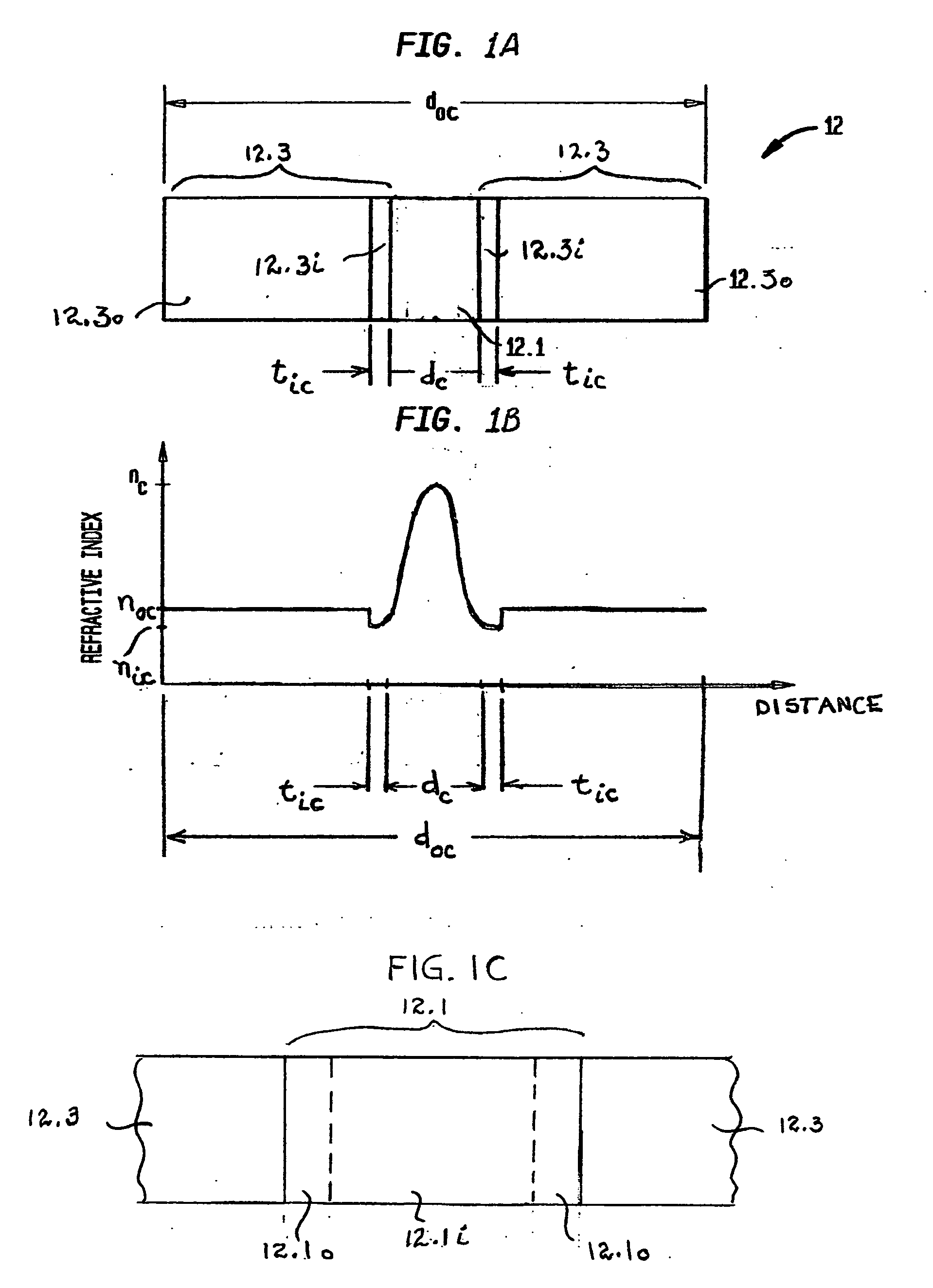
[0022]The optical fiber typically contains a high-purity silicate glass core optionally doped with a refractive index-raising element such as germanium, an optional inner cladding of high-purity silica glass optionally doped with a refractive index-lowering element such as fluorine, and an outer cladding of undoped silica glass. In some manufact...

the structure of the environmentally friendly knitted fabric provided by the present invention; figure 2 Flow chart of the yarn wrapping machine for environmentally friendly knitted fabrics and storage devices; image 3 Is the parameter map of the yarn covering machine
Login to View More

PUM

PropertyMeasurementUnit
wavelengthsaaaaaaaaaa
refractive index profileaaaaaaaaaa
wavelengthaaaaaaaaaa
Login to View More

Abstract

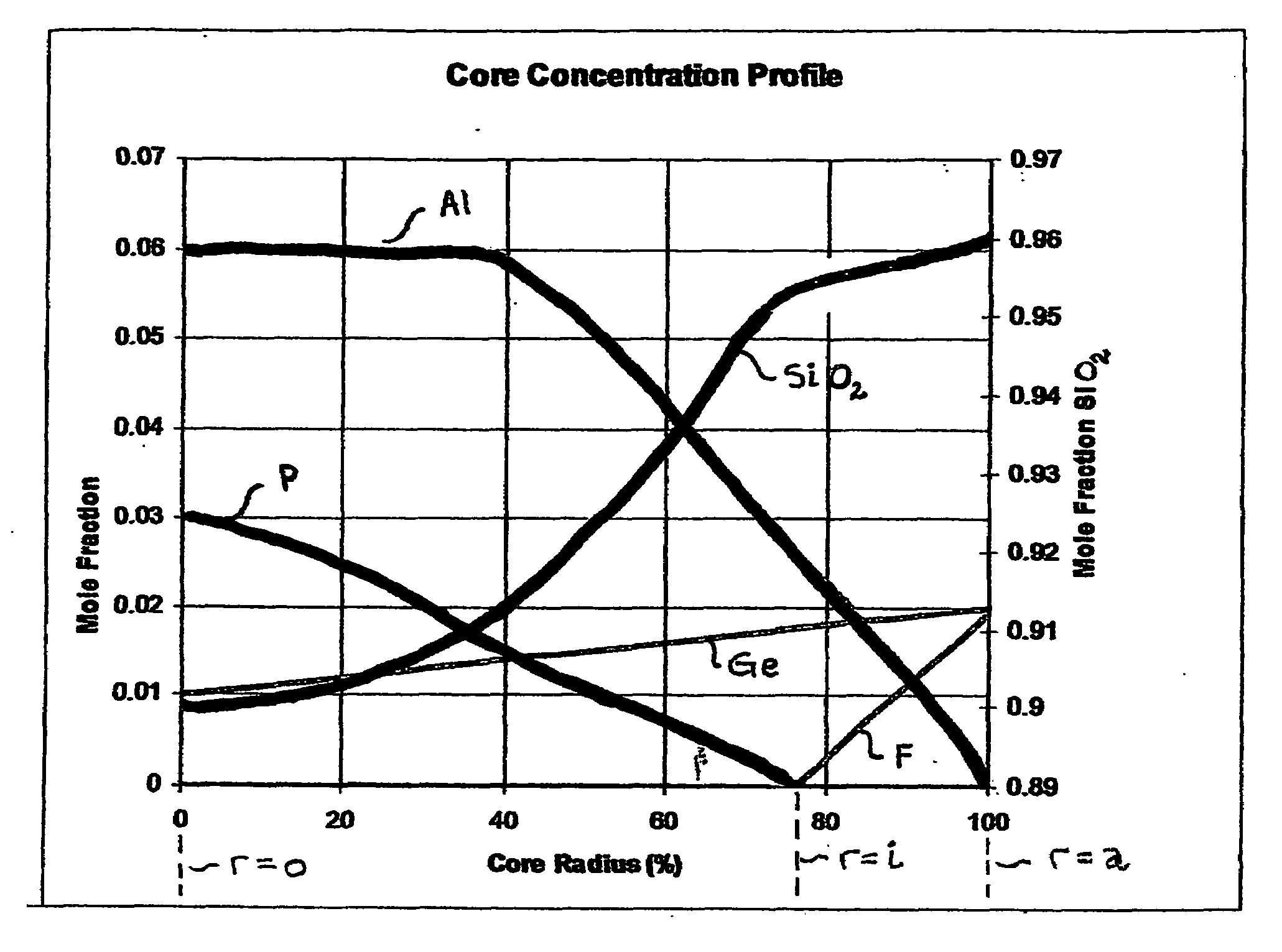
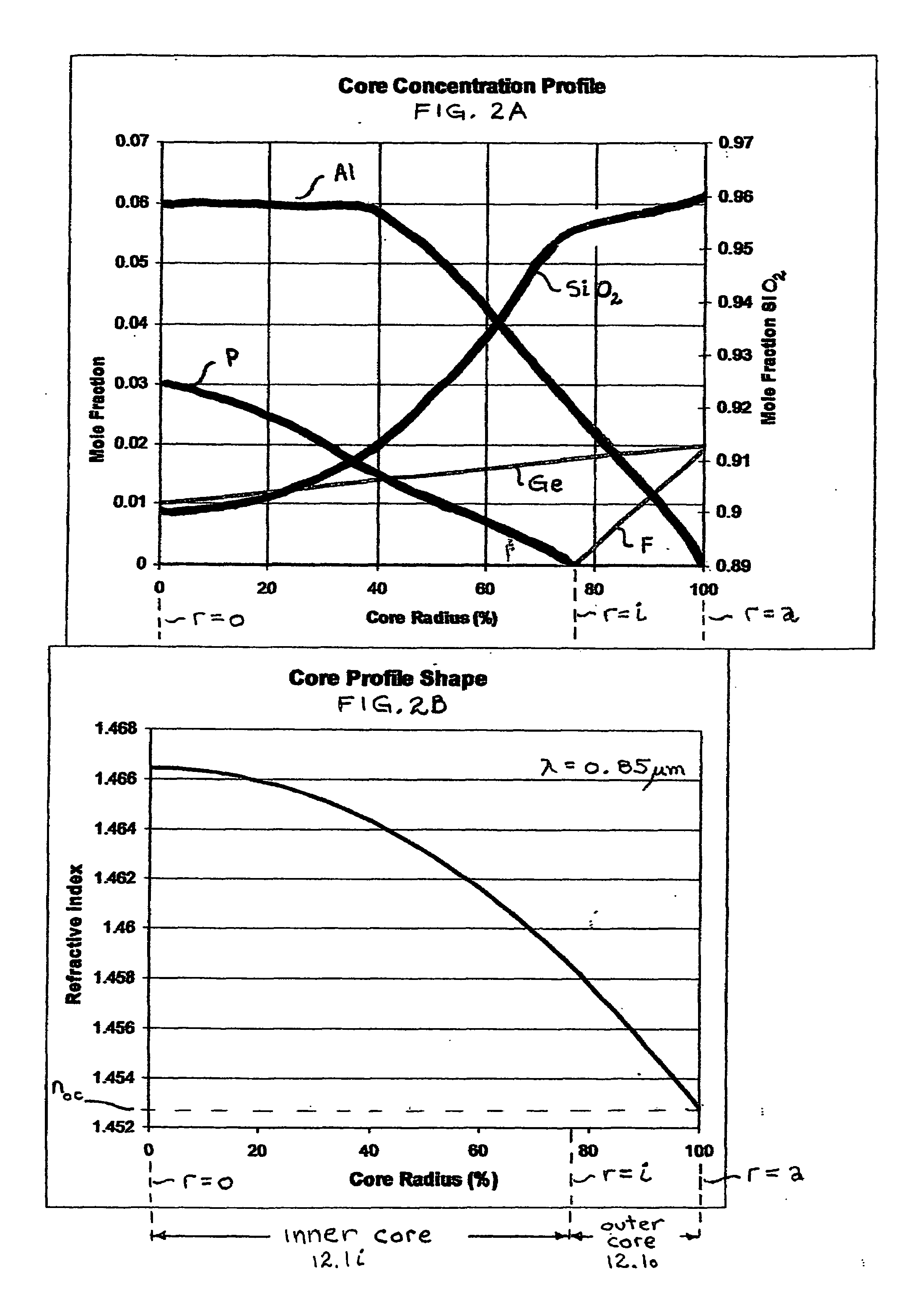
A silicate optical fiber comprises a graded index silicate core co-doped with aluminum oxide, phosphorus oxide, germanium oxide and fluorine in unique compositions that we have discovered allow multimode, multi-wavelength operation without significant intermodal dispersion. Illustratively, the core comprises a multiplicity of compositions whose refractive indices are graded from a maximum at or near the center of the core to a minimum at the interface with the cladding. Each core composition resides within a sub-volume of a 5 dimensional phase space in which an optimum core profile shape is essentially constant over the wavelength range of operation of the fiber. For operation in the wavelength range of about 0.78 μm to 1.55 μm, each composition preferably comprises no more than approximately 6 mole % Al2O3, 9 mole % P2O5, 6 mole % GeO2, 6 mole % F, and 90-100 mole % SiO2.

Description

BACKGROUND OF THE INVENTION[0001]1. Field of the Invention[0002]This invention relates to optical fibers and, more particularly, to multi-wavelength, multimode silica optical fibers.[0003]2. Discussion of the Related Art[0004]The manufacture of multi-transverse-mode optical fiber (simply multimode fiber hereinafter) has reached a very sophisticated level of development. Yet, in some cases, multimode fiber specifications are so stringent that it is difficult to develop materials and processes capable of satisfying requisite specifications. For example, the properties of many high bandwidth fibers, particularly their dispersion properties, are extremely sensitive to variations in the diameter of the fiber core and its refractive index profile. In fact, calculations for some commercially-available multimode fibers have shown that as little as a 1% variation in core profile induces up to a 10% variation in dispersion. Due to this dispersion effect, specifications for such fiber generall...

Claims

the structure of the environmentally friendly knitted fabric provided by the present invention; figure 2 Flow chart of the yarn wrapping machine for environmentally friendly knitted fabrics and storage devices; image 3 Is the parameter map of the yarn covering machine
Login to View More

Application Information

Patent Timeline
28 Feb 2008
Publication
US20080050075A1
IPC
G02B6/02
CPC
C03B2201/12; C03B2201/28; C03B2201/31; G02B6/03627; C03B2203/26; C03C13/046; G02B6/0288; C03B2201/32
Inventors
FLEMING, JAMES WILLIAM; OULUNDSEN, GEORGE EDWARD